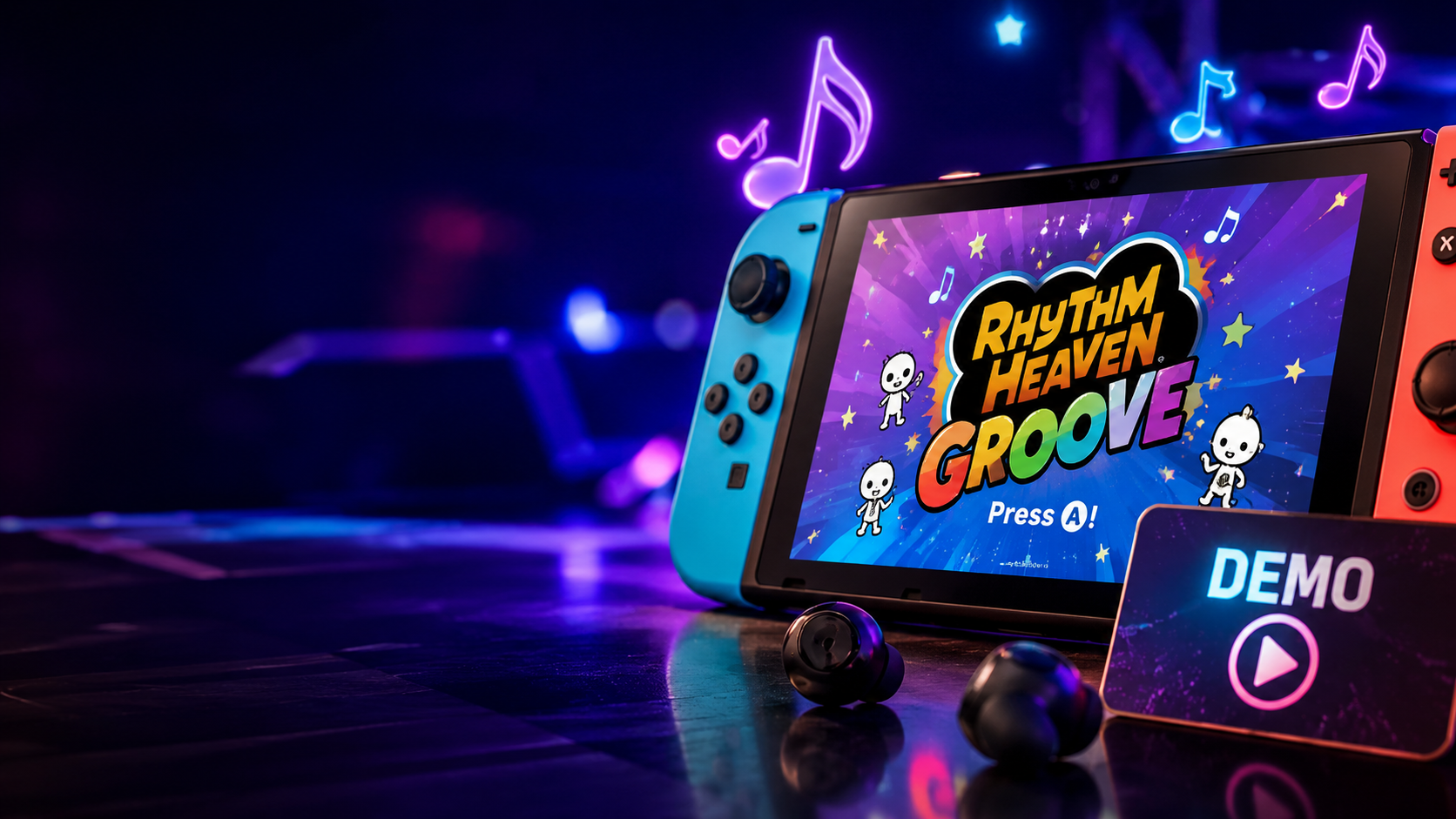
Rhythm Heaven Groove: What the Demo Actually Tells You Before You Buy
A note on how this article was built: Rhythm Heaven Groove launches July 2, 2026 — two days from now. No one outside Nintendo has played the full game yet, and neither have I. What follows is built from the free Starter Demo, Nintendo’s own product listings, and hands-on impressions from outlets and players who did get time with it. Where I’m reporting what someone else observed, I say so. I’m not going to pretend I’ve logged hours with a game that isn’t out yet.
Why “It’s just WarioWare with music” undersells this game
Every Rhythm Heaven pitch gets compared to WarioWare, and the comparison isn’t wrong — both are collections of tiny games strung into a rhythm. But WarioWare tests reflexes against a shrinking clock. Rhythm Heaven tests something narrower and, for a lot of players, harder: whether you can feel a beat and act on it without a visual countdown telling you exactly when.
That distinction is the whole reason people either bounce off this series immediately or get quietly obsessed with it. If you’re deciding whether Groove is worth $39.99, that’s the actual question — not “is this WarioWare.”
What’s confirmed about the game itself
Rhythm Heaven Groove is the fifth mainline entry in the series and the first new installment in roughly a decade, following Rhythm Heaven Megamix, which came to Nintendo 3DS in 2015. It’s developed by Nintendo alongside TNX, and series composer Tsunku returns to score it — notably continuing his work on the franchise after recovering from laryngeal cancer, which affected his vocal cords starting in 2014.
The scope, per Nintendo’s own reveal, is large for the genre: over 80 single-player rhythm minigames and 30 multiplayer games, playable with just A, B, and occasionally the plus button. The series’ traditional structure carries over — you play a run of standalone games, then a “Remix” that stitches several of them together back-to-back, testing whether you actually internalized each rhythm or just memorized visual cues.
One real structural addition: a mode called Beatspell, described as a role-playing-style mode, which is new to the series. Details on how it plays are still thin, since Nintendo hasn’t shown it in the demo.
Price is the detail worth pausing on
Digital release is $39.99, physical is $49.99. That digital price sits noticeably below what Nintendo typically charges for a first-party Switch release ($49.99–$59.99 is standard). For a game built around dozens of short, replayable minigames rather than a single long campaign, that pricing looks deliberate — Nintendo seems to be positioning Groove as an easy “why not” purchase rather than a marquee flagship title.
Whether that price feels right depends entirely on how you value the format. Player reaction on forums has already split along that line: some see 80+ minigames plus a competitive multiplayer mode as a lot of content for the price; others point out each minigame runs under a couple of minutes and question whether that adds up to $40 of playtime. Both are reasonable positions — it comes down to whether short-form, replay-focused games hold your attention the way a longer campaign does.
What the demo actually contains
Nintendo released a free “Starter Demo” on the eShop on June 22, 2026, ten days ahead of launch, playable on both original Switch and Switch 2. It includes five single-player games — Hoop Trundling, Brolly Good Show, Disc Dog, Feeding the Beast — plus the first Remix, and one multiplayer game, Rhythm Tweezers, which supports up to four players on a single console.
The demo isn’t a throwaway sampler: Nintendo built it as the literal opening chapter of the retail game. Medals and progress earned in the demo carry over automatically when you buy the full release, so anything you clear now, you won’t replay on July 2.
What people who’ve actually played it are saying
This is the part a spec sheet can’t tell you, so it’s worth pulling from people who put controller time in.
On the timing model: one player on the ResetEra forums flagged that Groove appears to penalize “extra” inputs more strictly than earlier entries. In the hoop-jumping minigame, jumping in rhythm even when there’s no hoop present to jump through drew a failing grade — where past Rhythm Heaven titles were often forgiving of harmless extra taps. That’s a real design shift, not a minor nitpick, since a chunk of the series’ appeal has always been that acting on the beat mattered more than acting only when required.
On feel and presentation: a Nintendo Life writer who completed the demo called it a “return to form” after finding some of Megamix’s story cutscenes and prequel content unnecessary — Groove’s demo, by their account, drops you straight into minigames with minimal narrative padding. A CGMagazine preview from an earlier hands-on session described the onboarding as gentle: each new minigame gets a short intro clip before you’re asked to actually perform it, which matters in a genre where the biggest early-game friction is “I don’t understand what this game wants from me yet.”
On difficulty variance: reactions to individual minigames were mixed even among people who liked the demo overall. Kotaku’s Rebekah Valentine singled out the frisbee-throwing minigame, Disc Dog, as more finicky than it looks — a strict 4/4 beat with only one action, but timing that felt inconsistent between attempts. Other demo players echoed frustration with the same minigame while calling a chomping-dinosaur game and the closing Remix highlights of the demo.
The throughline across independent accounts: the demo is short, the core feel is recognizably Rhythm Heaven, and the timing windows in at least a couple of games are tighter than longtime fans expect. That last point matters if you’re coming in as a total newcomer — go in expecting to fail a few times before you find the beat, because that’s apparently by design here, not a bug.
Common mistakes newcomers make with this series
These aren’t hypothetical — they’re the same mistakes that show up in demo feedback threads for every Rhythm Heaven entry, and Groove is no exception.
Watching instead of listening. The visual cues are secondary. Multiple demo players noted that games like Disc Dog and the umbrella-matching minigame are built to be misleading if you rely on your eyes over your ears. If you’re eyeballing character animations instead of locking onto the beat, you will get “Keep Trying” ratings that feel unfair but aren’t.
Adding extra inputs “just in case.” As the ResetEra feedback above shows, Groove seems less tolerant of filler taps than past entries. Pressing the button on every beat instead of only the beats the game asks for can now cost you a passing grade in specific minigames.
Judging the whole game off one bad minigame. Because each minigame has its own rhythm logic, difficulty is wildly uneven by design. Struggling with Disc Dog tells you nothing about how you’ll do with the umbrella game or the Remix. Don’t extrapolate from one rough five minutes.
Skipping the Remix. The Remix isn’t a victory lap — it’s the actual test of whether you learned the rhythms or just pattern-matched the visuals in isolation. Demo players who called the Remix a highlight were the ones who’d internalized the earlier games’ timing, not just cleared them once.
Should you buy it, or just play the demo?
If you’ve never played a Rhythm Heaven game, the honest answer is: play the free demo before deciding anything. It costs nothing, it’s built as the actual first chapter of the retail game so your progress carries over, and it will tell you in fifteen minutes whether “listen, don’t watch” gameplay clicks for you or frustrates you. That’s not true of most demos, which are disconnected samplers — this one is literally the start of the real thing.
If you’re a longtime fan of the series, the signals so far are good but not unanimous: a genuine return to form in tone and pacing, a stricter timing model that will divide players who liked the older games’ forgiveness, and a price point that undercuts typical Nintendo first-party releases. The Beatspell mode remains the biggest open question, since it hasn’t been shown in enough detail to evaluate.
Key takeaways
- Rhythm Heaven Groove releases July 2, 2026 on Switch — the first new mainline entry in about a decade, following 2015’s Megamix.
- It ships with 80+ single-player minigames, 30 multiplayer games, and a new RPG-style mode called Beatspell that’s still largely unrevealed.
- Digital price is $39.99, physical is $49.99 — notably below typical Nintendo first-party pricing.
- The free Starter Demo (five solo games, one multiplayer game, one Remix) is literally the opening chapter of the full game, and your demo progress transfers to launch day.
- Early hands-on accounts describe a stricter, less forgiving timing model in some minigames compared to past entries — good news if you want a tighter challenge, a real adjustment if you’re used to the series’ historical leniency.
FAQ
Is Rhythm Heaven Groove out yet? No. It releases July 2, 2026, on Nintendo Switch. A free demo is available now.
Does the demo save progress into the full game? Yes. Nintendo built the Starter Demo as the opening chapter of the retail release, and medals or completed minigames from the demo carry over automatically at launch.
What minigames are in the demo? Five single-player games — Hoop Trundling, Brolly Good Show, Disc Dog, and Feeding the Beast — plus the first Remix, and one multiplayer game, Rhythm Tweezers, for up to four players.
How much does Rhythm Heaven Groove cost? $39.99 digitally, $49.99 for a physical copy — below Nintendo’s usual $49.99–$59.99 first-party range.
Do I need to have played previous Rhythm Heaven games first? No. The series doesn’t have a meaningful ongoing story, and the demo is built to onboard new players with short intro clips before each minigame.
What is Beatspell? A newly announced role-playing-style game mode, confirmed by Nintendo but not yet shown in playable detail. It’s the least-understood part of the package right now.
Is the game harder than previous Rhythm Heaven entries? Some minigames in the demo appear stricter about penalizing extra or mistimed inputs than past entries were, based on early player reports — though this varies by minigame and hasn’t been confirmed as a series-wide change.
Can I play multiplayer with one Switch? Yes — the demo’s multiplayer game, Rhythm Tweezers, supports up to four players on a single console.
About the Author