Alhambra Palace Night Tour Attendance Revenue: What the Data Really Shows
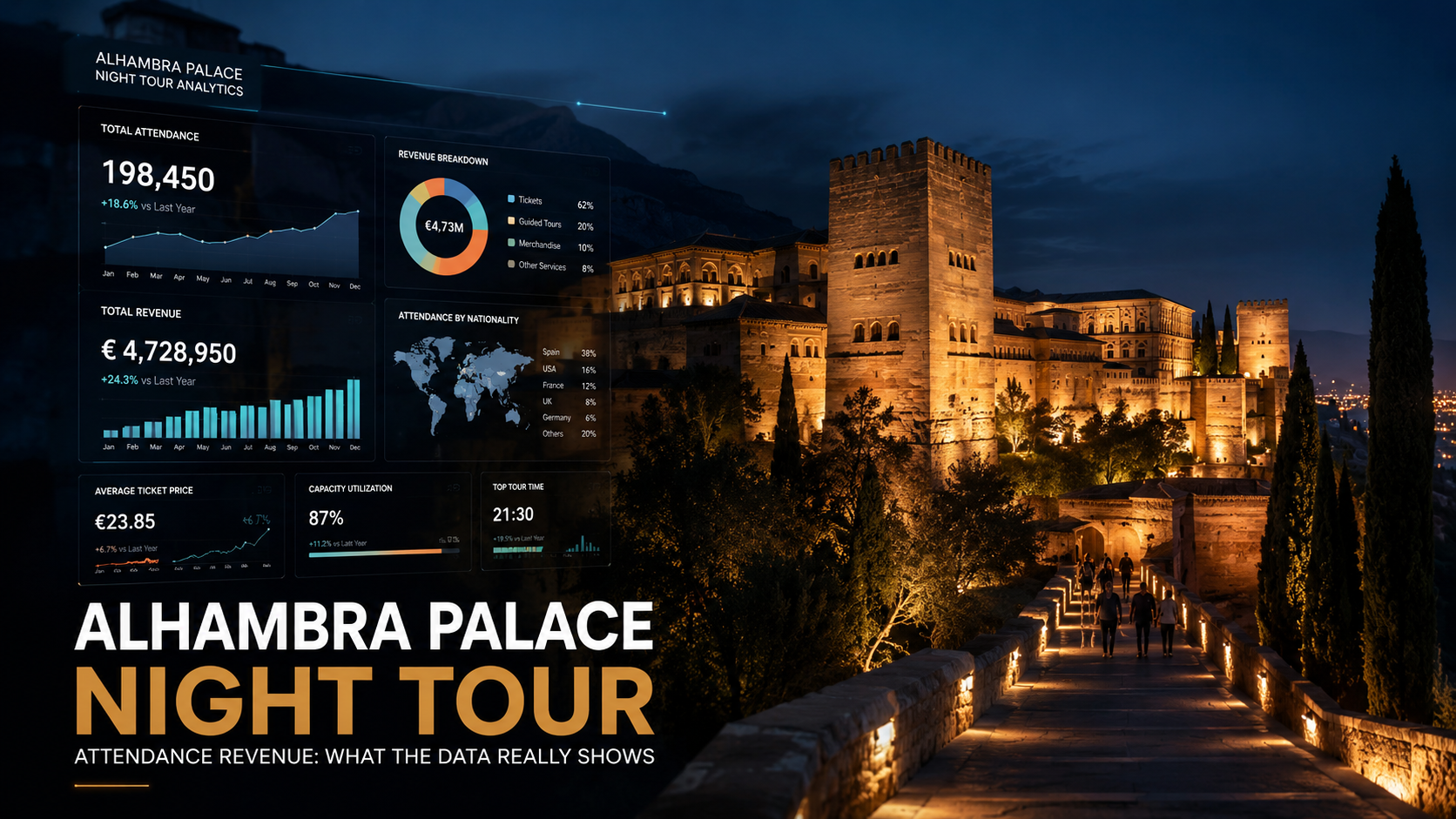
As interest has grown, many people have started searching for “Alhambra Palace night tour attendance revenue.” They want to know:
- How many people attend the night tours?
- How much money do they generate?
- Are night tours more profitable than daytime visits?
- Does the Alhambra publish official revenue figures?
The short answer is no official source publishes a standalone breakdown of annual attendance or revenue specifically for night tours. Most publicly available financial reports combine ticket income across the monument rather than separating daytime and nighttime operations. As a result, many websites publish estimates instead of verified statistics.
This guide explains what is officially known, what can reasonably be estimated, and where uncertainty remains.
Table of Contents
ToggleTable of Contents
- What Are the Alhambra Night Tours?
- Why People Search for Night Tour Attendance Revenue
- Official Visitor Statistics
- Are Night Tour Attendance Figures Public?
- Ticket Prices and Revenue Sources
- Estimating Night Tour Revenue
- Factors Affecting Attendance
- Why Capacity Is Strictly Limited
- Economic Importance of Night Tours
- Day Tours vs Night Tours
- Advantages and Limitations
- Comparison Table
- Pros and Cons
- Frequently Asked Questions
- Conclusion
What Are the Alhambra Night Tours?
The Alhambra offers specially scheduled evening visits that allow guests to experience selected parts of the monument after sunset.
Typically, visitors can choose between:
- Nasrid Palaces Night Visit
- Generalife Gardens Night Visit
Unlike daytime visits, night tours emphasize:
- Dramatic architectural lighting
- Smaller visitor groups
- Quiet surroundings
- Enhanced historical atmosphere
- Timed entry with controlled capacity
These tours are designed to improve the visitor experience while protecting one of Spain’s most fragile cultural treasures.
Why People Search for “Alhambra Palace Night Tour Attendance Revenue”
The search term has become popular because travelers, tourism researchers, and business analysts are interested in understanding how heritage attractions generate income without overwhelming historic sites.
Common questions include:
- Is the Alhambra profitable?
- How many people attend at night?
- Are night tickets more expensive?
- Does limited capacity increase revenue?
- How is the money used?
These questions relate not only to tourism economics but also to heritage conservation.
Official Visitor Statistics
The Alhambra consistently ranks among Spain’s most visited monuments.
Public reports indicate annual attendance in the range of approximately 2.5–2.8 million visitors in recent years, although totals vary by year and are affected by factors such as tourism demand and operational capacity.
However, the publicly released figures generally include:
- Day visitors
- Night visitors
- Museum admissions
- Combined ticket categories
They do not normally provide a separate annual total for night tours.
Are Night Tour Attendance Figures Public?
This is where many online articles become misleading.
What is officially available
Public information includes:
- Overall annual visitor totals
- Ticket categories
- Admission prices
- General financial information
- Conservation budgets
What is not officially published
The Alhambra administration does not routinely publish:
- Exact annual night-tour attendance
- Standalone night-tour revenue
- Detailed nightly occupancy rates
Because of this, many websites estimate attendance using ticket capacities and operating schedules rather than official audited data.
Ticket Prices and Revenue Sources
Night-tour income primarily comes from ticket sales.
Additional spending may include:
- Guided tours (often sold by independent operators)
- Audio guides
- Official publications
- Gift shop purchases
- Visitor services
An important distinction is that tour operator prices are not the same as monument revenue. A guided tour fee often includes:
- Licensed guide costs
- Booking platform commissions
- Operator margins
- Administrative expenses
Only the official admission portion goes directly to the monument.
Estimating Alhambra Night Tour Revenue
Since no official standalone figure exists, analysts generally use a simple formula:
Revenue = Number of Night Visitors × Average Ticket Price
Several independent analyses estimate:
| Metric | Estimated Range | Verification Status |
|---|---|---|
| Annual night visitors | ~100,000–150,000 | Estimated, not officially published |
| Average ticket price | Approximately €8–€13 | Based on published ticket pricing |
| Ticket revenue | Roughly €1–2 million from ticket sales alone | Estimate |
| Higher estimates including guided tours and ancillary spending | Up to €8–12 million | Not officially confirmed; depends on methodology |
The wide variation exists because different analysts include different revenue streams.
Factors Affecting Night Tour Attendance
Attendance depends on several variables rather than demand alone.
1. Conservation limits
Protecting centuries-old architecture takes priority over maximizing ticket sales.
2. Seasonal tourism
Spring and autumn generally attract stronger demand than winter.
3. Weather
Rain or extreme conditions can reduce attendance.
4. International tourism
Visitor numbers fluctuate with global travel trends.
5. Advance reservations
Many night tours sell out well before travel dates during peak season.
Why Capacity Is Strictly Limited
Unlike amusement parks or modern attractions, the Alhambra cannot simply admit more visitors.
Reasons include:
- Preservation of delicate plasterwork
- Protection of historic flooring
- Crowd management
- Visitor safety
- UNESCO conservation standards
This means the management strategy prioritizes:
Higher-quality experiences over higher visitor volume.
Economic Importance of Night Tours
Although night tours represent only a fraction of total visitors, they provide several important benefits.
Revenue diversification
Evening operations generate income outside standard visiting hours.
Visitor distribution
They reduce pressure during busy daytime periods.
Cultural tourism
Night visits create a premium experience that attracts photographers, historians, and repeat visitors.
Conservation funding
Like other ticket income, revenue contributes to maintaining the monument, staffing, security, and visitor services. Public reports generally describe revenues as supporting the operation and preservation of the site, though they do not isolate night-tour income.
Day Tours vs Night Tours
| Feature | Day Tour | Night Tour |
|---|---|---|
| Visitor numbers | Much higher | Much lower |
| Capacity | Larger | Strictly limited |
| Atmosphere | Busy | Quiet |
| Photography | Natural daylight | Dramatic lighting |
| Availability | Daily | Limited schedules |
| Revenue model | High volume | Lower volume, premium experience |
Advantages of Night Tours
- Smaller groups
- Less crowded experience
- Unique architectural lighting
- Cooler temperatures in summer
- Different perspective on the monument
- Strong visitor demand
Limitations
- Limited ticket availability
- Shorter visiting windows
- Restricted access to some areas
- Difficult to obtain tickets during peak season
Comparison Table
| Aspect | Night Tours | Standard Day Visits |
|---|---|---|
| Attendance | Limited | High |
| Experience | Exclusive | Comprehensive |
| Crowd levels | Low | Moderate to High |
| Photography | Excellent lighting | Natural lighting |
| Conservation impact | Carefully managed | Carefully managed |
| Booking difficulty | High | Moderate |
Pros and Cons
| Pros | Cons |
|---|---|
| Unique atmosphere | Limited capacity |
| Smaller crowds | Tickets sell out quickly |
| Premium experience | Fewer available time slots |
| Excellent photography | Shorter duration |
| Supports heritage tourism | Exact attendance data is not publicly separated |
Frequently Asked Questions
1. Does the Alhambra publish official night-tour revenue?
No. Public reports generally do not provide a separate audited figure specifically for night-tour revenue.
2. How many people attend the Alhambra night tours each year?
Independent estimates commonly suggest around 100,000–150,000 visitors annually, but this range is not officially confirmed.
3. Why are night tours limited?
Capacity is restricted to protect the historic monument and preserve the visitor experience.
4. Are night tours more expensive?
Official night ticket prices vary by tour type and season, but guided experiences sold by private operators can cost significantly more because they include additional services.
5. Does all guided-tour revenue go to the Alhambra?
No. Guided-tour prices often include operator fees, guide services, and commissions, so only the admission component is monument revenue.
6. Why do revenue estimates differ so much?
Some analyses count only official ticket sales, while others include guided tours, audio guides, and related visitor spending.
7. Are night tours usually sold out?
Popular dates—especially during peak travel seasons—can sell out well in advance due to limited capacity.
8. How do night tours help conservation?
Ticket income contributes to the monument’s operation and long-term preservation, alongside other funding sources.
9. Is there a verified annual revenue figure for night tours?
No verified standalone figure has been publicly released by the Alhambra administration.
10. Should published revenue estimates be treated as exact?
No. Unless they come directly from official financial reports, they should be considered informed estimates rather than audited facts.
Conclusion
The topic of Alhambra Palace night tour attendance revenue is more complex than it first appears. While the monument attracts millions of visitors annually, official sources do not publish separate annual attendance or revenue figures for night tours. This has led many analysts to estimate attendance and income using ticket prices, capacity limits, and operating schedules.
The most credible interpretation is that night tours represent a small but strategically important part of the Alhambra’s tourism model. Their value lies less in maximizing visitor numbers and more in balancing heritage preservation, high-quality visitor experiences, and sustainable funding. When evaluating figures online, distinguish clearly between officially reported data and third-party estimates, as the latter often use different assumptions and can vary substantially.
About the Author