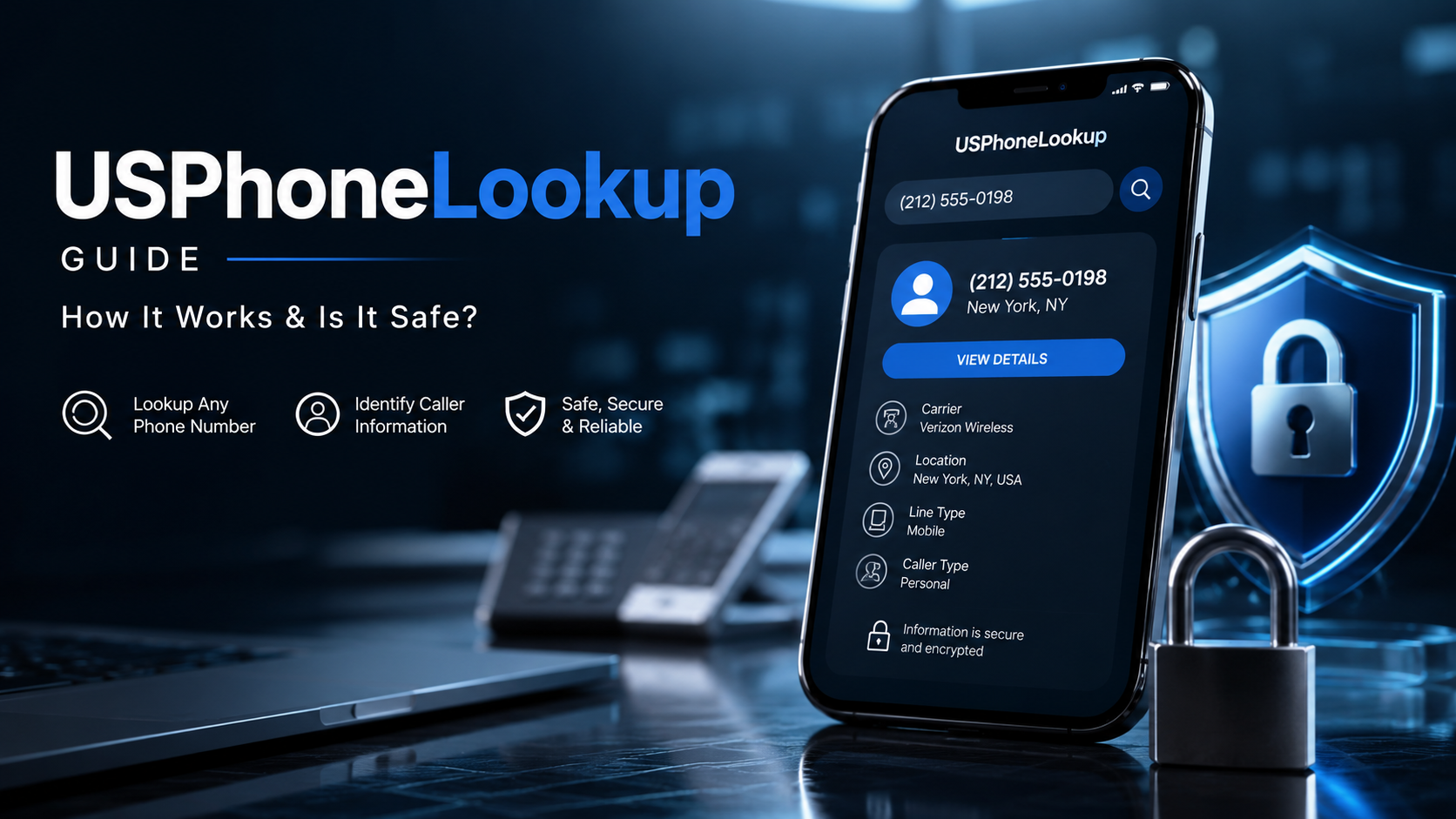
USPhoneLookup Explained: How It Works & Is It Worth It?
Introduction
You get a call from a number you don’t recognize, let it go to voicemail, and then spend the next ten minutes wondering who it was. That moment — the itch to know who just called — is exactly why services like USPhoneLookup exist.
USPhoneLookup is a reverse phone lookup website: you type in a phone number, and it searches public records and directories to try to match that number to a name, location, and other background details. It’s one of many sites in this space, alongside names like NumLookup, US Search, and PhoneLookup.com.
This guide breaks down what USPhoneLookup actually does, how the reverse lookup process works, what you can realistically expect from the results, where it falls short, and how it compares to other options. We’ll also cover the privacy side — including how to opt out if your own information shows up.
Table of Contents
- What Is USPhoneLookup?
- How Reverse Phone Lookup Works
- Key Features
- What You Can (and Can’t) Find
- Common Use Cases
- Benefits of Using USPhoneLookup
- Drawbacks and Limitations
- USPhoneLookup vs. Other Reverse Phone Lookup Services
- Pros and Cons
- Is USPhoneLookup Safe and Legal to Use?
- How to Opt Out of USPhoneLookup
- Frequently Asked Questions
- Conclusion
What Is USPhoneLookup?
USPhoneLookup is a web-based reverse phone number search tool. Instead of searching by a person’s name, you enter a 10-digit US phone number, and the platform searches phone directories, public records, and other listings to try to identify the number’s owner.
According to the site itself, a completed search can surface details such as the caller’s name, associated social media profiles, employment history, and, in some cases, criminal or traffic records — though how much information actually turns up depends heavily on how “findable” that particular number is in public data sources.
It’s worth being upfront about something important: USPhoneLookup is a people-search and data-aggregation site, not a law enforcement tool or a private investigator. It pulls together information that already exists in public and semi-public records rather than generating new intelligence about a person.
How Reverse Phone Lookup Works
Reverse phone lookup tools like USPhoneLookup generally work in three steps:
1. You Submit a Phone Number
You enter the number on the homepage search bar. No account is typically required just to start a search.
2. The Platform Cross-References Data Sources
The search engine checks the number against phone directories, public records, and other listings that have been compiled from various sources — think old phone books, marketing databases, voter records, and information people have shared publicly online at some point.
3. You Review a Report
Within a few minutes, you get a results page. Free previews are common; deeper background reports (address history, relatives, criminal records) are usually gated behind a paid subscription — this is standard practice across nearly the entire reverse-lookup industry, not something unique to one site.
This is fundamentally different from a CNAM lookup, which pings a phone carrier directly to retrieve the subscriber name tied to a number in real time. Aggregator sites like USPhoneLookup instead rely on pre-compiled databases, which means results can be outdated, incomplete, or occasionally mismatched — especially for prepaid numbers or numbers that have recently changed hands.
Key Features
- Free basic search — a preliminary lookup with limited details, common across this category of site
- Encrypted data transmission — the platform states that information entered is transmitted securely to its servers
- Mobile-friendly search — usable from a phone or tablet without a separate app
- Popular number directory — a browsable list of frequently searched numbers
- Opt-out process — a mechanism for individuals to request removal of their own listing
Specifications
| Attribute | Detail |
|---|---|
| Access | Web browser (desktop and mobile) |
| Input required | 10-digit US phone number |
| Account needed for basic search | No |
| Report depth | Basic (free) vs. detailed (paid) |
| Coverage | US phone numbers |
| Data removal | Opt-out form available |
Real-World Usage
In practice, most people use a tool like this the same way they’d use a caller ID app — except after the fact. You missed a call, the number isn’t in your contacts, and you want a quick sanity check before calling back or blocking the number.
What You Can (and Can’t) Find
It helps to set realistic expectations before you search.
Often available:
- Name associated with the number (if publicly listed)
- General location (city/state, sometimes more specific)
- Line type (landline, mobile, VoIP)
- Carrier information
Sometimes available, and less reliable:
- Social media profile links
- Employment history
- Household or relative information
Frequently unavailable or inaccurate:
- Information tied to newer prepaid or burner numbers
- Numbers that were recently reassigned to a new owner
- Unlisted or privacy-protected numbers
If a number simply isn’t tied to much public data, no reverse lookup site — USPhoneLookup included — is going to conjure information that doesn’t exist in a searchable record somewhere.
Common Use Cases
Screening unknown calls. This is the number one reason people use reverse phone lookup. Rather than answering blind, you check the number first.
Verifying a caller’s identity. If someone claims to be calling from your bank, a delivery service, or a government agency, a lookup can help confirm whether the number matches a legitimate organization — though scammers can and do spoof caller ID, so this isn’t foolproof.
Reconnecting with old contacts. Lost touch with a former coworker or classmate but still have an old number? A reverse lookup occasionally helps close that gap.
Pre-transaction checks. Before responding to a cold call from an “investor” or buying/selling something with a stranger online, some people run a quick lookup as a light due-diligence step.
Checking what’s public about your own number. Running a search on your own number is a reasonable way to see what a stranger could find out about you.
Benefits of Using USPhoneLookup
- Low barrier to entry. No technical skill needed — you type a number and get a result.
- Speed. Searches typically complete in a matter of minutes rather than requiring manual digging across multiple sites.
- No login required for a basic search. You can test the waters before committing to anything paid.
- Opt-out option exists. Unlike some data brokers, USPhoneLookup provides a way to request removal, which matters if you care about your own listing.
Drawbacks and Limitations
- Accuracy isn’t guaranteed. Public records lag behind reality — people move, change numbers, and get new phone plans constantly.
- Free results are limited by design. The free tier is meant to show enough to make you curious, not to be comprehensive.
- Not a substitute for FCRA-compliant background checks. Like most people-search sites, USPhoneLookup is not a consumer reporting agency, meaning its data legally cannot be used for decisions like employment screening, tenant screening, or credit eligibility under the Fair Credit Reporting Act (FCRA).
- Your own data may be listed without your direct input. This is standard for the entire data-broker industry, but it’s still a legitimate privacy concern worth knowing about.
- Spoofed numbers defeat the tool. If a scammer is spoofing a legitimate business’s number, a reverse lookup will show that legitimate business — not the scammer.
USPhoneLookup vs. Other Reverse Phone Lookup Services
| Feature | USPhoneLookup | NumLookup | US Search | IPQS Reverse Lookup |
|---|---|---|---|---|
| Free basic search | Yes | Yes | Limited | Yes |
| Paid detailed reports | Yes | Yes | Yes | Yes (API-based) |
| Social media matching | Claimed | Claimed | Claimed | Not primary focus |
| Opt-out process | Yes | Yes | Yes | N/A (fraud-prevention tool) |
| Primary audience | Consumers | Consumers | Consumers | Businesses/developers |
| FCRA-compliant reports | No | No | No (explicitly states this) | No |
This isn’t an exhaustive list of every competitor, but it reflects the general shape of the market: most consumer-facing reverse lookup tools operate the same way — free teaser, paid depth, opt-out available, and none of them positioned as a legal background-check substitute.
Pros and Cons
| Pros | Cons |
|---|---|
| Fast, simple search process | Free results are often shallow |
| No account needed to start | Paid tier required for full reports |
| Mobile-friendly | Data can be outdated or mismatched |
| Opt-out option available | Not FCRA-compliant for legal decisions |
| Useful first step for screening unknown calls | Can’t unmask spoofed numbers |
Is USPhoneLookup Safe and Legal to Use?
Using a reverse phone lookup tool is legal in the United States — you’re searching publicly available and licensed data sources, not hacking into anything. That said, “legal to use” and “legal to use for anything” are different things.
Because USPhoneLookup is not a Consumer Reporting Agency under the FCRA, its reports cannot legally be used to make decisions about employment, housing, credit, or insurance eligibility. If you need that kind of vetting, you’d need a service specifically certified for FCRA-compliant background checks.
As for safety: the platform states it transmits submitted data through encryption. As with any site where you enter personal search queries, it’s reasonable to review the site’s privacy policy and terms of use before subscribing to a paid plan, since we can’t independently verify internal data-handling practices beyond what the company publicly states.
How to Opt Out of USPhoneLookup
If your own name or number shows up and you’d rather it didn’t, USPhoneLookup provides an opt-out page where you can submit a removal request. General steps that apply across most people-search sites, including this one:
- Find your listing on the site’s search results.
- Locate the opt-out or “remove my information” page.
- Submit the request with the required identifying details.
- Allow processing time for the removal to take effect.
Keep in mind that opting out of one site doesn’t remove you from others — data brokers each maintain separate databases, so a comprehensive privacy cleanup means repeating this process across multiple platforms.
Frequently Asked Questions
Is USPhoneLookup completely free? A basic search is generally free, but full detailed reports — address history, relatives, background records — typically require a paid subscription, which is standard across this category of service.
Does USPhoneLookup work for landlines and cell phones? Yes, reverse phone lookup tools in this category are generally designed to search both landline and mobile numbers, along with VoIP lines where data is available.
Can USPhoneLookup identify a spoofed number? No. If a scammer is spoofing caller ID to display a legitimate number, the lookup will return information about the real owner of that number, not the scammer actually calling you.
Will my search be anonymous? The platform states searches are conducted securely, but as with any online service, you should review its privacy policy directly rather than assume complete anonymity.
How accurate are the results? Accuracy varies by number. Landlines and older, well-documented numbers tend to return more reliable matches than newer prepaid or recently reassigned mobile numbers.
Can I remove my own information from USPhoneLookup? Yes, the site offers an opt-out form specifically for this purpose.
Is USPhoneLookup the same as a background check company? No. It is not a Consumer Reporting Agency under the FCRA, so its reports aren’t legally valid for employment, tenant, or credit decisions.
What’s the difference between USPhoneLookup and a carrier-based CNAM lookup? A CNAM lookup queries the phone carrier directly for the current subscriber name in real time. USPhoneLookup instead searches pre-compiled public records and directories, which can be less current but broader in scope.
Why does a search sometimes return no results? If a number isn’t tied to any public record, listing, or directory entry — which is increasingly common for newer mobile numbers — there may simply be nothing to find.
Are there free alternatives to USPhoneLookup? Yes. Sites like NumLookup and PhoneLookup.com also offer free basic reverse lookups, and carrier-provided caller ID apps offer a complementary, real-time alternative.
Conclusion
USPhoneLookup fits into a well-established category of consumer reverse phone lookup tools: quick, free to start, and useful as a first screening step when an unknown number calls. It won’t unmask a spoofed scam call, and it’s not a legal substitute for a background check — but for the everyday task of deciding whether to call back a stranger, it does what it says on the tin.
If you decide to try it, treat the free result as a starting point rather than a verdict, and cross-check anything important — especially before making a decision that involves money, safety, or trust. And if you ever find your own number listed somewhere you didn’t expect, use the opt-out process; it takes a few minutes and puts a little more control back in your hands.
About the Author




1 thought on “USPhoneLookup Guide: How It Works & Is It Safe?”