Introduction
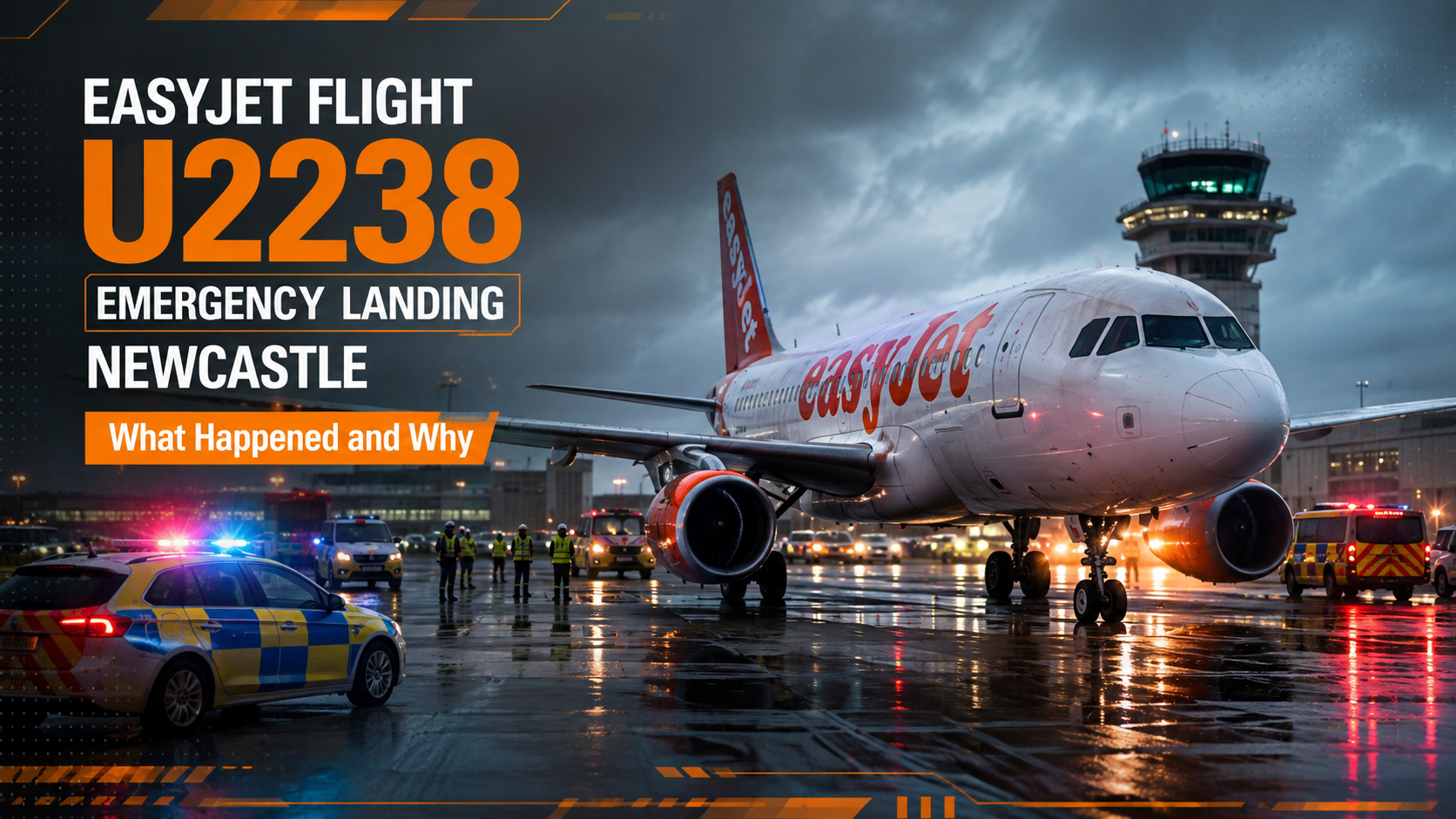
Flying is remarkably safe, but when an aircraft makes an unscheduled stop, it makes headlines. In October 2025, EasyJet flight U2238, traveling from Copenhagen to Manchester, diverted to Newcastle International Airport in what was reported as an emergency landing. The reason: a passenger required urgent medical attention .
While the term “emergency landing” might sound alarming, this event is actually a testament to how aviation safety protocols work. It shows how pilots, cabin crew, and ground staff coordinate to protect lives—even when the flight plan has to change.
This article explains exactly what happened on that flight, the difference between types of landings, how pilots make diversion decisions, and what it means for passengers. We’ll also cover the aircraft involved, the typical route, and what to expect if your flight diverts.
What Happened on EasyJet Flight U2238?
The Diversion: Copenhagen to Manchester via Newcastle
On October 27, 2025, EasyJet flight U2238 departed Copenhagen Airport at approximately 10:00 PM local time. The flight was scheduled to arrive at Manchester Airport at 10:45 PM UK time .
During the flight, a passenger experienced a medical emergency that required immediate attention. The cabin crew alerted the pilots, who made the decision to divert the aircraft to the nearest suitable airport rather than continuing to Manchester.
The plane touched down at Newcastle International Airport, where paramedics and medical teams were waiting on the tarmac. The affected passenger was handed over to emergency services for treatment .
After the passenger was taken care of, the aircraft was refueled and cleared for departure. The flight then continued to its original destination, Manchester, albeit with a delay .
The Aircraft: Airbus A320
Flight U2238 was operated using an Airbus A320—one of the most commonly flown aircraft in the world. According to flight tracking data, the aircraft was equipped with 186 seats and had been in service for approximately 10 years at the time of the incident .
This aircraft type is designed for short to medium-haul routes. It has a strong safety record and is widely used by EasyJet, Ryanair, and other European carriers.
A Statement from EasyJet
An EasyJet spokesperson confirmed the diversion and explained the reasoning behind it:
“Flight EZY2238 from Copenhagen to Manchester on October 27 diverted to Newcastle, due to a customer onboard requiring urgent medical attention. The customer was met by medical services on arrival, and the flight continued to Manchester. The safety and wellbeing of our customers is always easyJet’s highest priority” .
Understanding Emergency Landings vs. Diversions
The terms “emergency landing,” “precautionary landing,” and “diversion” are often used interchangeably—but they actually mean different things .
| Term | Definition | Example |
|---|---|---|
| Emergency Landing | Immediate landing required due to a serious threat to safety. The aircraft must touch down as soon as possible. | Engine fire, severe mechanical failure, or critical medical event. |
| Precautionary Landing | No immediate danger, but the crew chooses to land early to prevent a situation from escalating. | A minor technical warning light, or a passenger showing signs of distress that could worsen. |
| Diversion | A change in planned destination for operational or safety reasons. | Weather at the destination, or an alternate airport chosen for a medical issue. |
Flight U2238 is best described as a precautionary diversion driven by a medical emergency. The aircraft was not in danger, and the pilots were not forced to land immediately. Instead, they made a calculated choice to land at Newcastle because it offered the quickest access to medical support .
Think of it like driving someone to the nearest hospital instead of continuing to your scheduled clinic appointment. It might not have been the plan, but it was the safest choice for the person in need.
Why Newcastle Was the Chosen Diversion Airport
When a pilot decides to divert, they weigh several factors. For flight U2238, Newcastle International Airport made sense for a number of reasons :
1. Proximity
At the time of the medical emergency, Newcastle was the closest suitable airport. Every minute counts when someone needs urgent medical care. Continuing to Manchester could have added unnecessary time before the passenger could receive professional help.
2. Runway Capability
Not every airport can safely handle an Airbus A320. Newcastle’s runway is fully equipped for this aircraft type, with adequate length for a safe landing.
3. Ground Support and Medical Services
Newcastle Airport has trained emergency crews and a clear protocol for handling medical diversions. Paramedics were waiting on arrival, which was critical for the passenger’s wellbeing.
4. Weather and Air Traffic Conditions
The weather in Newcastle was suitable for landing, and air traffic control was able to accommodate the unscheduled arrival. Pilots don’t divert to airports with poor weather or heavy congestion unless absolutely necessary.
Flight U2238: Route, Schedule, and On-Time Performance
Outside of this diversion, flight U2238 typically operates as a domestic route between Newcastle International Airport (NCL) and Bristol Airport (BRS) .
Standard Route Details
| Detail | Information |
|---|---|
| Origin | Newcastle International Airport (NCL) |
| Destination | Bristol Airport (BRS) |
| Flight Number | U2238 |
| Airline | EasyJet |
| Aircraft | Airbus A320 |
| Distance | Approximately 412 km (255 miles) |
| Flight Time | Around 1 hour 5 minutes |
On-Time Performance
Historically, U2238 has strong punctuality:
-
Departure on-time rate: Approximately 87%
-
Arrival on-time rate: Approximately 87%
-
Average delay: Around 16 minutes
-
Cancellation rate: Low
The flight operates several times per week. According to flight data, it’s currently scheduled on Sundays, Tuesdays, Wednesdays, and Thursdays, with around 10 flights per week on the Newcastle–Bristol route .
Other Flights Using the U2238 Code
It’s worth noting that EasyJet flight numbers are used for different routes on different days or seasons. While U2238 usually connects Newcastle with Bristol, it has also been used for the Copenhagen–Manchester route, as seen in the October 2025 diversion .
Always check your specific flight details—the same flight number may refer to completely different origins and destinations depending on the day of the week or time of year.
Passenger Rights: What to Do If Your Flight Diverts
If your flight diverts due to a medical emergency or other unexpected event, it’s important to understand your rights. Here’s a quick guide:
What the Airline Must Provide
-
Care and assistance: If a diversion causes a long delay, the airline must provide meals, refreshments, and, if needed, hotel accommodation .
-
Communication: You should be kept informed about what’s happening and when the flight will continue.
-
Alternative arrangements: If the flight cannot continue, the airline must offer rebooking or a refund.
Compensation Eligibility
Under UK and EU regulations, passengers may be entitled to compensation for delays. However, there’s a critical exception:
“Extraordinary circumstances” —including medical emergencies, severe weather, and air traffic control strikes—are generally not eligible for compensation. If a diversion is caused by a passenger medical emergency, it is usually considered extraordinary, meaning compensation may not be payable .
If you’re unsure whether you qualify, keep your flight details and boarding passes, and check with the airline or a passenger rights service.
Practical Steps During a Diversion
-
Stay calm and follow crew instructions—they are trained for these situations.
-
Be patient—the ground crew needs time to handle the issue, refuel, and get clearance.
-
Ask for updates—if you’re not sure what’s happening, politely ask cabin crew for an update.
-
Keep receipts—if you need to buy food or other essentials during a delay, keep receipts in case you can claim reimbursement.
Frequently Asked Questions (FAQs)
1. Why did EasyJet flight U2238 make an emergency landing at Newcastle?
The flight diverted to Newcastle because a passenger on board required urgent medical attention. The decision was made to ensure the passenger could receive medical care as quickly as possible .
2. Was anyone injured on EasyJet flight U2238?
The only reported issue was a passenger who experienced a medical emergency. No other injuries were reported, and the aircraft was fully operational .
3. What is the normal route for flight U2238?
Typically, U2238 flies between Newcastle International Airport (NCL) and Bristol Airport (BRS). However, flight numbers are sometimes reused for different routes—the October 2025 incident involved a Copenhagen–Manchester service .
4. Does EasyJet compensate passengers for diversions due to medical emergencies?
Under UK and EU regulations, medical emergencies are considered “extraordinary circumstances,” so compensation may not be payable. However, the airline must still provide care and assistance, such as food and accommodation if a long delay occurs .
5. What aircraft was used for flight U2238?
The flight was operated by an Airbus A320 with up to 186 seats. It was around 10 years old at the time of the incident .
6. How far is the Newcastle–Bristol route?
The direct flight distance is approximately 412 kilometers (255 miles), with a typical flight time of around 1 hour and 5 minutes .
7. How often does U2238 fly?
U2238 operates several times a week, currently scheduled on Sundays, Tuesdays, Wednesdays, and Thursdays .
8. Is an emergency landing dangerous?
Not necessarily. In many cases, an “emergency landing” is actually a precautionary diversion—the crew lands early to prevent a situation from becoming serious. Flight crews train extensively for these scenarios .
9. How do pilots decide where to divert during an emergency?
Pilots consider factors like proximity to the airport, runway length, weather conditions, ground support, medical services, and air traffic clearance .
10. Can I track a specific flight like U2238 in real time?
Yes. Most flight tracking websites and apps allow you to enter the flight number to see real-time status, location, and estimated arrival times .
Final Thoughts: Safety Is the Priority
The EasyJet flight U2238 incident is a reminder that unexpected events happen in aviation—but also that safety systems work.
From the cabin crew’s initial response to the pilots’ decision to divert, every step followed established guidelines. The aircraft was not in danger. The passengers were not at risk. The decision to land at Newcastle was not a failure—it was a carefully calculated choice to prioritize human life over schedule.
Aviation is built on layers of redundancy and planning. Medical emergencies, technical glitches, and weather disruptions are all part of operating a modern airline. The difference is that procedures are in place to handle each one.
For passengers, it’s normal to feel anxious when a flight changes suddenly. But understanding why these decisions are made—and knowing that they’re driven by safety first—can make a big difference.
If you find yourself on a diverted flight, take a deep breath, listen to the crew, and remember: every decision was made with your wellbeing in mind.
About the Author




1 thought on “EasyJet Flight U2238 Emergency Landing Newcastle: What Happened and Why”