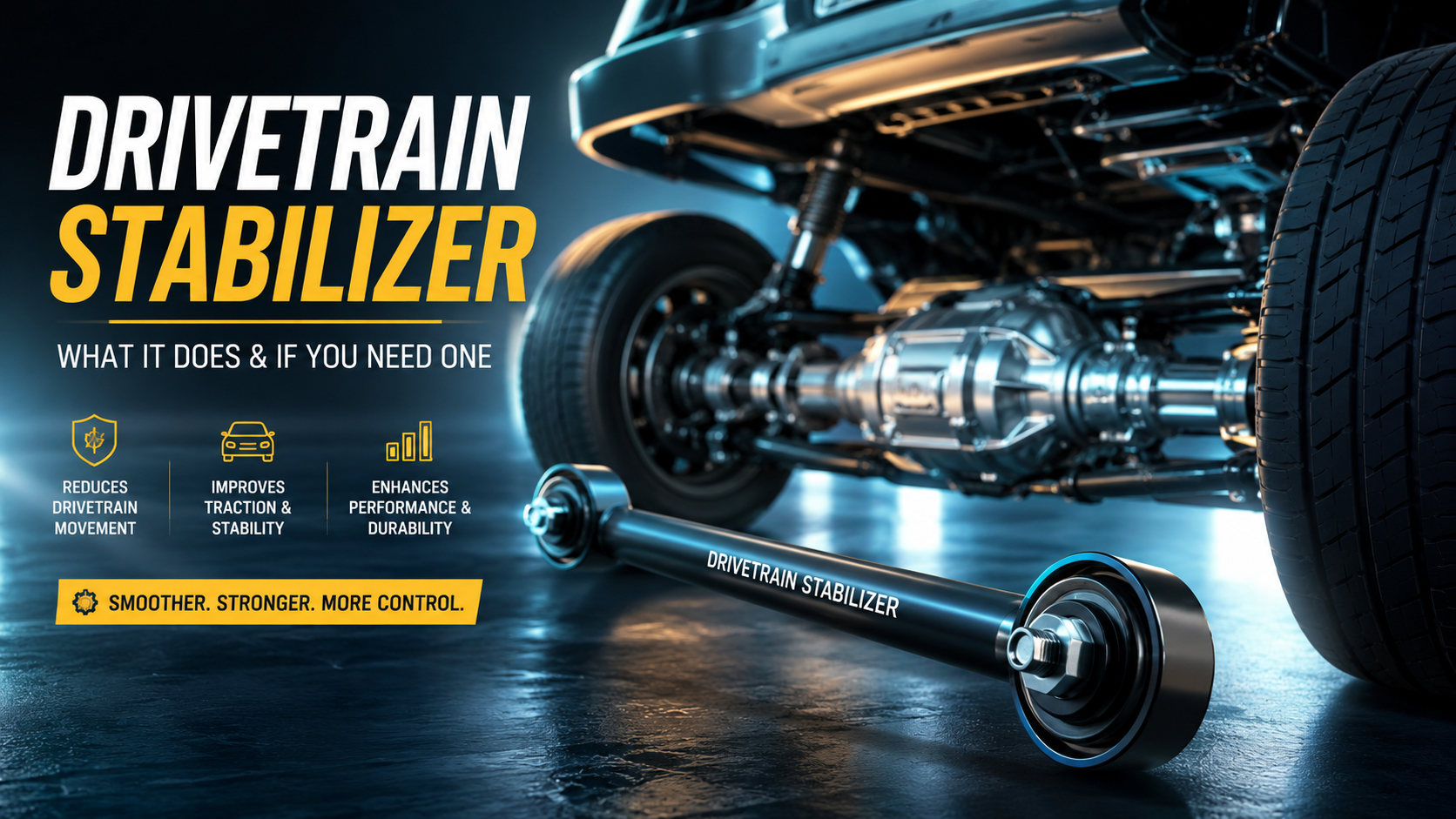
If you’ve ever mashed the throttle in a front-wheel-drive or transverse-engine car and felt the whole nose of the engine bay lurch, you’ve felt torque reaction — and it’s exactly the problem a drivetrain stabilizer is built to solve.
I got curious about this part after chasing a clunk in a Volkswagen with a manual transmission that turned out to be a tired mount, not the transmission itself. That’s a common story. A lot of drivers assume “notchy shifting” or “clunk on takeoff” means expensive internal damage, when the real culprit is often just movement in the engine and transmission mounting system.
This guide breaks down what a drivetrain stabilizer actually is, how it differs from a standard motor mount or a torque strut, when it’s worth installing, and what to realistically expect from one — benefits and limitations included.
Table of Contents
- What Is a Drivetrain Stabilizer?
- How a Drivetrain Stabilizer Works
- Signs Your Drivetrain Needs Stabilizing
- Drivetrain Stabilizer vs. Torque Strut Mount vs. Standard Engine Mount
- Key Features, Benefits, and Drawbacks
- Comparison Table: Stabilizer Options
- Pros and Cons
- Installation: What to Expect
- Who Actually Benefits From One?
- Frequently Asked Questions
- Final Thoughts
What Is a Drivetrain Stabilizer?
A drivetrain stabilizer is an aftermarket bracket-and-bushing assembly that adds a rigid (or semi-rigid) connection point between the engine/transmission assembly and the vehicle’s chassis or subframe. Its job is to limit the amount of rotational movement — often called torque reaction — that the powertrain undergoes when you accelerate, brake, or shift gears.
This part is most commonly associated with AWE Tuning’s Drive Train Stabilizer (DTS), a well-known product built for Volkswagen and Audi platforms with transverse-mounted engines, such as certain A4, Passat, Golf, and GTI models. AWE’s version bolts to existing factory mounting points, uses a CNC-machined aluminum bracket, and pairs with either a rubber or polyurethane bushing depending on the kit.
It’s important to be upfront here: “drivetrain stabilizer” isn’t a universal, standardized part the way a “brake pad” is. It’s largely a brand-specific product name used in the tuning and enthusiast-parts space, most associated with AWE Tuning. Other manufacturers sell similar-purpose components under different names, including torque mounts, torque strut mounts, dogbone mounts, and transmission stabilizer bars. They all address the same underlying issue — excess drivetrain movement — using slightly different hardware and mounting geometry.
How a Drivetrain Stabilizer Works
Every time your engine makes torque, Newton’s third law comes into play: as the crankshaft spins one direction, the engine and transmission assembly try to twist in the opposite direction. Engineers call this torque reaction or powertrain roll.
Factory engine and transmission mounts are usually made from rubber. Rubber is chosen because it’s excellent at absorbing vibration and noise — but that same softness allows a certain amount of controlled flex under load. In daily driving, that flex is barely noticeable. In modified vehicles with more power, aggressive driving styles, or simply aging rubber mounts, that flex becomes pronounced enough to cause:
- Delayed or “rubbery” throttle response
- Clunking or banging noises on hard acceleration or gear changes
- Inconsistent, notchy shifting on manual transmissions
- Extra wear on other mounts as they compensate for a failing one
A drivetrain stabilizer doesn’t replace your primary engine or transmission mounts. Instead, it acts as a secondary restraint, typically mounted low on the undercarriage, that limits how far the powertrain can rotate before it runs out of travel. Less uncontrolled movement generally translates to crisper shifts and more predictable power delivery to the wheels, according to product descriptions from manufacturers like AWE Tuning.
Rubber vs. Polyurethane Bushings
Most drivetrain stabilizers are offered with a choice of bushing material:
- Rubber bushings — quieter, more compliant, closer to factory ride comfort, but allow slightly more movement over time.
- Polyurethane (poly) bushings — stiffer and more durable, reduce drivetrain movement more aggressively, but transmit more vibration and noise into the cabin.
Neither option is objectively “better” — it’s a trade-off between comfort and rigidity, and the right choice depends on how the vehicle is used.
Signs Your Drivetrain Needs Stabilizing
Before assuming you need an aftermarket stabilizer, it’s worth ruling out whether your existing mounts are simply worn out. Common symptoms of worn engine or transmission mounts include:
- Clunking on acceleration or deceleration — a sudden thud when you go from coasting to accelerating, or vice versa.
- Excessive engine movement at idle or startup — visible rocking when you look into the engine bay as the car starts.
- Increased cabin vibration, especially at idle or under load.
- Notchy or imprecise manual shifting, since engine movement can pull the transmission out of alignment with the shift linkage momentarily.
- Clunks specifically during shifts, which point toward the transmission mount rather than the engine mount.
If these symptoms show up on a vehicle with high mileage, the most likely fix is simply replacing worn factory mounts — not adding a stabilizer. A stabilizer is generally an upgrade for a vehicle with healthy mounts that still exhibits more drivetrain movement than the owner wants, often because of increased power output from tuning, or because the owner drives aggressively and wants tighter response.
Drivetrain Stabilizer vs. Torque Strut Mount vs. Standard Engine Mount
These terms get used loosely, so here’s how they actually differ:
- Standard engine/transmission mount: A primary mounting point that bears the weight of the engine or transmission and absorbs vibration. Every vehicle has several of these from the factory.
- Torque strut mount (a.k.a. “dogbone” mount): Often the factory’s own solution to torque reaction on transverse-engine vehicles. It connects the engine/transmission assembly to the frame at a point specifically designed to resist rotational movement. Many cars already have one from the factory, according to CarParts.com’s technical explainer on the subject.
- Drivetrain stabilizer (aftermarket): An added or upgraded restraint, usually mounted at the subframe or undercarriage, designed to further limit torque reaction beyond what the factory mounts (including the factory torque strut, if equipped) allow.
In short: a torque strut mount is often already part of your car. A drivetrain stabilizer is typically an aftermarket addition or upgrade layered on top of the stock mounting system to further reduce movement.
Key Features, Benefits, and Drawbacks
Key Features
- Bolts to existing factory mounting locations (no drilling or fabrication, on most applications)
- CNC-machined aluminum bracket construction on most premium options
- Interchangeable rubber or polyurethane bushing inserts
- Designed as a bolt-on addition rather than a mount replacement
Benefits
- Tighter throttle response. Less powertrain rotation means less delay between throttle input and power reaching the wheels.
- Crisper gear changes, particularly noticeable on manual transmissions where engine movement can throw off shift feel.
- Reduced drivetrain-related clunks, especially on cars carrying more torque than the factory mounts were designed around.
- Non-destructive installation on most applications, since it typically reuses OEM mounting points.
Drawbacks
- Increased vibration, particularly with polyurethane bushings, which can make the cabin noisier or buzzier at idle.
- Doesn’t fix worn mounts. If your existing mounts are already deteriorated, a stabilizer won’t resolve the underlying issue — it may even mask it temporarily.
- Limited to specific platforms. Products like AWE’s DTS are engineered for particular chassis and engine layouts; there’s no universal “one size fits all” version.
- Diminishing returns on stock power vehicles. Drivers with unmodified, factory-power engines may notice the change is subtle rather than transformative.
Comparison Table: Stabilizer Options
| Option | Movement Reduction | Ride Comfort | Typical Install Difficulty | Best For |
|---|---|---|---|---|
| Factory rubber mounts (OEM) | Baseline | High | N/A (stock) | Daily commuting, stock power |
| Rubber-bushed drivetrain stabilizer | Moderate | High | Low–moderate | Daily-driven cars with mild tuning |
| Poly-bushed drivetrain stabilizer | High | Moderate–low | Low–moderate | Spirited driving, performance builds |
| Full poly mount replacement kit | Highest | Low | Moderate–high | Track/dedicated performance cars |
This table reflects general characteristics described by aftermarket parts manufacturers and installers; actual results vary by vehicle, mileage, and driving style.
Pros and Cons
| Pros | Cons |
|---|---|
| Improves throttle response and shift feel | Adds cabin vibration, especially with poly bushings |
| Often reuses factory mounting points | Not a fix for already-worn OEM mounts |
| Available in comfort-oriented (rubber) or performance-oriented (poly) versions | Platform-specific — not available for every vehicle |
| Relatively straightforward bolt-on install on supported vehicles | Benefit is more noticeable on modified/higher-torque vehicles than stock ones |
Installation: What to Expect
Installation specifics vary by vehicle and by product, so always follow the instructions provided with your specific kit. In general, though, installing a bolt-on drivetrain stabilizer on a supported platform involves:
- Safely lifting and supporting the vehicle.
- Locating the factory mounting points the stabilizer is designed to use.
- Removing any factory bracket or hardware being replaced or supplemented.
- Bolting the new bracket and bushing assembly into place.
- Torquing all hardware to the manufacturer’s specification.
Many enthusiasts complete this as a driveway job with basic hand tools and a jack, since most stabilizer kits are designed to avoid modifying factory components. That said, if you’re not comfortable working under a vehicle, this is a reasonable job to hand to a shop, especially since correct torque specs matter for a part that’s meant to control powertrain movement.
Who Actually Benefits From One?
- Owners of tuned or modified vehicles producing more torque than the factory mounting system was designed around.
- Manual transmission drivers who want more precise, predictable shift feel.
- Enthusiast and performance-oriented drivers who notice and care about small changes in throttle response.
- Track or autocross participants who want the drivetrain to behave consistently under hard, repeated acceleration and braking cycles.
Drivers with a stock, low-mileage daily driver and no performance modifications are less likely to notice a dramatic difference, and are usually better served by simply keeping their factory mounts in good condition.
Frequently Asked Questions
1. Is a drivetrain stabilizer the same thing as an engine mount? No. It’s typically installed in addition to your existing engine and transmission mounts, not as a replacement for them. It supplements the factory mounting system rather than bearing the engine’s weight itself.
2. Will a drivetrain stabilizer void my warranty? Aftermarket suspension and drivetrain modifications can affect warranty coverage on the specific components they interact with, depending on your manufacturer and dealer. Check with your dealership or read your warranty documentation before installing one.
3. Does a drivetrain stabilizer improve horsepower? No. It doesn’t add power. It can improve how efficiently existing power reaches the wheels by reducing wasted movement in the drivetrain, but it isn’t a power-adder like an intake or exhaust modification.
4. Can I install a drivetrain stabilizer myself? On many supported platforms, yes — it’s often a bolt-on job using factory mounting points. However, mechanical comfort and the right tools (jack, jack stands, torque wrench) matter, since incorrect installation or torque can cause noise, vibration, or premature wear.
5. Rubber or polyurethane — which should I choose? Rubber is quieter and closer to stock comfort; polyurethane reduces movement more but increases vibration and noise. Choose based on whether you prioritize comfort or maximum responsiveness.
6. Do all cars have a drivetrain stabilizer option available? No. These are largely platform-specific aftermarket products. Availability depends on your vehicle’s make, model, and engine layout — transverse-engine vehicles are the most common candidates.
7. Will it fix a clunking noise from my transmission? It might reduce clunks caused by excess powertrain movement, but if the clunk is coming from worn factory mounts, transmission internals, or CV joints, a stabilizer won’t resolve it. Diagnose the actual source first.
8. Is a drivetrain stabilizer worth it on a completely stock car? It’s optional rather than essential on a stock vehicle. The benefit is usually more noticeable on cars with added power or aggressive driving habits, where factory mounts are working harder than they were designed for.
9. How long does a drivetrain stabilizer last? Bushing life depends on material, driving style, and climate. Polyurethane bushings generally resist wear and degradation longer than rubber, but exact lifespan claims vary by manufacturer and aren’t independently standardized.
10. What’s the difference between this and a “torque arm”? The terms are often used interchangeably in enthusiast communities. Both describe hardware designed to resist torque reaction, though exact design and mounting location can differ by manufacturer and vehicle platform.
Final Thoughts
A drivetrain stabilizer isn’t a magic fix, and it isn’t something every driver needs. But if you’ve got a modified vehicle, a manual transmission, or just find yourself annoyed by clunky shifts and laggy throttle response, it’s a genuinely useful, relatively low-risk upgrade — provided your existing mounts are already in good shape.
Before you buy one, do two things: confirm your factory mounts aren’t simply worn out (that’s a cheaper, more fundamental fix), and check that a stabilizer kit actually exists for your specific make and model, since this isn’t a universal part. If both boxes are checked, it’s a reasonable weekend project that can noticeably tighten up how your car feels under acceleration.
About the Author