Introduction
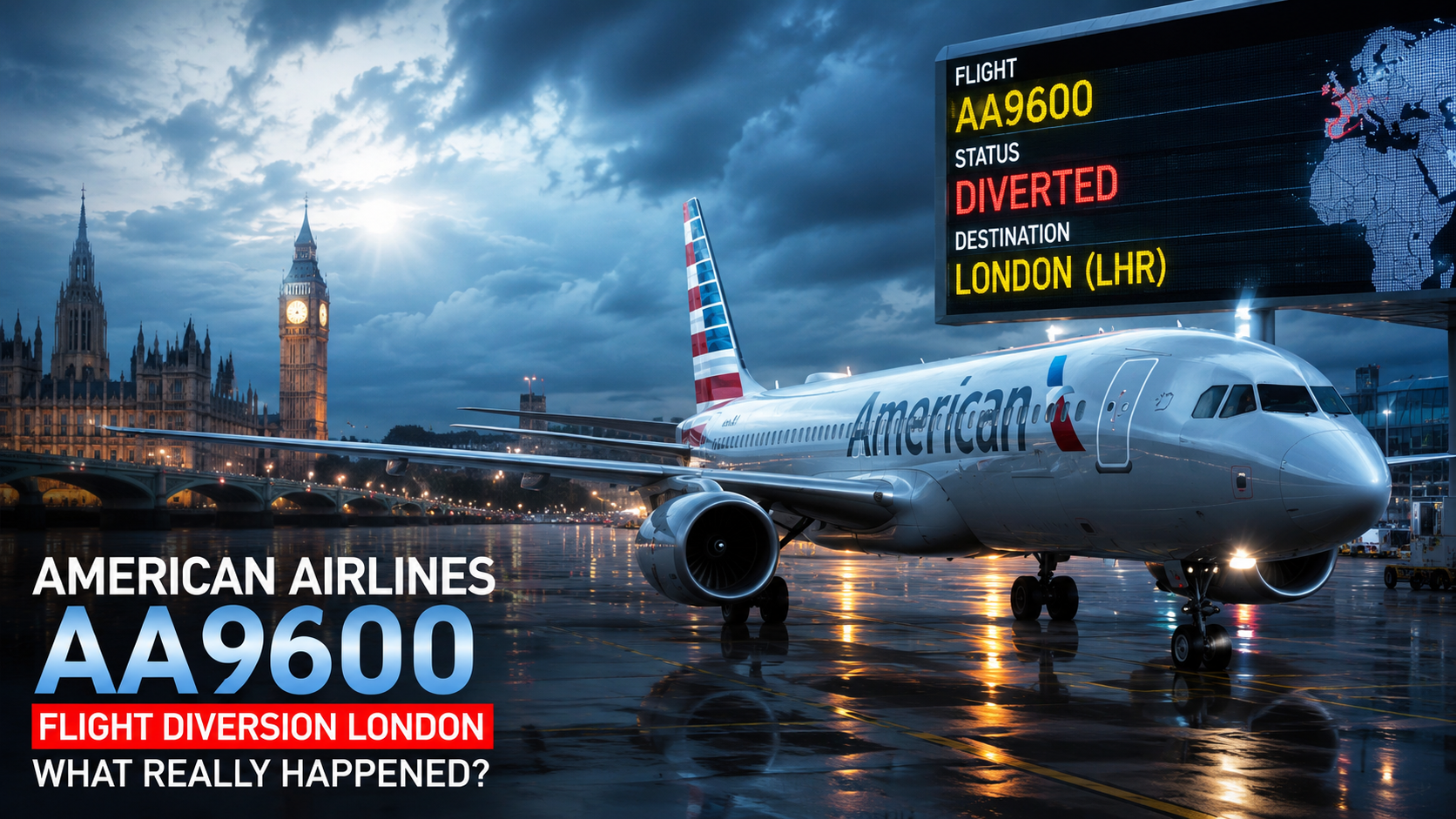
Imagine settling into your seat on a transatlantic flight, expecting an eight-hour journey across the Atlantic, only to find yourself landing in a completely different country. That’s exactly what happened to passengers aboard American Airlines flight AA9600 on November 2, 2025.
The Boeing 787-9 Dreamliner, operating a route from Rome’s Fiumicino Airport (FCO) to Philadelphia (PHL), turned back over Irish airspace just two hours into its journey. Instead of continuing west across the Atlantic, the aircraft made an unexpected landing at London Heathrow Airport (LHR). This article examines the events of that day, the likely causes, and how American Airlines responded to the situation .
Understanding Flight Diversions
Before dissecting the specifics of AA9600, it’s helpful to understand why flights sometimes divert from their planned routes.
What Is a Flight Diversion?
A flight diversion occurs when an aircraft is forced to land at an airport other than its intended destination. This differs from a “diversion” in air traffic control, where a plane might be rerouted to manage congestion. An operational diversion like AA9600’s is typically driven by safety, medical, or operational concerns .
Common Reasons for Diversions
Several factors can lead a pilot to change course:
-
Technical Issues: Mechanical or system malfunctions are a common cause. In the case of AA9600, unconfirmed reports suggest a technical problem prompted the return .
-
Medical Emergencies: If a passenger experiences a severe health issue mid-flight, the pilot may divert to the nearest suitable airport to get them urgent medical care.
-
Weather Conditions: Severe turbulence, storms, or volcanic ash clouds can force a change of plan.
-
Security Threats: Any perceived security risk on board would necessitate an immediate diversion.
The specific circumstances of AA9600 point towards a technical issue as the primary driver, though the airline has not publicly confirmed this .
The AA9600 Incident: A Timeline
The events of November 2, 2025, unfolded over several hours. Here is a detailed timeline based on available flight data and reports .
November 2, 2025: The Day of the Diversion
-
~11:00 AM (Local Time): The aircraft departs from Rome Fiumicino Airport (FCO) as scheduled, beginning its journey to Philadelphia.
-
~2 Hours After Takeoff: The Boeing 787-9 is over Irish airspace when it makes a U-turn and begins heading back east towards the United Kingdom. The decision to turn back so early in a transatlantic flight is significant, as it suggests the issue was serious enough to warrant not continuing over the ocean .
-
~3:00 PM (Local Time): The aircraft lands safely on runway 27L at London Heathrow Airport (LHR). This is approximately four hours after its initial departure from Rome .
-
Post-Landing: Passengers disembark at Heathrow. American Airlines begins the process of arranging an alternative flight to get them to their final destination in Philadelphia.
Key Location Data
| Location | Detail |
|---|---|
| Departure | Rome Fiumicino Airport (FCO), Italy |
| Diversion Point | Over Irish airspace |
| Diversion Airport | London Heathrow Airport (LHR), United Kingdom |
| Intended Destination | Philadelphia International Airport (PHL), USA |
Aircraft Details: The Boeing 787-9
The aircraft operating AA9600 was a Boeing 787-9 Dreamliner. This is a modern, long-haul aircraft known for its fuel efficiency and advanced technology. The type is frequently used on transatlantic routes like Rome to Philadelphia.
While specific details of this airframe are not public, it’s worth noting that American Airlines operates a large fleet of these aircraft. The 787-9 typically seats around 290 passengers in a three-class configuration.
American Airlines Response and Passenger Handling
Airlines have detailed procedures for managing irregular operations. After the safe landing at Heathrow, American Airlines moved quickly to re-accommodate affected passengers.
Securing an Alternative Flight
The airline arranged a replacement aircraft to continue the journey. This “ferry” flight departed from London Heathrow later that same day, around 3:53 PM local time, to minimize disruption for passengers heading to Philadelphia .
Communication and Compensation
When a flight diverts to an unscheduled destination, the airline is responsible for:
-
Providing information: Keeping passengers updated on the status of their onward journey.
-
Securing rebooking: Either on the replacement aircraft or on other airlines.
-
Arranging necessities: Providing meal vouchers and, if necessary, hotel accommodations for passengers who face an overnight delay.
In this instance, the rapid rebooking suggests American Airlines had contingency plans in place.
Analysis: Why Did the Flight Divert?
The airline did not immediately disclose the specific cause of the diversion, stating that they do so only after a full evaluation . This is standard practice for aviation incidents.
Technical or Mechanical Issue
The most widely cited speculation from aviation trackers is that a technical or mechanical issue was the cause. The decision to turn back over Ireland, rather than continue over the ocean, suggests the crew believed it was safer to be closer to a well-equipped maintenance base rather than press on across the Atlantic .
Safety as a Priority
Regardless of the specific cause, the pilot’s decision to divert demonstrates a commitment to safety. In aviation, this is known as a “safety-first” culture. The crew is trained to choose the safest option, even if it is the most inconvenient for passengers.
Similar Incidents and Context
Flight diversions, while alarming, are a routine part of aviation safety management. Major hubs like London Heathrow are frequently used as diversion airports for transatlantic flights because they have the facilities to handle large aircraft and large numbers of passengers.
What Happens to the Aircraft?
Once the aircraft lands and is assessed, it will either be repaired at the diversion airport or a replacement aircraft will be sent. The original aircraft may then be ferried (flown without passengers) to its intended destination or to a major maintenance base.
Frequently Asked Questions (FAQs)
What caused American Airlines flight AA9600 to divert to London?
While American Airlines did not officially confirm the reason, reports from the time suggest a technical or mechanical issue led the pilots to turn back from over the Atlantic as a safety precaution .
When did the AA9600 diversion happen?
The incident occurred on November 2, 2025, shortly after the flight departed from Rome.
Where did AA9600 land after the diversion?
The Boeing 787-9 landed safely at London Heathrow Airport (LHR) in the United Kingdom .
What type of aircraft was AA9600?
The aircraft operating the flight was a Boeing 787-9 Dreamliner .
How did American Airlines help passengers after the diversion?
American Airlines arranged a replacement flight from London Heathrow to Philadelphia later that same day, allowing passengers to continue their journey with minimal delay .
Did AA9600 have a medical emergency?
No reports from the time suggest a medical emergency; the focus was on a potential technical problem with the aircraft .
Why did the pilot turn back over Ireland instead of continuing?
The decision to turn back over Ireland, rather than continuing over the ocean, suggests the flight crew believed it was safer to return to a major maintenance hub (London) than to cross the Atlantic with an unresolved technical issue .
Was anyone injured during the AA9600 diversion?
There are no reports of injuries. The aircraft landed safely at Heathrow without incident .
Conclusion
The diversion of American Airlines flight AA9600 on November 2, 2025, serves as a powerful reminder of the safety-first approach that governs modern aviation. While inconvenient, the decision by the crew to turn back over Ireland and divert to London Heathrow was a precautionary measure designed to ensure the safety of everyone on board.
For passengers, the experience was no doubt unsettling. However, American Airlines’ swift response in securing a replacement aircraft demonstrates the industry’s ability to handle disruptions efficiently. The exact nature of the technical issue remains undisclosed, but the professionalism displayed by the crew and the airline’s operational response turned a potential crisis into a manageable logistical challenge.
About the Author