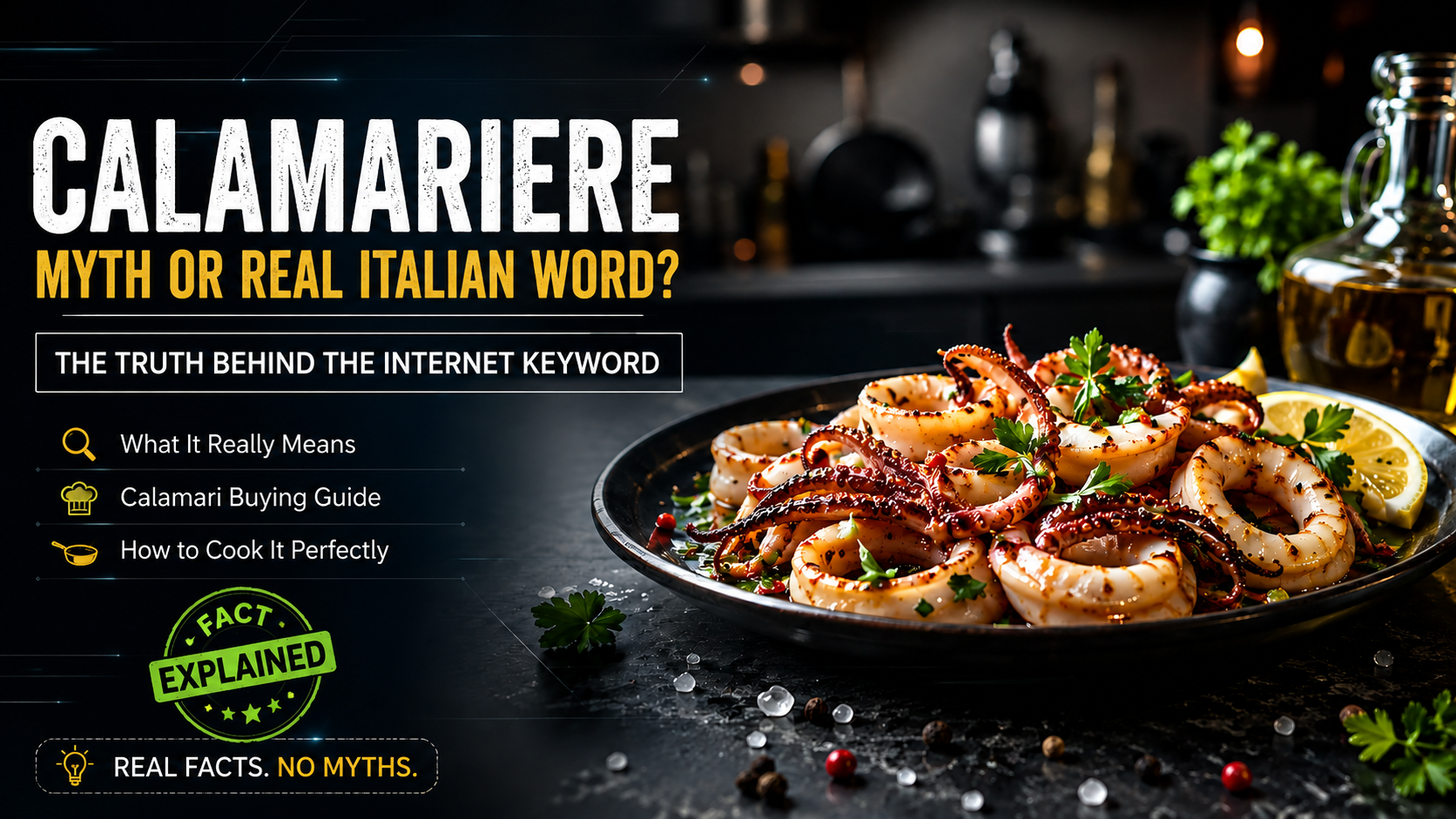
Calamariere: What the Word Actually Means (and How to Cook Great Calamari)
Type “calamariere” into Google and you’ll land on half a dozen articles claiming it’s an ancient Mediterranean dish with centuries of coastal heritage, or a prestigious chef title passed down through Sicilian families. None of that is true. It’s a word that started showing up online only recently, with no dictionary entry, no historical record, and no fixed meaning — and most of the pages “explaining” it were written to catch search traffic, not to inform anyone.
What this article actually delivers
You’ll get a straight answer on where “calamariere” came from and why it spread, plus something the word itself can’t give you: a real, usable guide to buying and cooking calamari — the actual Italian word for squid — so it comes out tender instead of rubbery.
Is “calamariere” a real word?
No. It doesn’t appear in Italian dictionaries, English dictionaries, or any classical culinary reference. It’s built from “calamaro” (Italian for squid) plus the suffix “-iere,” which in Italian usually marks a profession or specialist — the same pattern behind words like fruttivendolo (fruit seller) or, in French-influenced English, “sommelier” and “pâtissier.” That pattern makes “calamariere” sound like it should mean “squid specialist” or “squid chef,” even though no one actually uses it that way in Italy.
The most plausible explanation for its sudden appearance is simple: it’s a low-competition keyword. A word with no fixed meaning and no existing authoritative pages is easy to rank for, which is why a cluster of near-identical blog posts appeared within the same few months, each inventing its own “history” for the term — Roman-era origins, family recipes, a fictional culinary profession. None of these cite an actual source, because there isn’t one.
That’s worth knowing if you searched for a recipe, a restaurant term, or a job title and got confusing, contradictory answers. You’re not missing something — the word simply doesn’t have an established meaning yet.
What people are probably actually looking for: calamari
If you landed here wanting food information, you almost certainly mean calamari — squid, usually cleaned, sliced into rings or left as whole tubes, and cooked quickly. This part has a long, well-documented history in Mediterranean cooking, particularly in Italy, Greece, and Spain, where squid has been part of coastal diets for centuries.
Buying calamari
- Fresh vs. frozen: Most calamari sold at fish counters has already been frozen once, since squid is caught and processed at sea. That’s fine — squid freezes well. Avoid a second thaw-refreeze cycle, which is what actually causes mushy texture, not freezing itself.
- Size matters more than freshness for tenderness. Smaller squid (tubes under 3 inches) are naturally more tender and forgiving. Larger squid need either a very fast, hot cook or a long, slow braise — anything in between turns rubbery.
- Smell test: Fresh or properly thawed squid should smell faintly of the sea, not fishy or ammonia-like. A strong ammonia smell means it’s past its prime.
The two ways to cook squid without rubber bands
Squid protein tightens almost instantly with heat and turns tough within about 30–60 seconds past that point, then only relaxes again after a long, slow cook breaks the connective tissue down. There’s effectively no safe middle ground:
- Fast and hot (30–90 seconds): Rings or scored tubes in a screaming-hot pan or deep fryer, in small batches so the pan doesn’t cool down. Pull it the moment it turns opaque and curls slightly.
- Slow and low (45+ minutes): Braised in a tomato sauce, wine, or stew, where the same connective tissue that made it tough eventually breaks down and turns the squid tender again — this is how most Mediterranean stewed calamari dishes work.
Anything cooked for 3–15 minutes — the range home cooks land in most often when they’re distracted or unsure — is where rubbery calamari comes from almost every time.
Common mistakes
- Overcrowding the pan. Adding wet squid to a pan drops the temperature fast, and it starts steaming instead of searing — which pushes it straight into the rubbery zone. Cook in small batches.
- Skipping the pat-dry step. Excess moisture on the squid is the main cause of overcrowding-style steaming, even in an otherwise hot pan.
- Not scoring larger tubes. A shallow crosshatch cut on tubes over 3 inches helps heat penetrate faster and lets the tube curl attractively instead of seizing into a tight coil.
- Trusting a random blog’s “ancient history.” As covered above, several pages attach invented backstories to “calamariere” specifically. If a claim about squid’s history has no cited source, treat it as decorative writing, not fact.
FAQ
Is calamariere the same as calamari? No. Calamari is a real, established word for squid or squid dishes. Calamariere has no fixed or official meaning — it’s a recently coined internet term, sometimes used loosely to mean the same thing, sometimes invented as a fictional chef title.
Where does the word calamari come from? From the Italian word for squid, itself from “calamaio” (inkwell), a reference to the squid’s ink sac.
Why does calamari turn rubbery? Because squid protein tightens with heat almost instantly and only relaxes again after prolonged, slow cooking. Mid-length cooking times (a few minutes) hit it exactly when it’s toughest.
Can you eat the whole squid, including tentacles? Yes — tentacles are edible and popular in many preparations; only the beak, eyes, and internal cartilage (“pen”) are removed before cooking.
Is frozen calamari worse than fresh? Not meaningfully. Squid freezes and thaws well because of its texture; quality loss mainly comes from repeated freeze-thaw cycles or poor storage, not the initial freeze.
Is “calamariere” used in real Italian restaurants or kitchens? No verified usage exists in professional Italian kitchens or culinary schools. It does not appear in standard culinary glossaries.
Key takeaways
- “Calamariere” has no dictionary definition, no historical record, and no standard usage — it’s a modern internet term, not a traditional culinary word.
- What most searchers actually want is information about calamari (squid), which does have a long, real Mediterranean history.
- Squid cooks well only two ways: very fast and hot, or slow and low. The in-between range is what causes rubbery texture.
- Be skeptical of any article that gives “calamariere” a detailed backstory without citing a source — that history was very likely invented for the page you’re reading.
About the Author