Appearance of Filter Paper: Types, Features, and How to Identify Quality
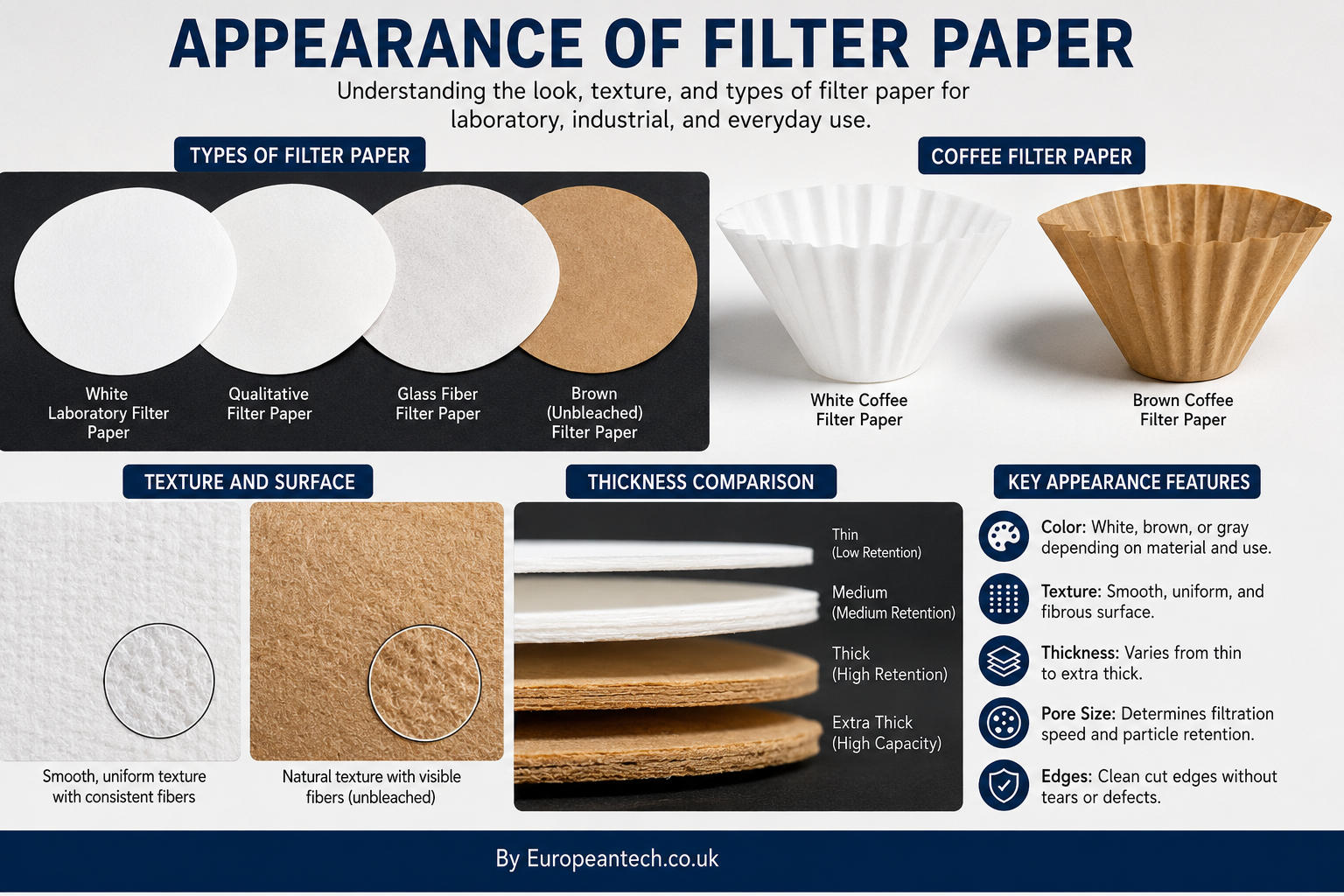
Filter paper may look like an ordinary sheet of paper, but its appearance reveals a great deal about its quality, purpose, and performance. Whether you’re working in a laboratory, brewing coffee, testing water samples, or conducting educational experiments, understanding the appearance of filter paper helps you choose the right product for the job.
The texture, thickness, color, pore size, and overall finish all influence how efficiently a filter paper separates solids from liquids. While many people focus only on filtration speed, visual characteristics often indicate important manufacturing qualities.
In this guide, you’ll learn what filter paper looks like, why its appearance varies, the different types available, how to evaluate quality, and the best applications for each.
Table of Contents
- What Is Filter Paper?
- Why the Appearance of Filter Paper Matters
- Main Characteristics of Filter Paper
- Color
- Texture
- Thickness
- Surface Finish
- Pore Size
- Types of Filter Paper
- Appearance of Laboratory Filter Paper
- Appearance of Coffee Filter Paper
- Appearance of Industrial Filter Paper
- Materials Used to Make Filter Paper
- How to Identify High-Quality Filter Paper
- Comparison Table
- Advantages and Limitations
- Common Applications
- Storage and Handling
- Frequently Asked Questions
- Conclusion
What Is Filter Paper?
Filter paper is a specially manufactured porous paper designed to separate solid particles from liquids or gases. Unlike ordinary writing paper, filter paper is produced from carefully processed cellulose fibers or specialized materials to achieve controlled pore sizes and consistent filtration performance.
Its appearance varies depending on its intended use, manufacturing process, and filtration grade.
Why the Appearance of Filter Paper Matters
The appearance of filter paper is not merely cosmetic.
It often indicates:
- Filtration efficiency
- Flow rate
- Fiber quality
- Manufacturing consistency
- Intended application
- Chemical purity
- Mechanical strength
Scientists, laboratory technicians, food manufacturers, and coffee enthusiasts often inspect filter paper visually before use.
Main Characteristics of Filter Paper
Color
The color of filter paper depends on the manufacturing process.
White Filter Paper
White filter paper is the most common variety.
Characteristics:
- Bright white
- Uniform color
- Bleached during production
- Clean appearance
- Common in laboratories
Applications:
- Chemical analysis
- Microbiology
- Pharmaceutical testing
- Food laboratories
Brown Filter Paper
Brown filter paper is generally unbleached.
Characteristics:
- Natural brown color
- Eco-friendly appearance
- No bleaching chemicals
- Popular for coffee brewing
Applications:
- Coffee filters
- Environmental testing
- Food preparation
Gray or Specialized Colors
Some industrial filter papers appear gray or slightly off-white due to:
- Synthetic fibers
- Glass microfiber
- Activated carbon
- Mixed filtration materials
Texture
Quality filter paper has a consistent texture.
Typical characteristics include:
- Smooth but porous
- Uniform fiber distribution
- No visible holes
- No wrinkles
- No clumps
Lower-quality filter paper may have:
- Uneven fibers
- Rough patches
- Weak spots
- Visible defects
Thickness
Filter paper ranges from extremely thin to very thick.
Thin papers:
- Faster filtration
- Smaller liquid capacity
- Used for rapid filtering
Thick papers:
- Stronger
- Better particle retention
- Higher liquid capacity
- Used for vacuum filtration
Surface Finish
Most filter papers have a matte finish rather than a glossy surface.
The surface should:
- Feel soft
- Have slight roughness
- Absorb liquid easily
- Maintain structural integrity when wet
Pore Size
Although pore size cannot usually be seen with the naked eye, it greatly affects performance.
Different pore sizes provide:
| Filtration Grade | Particle Retention | Typical Use |
|---|---|---|
| Coarse | Large particles | General filtration |
| Medium | Moderate particles | Routine laboratory work |
| Fine | Small particles | Analytical chemistry |
| Ultra-fine | Very small particles | Microbiological filtration |
Types of Filter Paper
Qualitative Filter Paper
Designed for general laboratory filtration.
Appearance:
- White
- Lightweight
- Soft texture
- Uniform surface
Uses:
- Student laboratories
- Chemical separation
- Educational experiments
Quantitative Filter Paper
Manufactured for precise laboratory analysis.
Appearance:
- Pure white
- Highly consistent
- Ashless after burning
- High manufacturing quality
Commonly used in:
- Gravimetric analysis
- Environmental testing
- Pharmaceutical research
Glass Fiber Filter Paper
Made from glass microfibers rather than cellulose.
Appearance:
- White to off-white
- Slightly thicker
- Fibrous texture
- More rigid
Advantages:
- High flow rate
- Excellent chemical resistance
- Heat resistant
Coffee Filter Paper
Designed specifically for brewing coffee.
Appearance:
- White or brown
- Cone or basket shape
- Lightweight
- Flexible
Brown versions are generally unbleached.
Industrial Filter Paper
Industrial filtration papers vary significantly.
They may appear:
- Thick
- Gray
- Cream-colored
- Reinforced
- Multi-layered
Applications include:
- Oil filtration
- Fuel systems
- Air filtration
- Manufacturing
Appearance of Laboratory Filter Paper
Laboratory-grade filter paper usually features:
- Bright white color
- Circular sheets
- Smooth edges
- Uniform thickness
- No visible contamination
- Clean fiber structure
Premium laboratory filter paper is manufactured under strict quality standards to ensure reproducible filtration performance.
Appearance of Coffee Filter Paper
Coffee filter papers are recognizable by their:
- Cone or basket shape
- Thin profile
- Soft feel
- High flexibility
- Even texture
Two common colors include:
| Color | Characteristics |
|---|---|
| White | Bleached, clean appearance |
| Brown | Unbleached, natural look |
The color itself does not necessarily determine brewing quality, though some users prefer unbleached filters for environmental reasons.
Appearance of Industrial Filter Paper
Industrial-grade filter paper often differs considerably from laboratory paper.
Characteristics include:
- Heavy construction
- Reinforced fibers
- Multi-layer design
- Higher durability
- Specialized coatings in some applications
These papers prioritize mechanical strength over appearance.
Materials Used to Make Filter Paper
Different raw materials influence both appearance and performance.
| Material | Appearance | Common Uses |
|---|---|---|
| Cellulose | White or brown | Laboratories, coffee |
| Cotton fibers | Soft white | High-quality filtration |
| Glass microfiber | White, fibrous | Laboratory analysis |
| Synthetic fibers | Gray or white | Industrial filtration |
| Mixed fibers | Varies | Specialized applications |
How to Identify High-Quality Filter Paper
Before purchasing or using filter paper, inspect the following:Uniform Color
Good filter paper has consistent coloration without dark spots or discoloration.
Even Thickness
High-quality paper maintains a uniform thickness throughout the sheet.
Clean Edges
Professionally manufactured filter paper has smooth, clean-cut edges.
Strong Wet Strength
Quality paper should resist tearing after absorbing liquid.
No Visible Defects
Avoid papers with:
- Holes
- Fiber clumps
- Wrinkles
- Tears
- Foreign particles
Comparison of Common Filter Paper Types
| Feature | Laboratory | Coffee | Industrial |
|---|---|---|---|
| Color | White | White/Brown | Gray/Cream |
| Thickness | Medium | Thin | Thick |
| Surface | Smooth | Soft | Reinforced |
| Strength | Moderate | Moderate | High |
| Precision | Excellent | Moderate | Application-specific |
| Primary Use | Scientific testing | Brewing | Manufacturing |
Advantages of Quality Filter Paper
| Pros | Details |
|---|---|
| Reliable filtration | Consistent particle retention |
| High purity | Suitable for sensitive analysis |
| Uniform appearance | Indicates manufacturing quality |
| Wide availability | Many grades and sizes |
| Easy handling | Lightweight and flexible |
Limitations
| Cons | Explanation |
|---|---|
| Single-use in many applications | Often discarded after filtration |
| Limited chemical compatibility | Cellulose may not suit all solvents |
| Fragility | Thin papers can tear when wet |
| Grade-specific | Wrong grade reduces filtration efficiency |
Common Applications
The appearance of filter paper differs slightly depending on its purpose.
Common uses include:
- Laboratory experiments
- Water quality testing
- Soil analysis
- Pharmaceutical production
- Food processing
- Coffee brewing
- Air filtration
- Oil filtration
- Educational demonstrations
- Environmental monitoring
Storage and Handling Tips
Proper storage preserves both appearance and performance.
Best practices include:
- Store in a dry location.
- Keep away from direct sunlight.
- Avoid excessive humidity.
- Protect from dust.
- Handle with clean hands or gloves in laboratory settings.
- Keep unused papers sealed in their original packaging.
Frequently Asked Questions
Does the color of filter paper affect filtration?
Generally, no. Color mainly reflects the manufacturing process, such as whether the paper is bleached or unbleached. Filtration performance depends on the paper’s grade, pore size, and material.
Why is some filter paper brown?
Brown filter paper is typically unbleached cellulose, giving it a natural appearance. It is commonly used in coffee brewing and applications where bleaching is unnecessary.
What does high-quality filter paper look like?
High-quality filter paper has a uniform color, consistent thickness, smooth edges, an even fiber structure, and no visible defects.
Is white filter paper always better?
Not necessarily. White filter paper is often bleached for cleanliness and analytical applications, while unbleached brown paper can perform equally well for many filtration tasks.
Can you reuse filter paper?
Most cellulose filter papers are intended for single use. However, some specialized industrial or synthetic filter media are designed for cleaning and reuse.
Why does laboratory filter paper appear brighter than coffee filters?
Laboratory-grade papers are commonly manufactured with high-purity bleached cellulose and strict quality controls, resulting in a brighter and more uniform appearance.
Does thicker filter paper filter better?
Thicker paper often has greater strength and particle-holding capacity, but filtration efficiency depends primarily on pore size and the specific filter grade rather than thickness alone.
Can damaged filter paper still be used?
Torn, punctured, or visibly defective filter paper should generally be replaced, as damage can allow particles to bypass the filtration medium and affect results.
How should filter paper be stored?
Store filter paper in a clean, dry environment, protected from moisture, dust, and direct sunlight to preserve its performance.
Is filter paper biodegradable?
Most cellulose-based filter papers are biodegradable under appropriate conditions, while papers made with synthetic or glass fibers may not be.
Conclusion
The appearance of filter paper provides valuable clues about its quality, composition, and intended use. Features such as color, texture, thickness, surface finish, and overall uniformity are more than visual details—they often reflect the paper’s filtration capabilities and manufacturing standards.
Whether you’re selecting filter paper for scientific research, coffee brewing, industrial processes, or educational experiments, understanding these characteristics helps you make an informed choice. Rather than relying on appearance alone, consider it alongside specifications such as filtration grade, pore size, chemical compatibility, and wet strength to ensure the best performance for your application.
Read Also: Y8: Free Online Games Platform Guide (2026)
About the Author