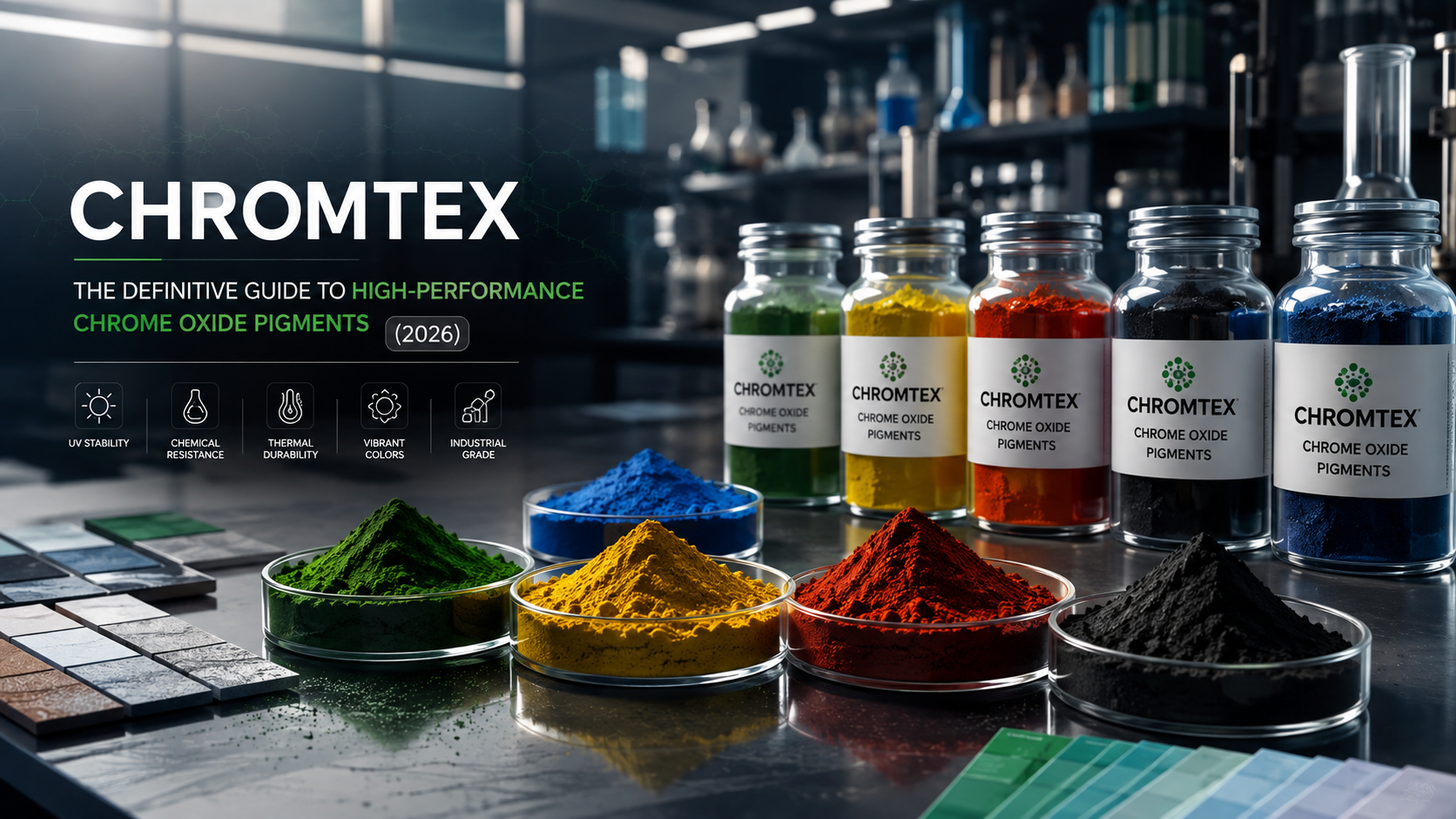
Introduction
Choosing the right pigment might seem like a minor detail, but if you work in industries like paints, plastics, or construction, you know it can make or break your product’s quality and longevity. You need pigments that deliver consistent color, withstand harsh conditions, and meet strict environmental regulations—all while being cost-effective.
Chromtex has emerged as a top-tier synthetic chrome oxide green pigment that addresses these demands. It’s engineered for superior performance, offering advantages in color intensity, durability, and environmental safety over standard chrome-based alternatives .
This guide explores Chromtex in detail—from what it is and how it’s made to its key features, real-world applications, and a clear comparison with standard chrome pigments.
Table of Contents
-
What is Chromtex?
-
Chromtex vs. Standard Chrome Pigments
-
Key Features and Benefits of Chromtex
-
Industrial Applications
-
Technical Specifications and Performance
-
Pros and Cons
-
Comparison Table
-
Frequently Asked Questions (FAQs)
-
Conclusion
What is Chromtex?
Chromtex is a high-performance synthetic chrome oxide green pigment, primarily composed of chromium(III) oxide (Cr₂O₃) . It’s known for its exceptional stability, vibrant color, and fine particle size.
While we don’t have access to the original patent or exact manufacturing specifics, research indicates that Chromtex is produced using advanced milling technologies. This process results in a pigment with a much finer particle size than standard chrome pigments . This is the key difference, because this fine milling is what gives Chromtex its practical advantages: richer color, better dispersion, and superior hiding power.
What Does This Mean for You?
-
Richer Color: Fine particles scatter and absorb light more effectively, creating deeper, more uniform shades .
-
Better Dispersion: Chromtex mixes evenly and smoothly in paints, plastics, and other materials, preventing clumps and inconsistencies that can ruin a product’s finish .
-
Superior Hiding Power: You need less pigment to achieve full, opaque coverage. This can lower your raw material costs and improve your production efficiency .
This combination of physical and chemical properties makes Chromtex a benchmark for quality and performance in demanding applications.
Chromtex vs. Standard Chrome Pigments
To appreciate Chromtex, it helps to understand how it differs from standard chrome pigments. Traditional chrome pigments include a broader range of inorganic colorants—such as chromium oxide greens, lead chromates, and other chromium compounds. Their quality and performance can vary widely .
Here’s a detailed comparison across the metrics that matter most:
Chemical Composition and Purity
-
Chromtex: A pure synthetic chrome oxide green (Cr₂O₃). It contains no heavy metals like lead, a significant environmental and health advantage .
-
Standard Chrome Pigments: This is a broad category, but many standard pigments, especially older yellow and orange varieties, are lead chromates. These contain toxic heavy metals and are heavily restricted in many regions due to regulations like REACH .
The Impact: Using Chromtex allows you to create safer products and ensures compliance with strict environmental and safety standards, making it a more responsible choice for manufacturers .
Color Intensity and Hiding Power
-
Chromtex: Known for its vibrant and consistent color, thanks to its fine milling. It also boasts excellent hiding power, meaning it covers surfaces effectively with minimal product .
-
Standard Chrome Pigments: Color vibrancy and hiding power can be inconsistent. You often need to use a larger quantity of pigment to achieve the same level of opacity and richness as Chromtex .
The Impact: Chromtex can lead to cost savings. You use less pigment to get the same or better visual result, which is a win for both your budget and your product’s aesthetics.
Dispersibility and Application
-
Chromtex: Disperses like a dream. Its fine particles mix evenly, reducing production hassles and ensuring a smooth, uniform finish in coatings and plastics .
-
Standard Chrome Pigments: Many standard pigments have coarser particles, which can lead to clumping, inconsistent color, and a poor finish. This adds extra steps and headaches during manufacturing .
The Impact: Good dispersion means less downtime, fewer defective batches, and a smoother production process.
Durability and Stability
-
Chromtex: As a synthetic chrome oxide green, it is exceptionally stable. It resists fading from UV light, chemical exposure, and weathering. It’s a “tough” pigment built for long-lasting color .
-
Standard Chrome Pigments: Pigments like lead chromates can be less resistant to fading and chemical attack, making them unsuitable for outdoor or harsh environment applications .
The Impact: Chromtex is the clear winner for products that must last, such as exterior architectural coatings or roofing materials. The color stays vibrant for years.
Key Verdict
For applications where color quality, durability, and safety are paramount, Chromtex is the superior choice. It is a more technologically advanced product designed for modern standards of performance and responsibility. While some standard chrome pigments may be cheaper upfront, they often come with hidden costs in performance, safety, and compliance.
Key Features and Benefits of Chromtex
Let’s summarize the core features and benefits that set Chromtex apart:
-
Superior Color Performance:
-
Feature: Finely milled chromium oxide green.
-
Benefit: Provides vibrant, rich, and exceptionally uniform color with high opacity, reducing the amount of pigment needed for complete coverage.
-
-
Exceptional Durability:
-
Feature: High chemical stability and UV resistance.
-
Benefit: Its color remains stable even when exposed to harsh weather, chemicals, and sunlight, making it ideal for demanding applications .
-
-
Excellent Dispersibility:
-
Feature: Ultra-fine and uniform particle size.
-
Benefit: Integrates smoothly into binders for paints, plastics, and coatings, preventing clumping and ensuring a flawless finish .
-
-
Environmental Safety:
-
Feature: Lead-free chemical composition.
-
Benefit: Aligns with strict environmental regulations, ensuring product safety and compliance with standards like REACH .
-
-
Consistent Quality:
-
Feature: Synthetic manufacturing process.
-
Benefit: Guarantees a consistent product batch after batch, eliminating the variability often associated with natural or coarser pigments .
-
Industrial Applications of Chromtex
Because of its robust profile, Chromtex is the go-to pigment in several key industries:
Paints, Coatings & Inks: Used in high-quality architectural coatings, industrial paints, primers, and fillers to provide excellent hiding power and a durable, vibrant color that withstands the elements .
Construction Materials: Essential for building facades, concrete roof tiles, pavers, and colored glass where lasting color and durability are non-negotiable . Its UV resistance is critical here.
Plastics & Polymers: Provides stable and brilliant green color to a wide variety of plastic products without degrading the material’s properties.
Ceramics & Glass: Its high heat stability makes it suitable for coloring ceramics and glass products that undergo high-temperature processing.
Technical Specifications and Performance
While the exact specifications of Chromtex can vary slightly by manufacturer, a standard high-performance chromium oxide green (like Chromtex) typically exhibits these properties:
-
Chemical Formula: Cr₂O₃
-
Color Index: Pigment Green 17 (PG17) / C.I. 77288
-
Particle Size: < 1 µm for its fine-grade variants
-
Heat Stability: Excellent, stable up to very high temperatures (often over 1000°C).
-
Solubility: Insoluble in water and common solvents.
-
Density: Approximately 5.2 g/cm³
Production Process: The synthesis involves reducing sodium dichromate with sulfur or carbon at high temperatures, followed by extensive milling and purification steps to achieve the signature fine particle size and purity of Chromtex. As noted, this intensive processing is where Chromtex gains its performance edge.
Pros and Cons of Chromtex
| Pros | Cons |
|---|---|
| Excellent color strength and hiding power due to its fine milling, reducing the amount needed . | Potentially higher cost than lower-quality, coarser pigments. |
| Superior durability and UV resistance, ensuring long-lasting color for outdoor applications . | Color range limited primarily to its distinct greenish hue. It’s not a “universal” colorant for all shades. |
| Environmentally safer as a lead-free chromium oxide green pigment . | Application-specific, not suitable for all coloring needs (e.g., if a different color or particle size is required). |
| Excellent dispersibility in various mediums, leading to a smooth, professional finish . | |
| Consistent quality and batch-to-batch color reliability . |
Comparison Table: Chromtex vs. Top Alternatives
| Feature | Chromtex | Standard Chrome Oxide Green (Coarse) | Organic Green Pigments (e.g., Phthalo Green) |
|---|---|---|---|
| Type | Synthetic Inorganic (Cr₂O₃) | Inorganic (Cr₂O₃) | Synthetic Organic |
| Particle Size | Very Fine | Coarse | Fine |
| Color Strength | High | Medium | Very High |
| Hiding Power | Excellent | Good | Variable |
| Weather/UV Resistance | Excellent | Very Good | Poor to Good |
| Heat Resistance | Exceptional | Excellent | Limited |
| Chemical Resistance | Excellent | Excellent | Variable |
| Dispersibility | Excellent | Fair | Good |
| Environmental Profile | Safe (Lead-free) | Safe (Lead-free) | Varies (May contain heavy metals or have higher toxicity in production) |
| Key Applications | High-end coatings, construction, durable plastics | General-purpose paints, inexpensive products | Paints, inks, plastics requiring high tinting strength, not for outdoor use |
Frequently Asked Questions
Q1: What exactly is Chromtex?
Chromtex is a high-grade, synthetic chrome oxide green pigment known for its fine particle size and superior performance in terms of color strength, durability, and environmental safety .
Q2: How does Chromtex differ from standard chrome oxide green?
The primary difference is particle size. Chromtex is milled to a much finer consistency than standard pigments. This gives it superior color intensity, hiding power, and dispersibility .
Q3: Is Chromtex environmentally friendly?
Yes, compared to many older chrome pigments, Chromtex is a purer, lead-free chromium oxide. Its composition makes it safer for use in finished products and helps companies comply with modern environmental regulations like REACH .
Q4: What are the main applications for Chromtex?
Chromtex is used extensively in high-quality paints and industrial coatings, durable construction materials (like roofing and facade products), plastics, and ceramics .
Q5: Is Chromtex more expensive than standard pigments?
Generally, yes. Its advanced manufacturing process makes it more expensive. However, its superior performance and efficiency often justify the cost, as you can use less pigment to achieve better results .
Q6: Can Chromtex be used for coloring plastics?
Yes, its excellent dispersibility and stability make it a great choice for coloring polymers, such as polypropylene (PP) and polyethylene (PE).
Q7: Is Chromtex resistant to UV light?
Yes, exceptional UV resistance is one of its key features. It resists fading when exposed to sunlight, making it ideal for exterior applications .
Q8: Does Chromtex contain lead?
No. Chromtex is a pure chromium oxide green pigment and does not contain toxic heavy metals like lead .
Q9: How should I handle Chromtex in an industrial setting?
While Chromtex is considered safe, it’s a fine powder and should be handled with standard industrial hygiene practices: wear a dust mask and safety glasses to avoid inhalation and eye contact. Follow your organization’s Material Safety Data Sheet (SDS) guidelines.
Q10: Can Chromtex be used in food-contact applications?
Due to its safety profile, certain grades of chromium oxide green are certified for use in some indirect food-contact applications. You should always verify the specific grade’s compliance with relevant regulations (e.g., FDA or EU food contact) before using it.
Conclusion
Chromtex represents a significant advancement in pigment technology. Its ultra-fine particle size translates into tangible benefits: stronger, more consistent color, better coverage, easier processing, and a safer environmental profile .
While you may pay a premium compared to standard pigments, the return on investment comes in the form of superior product quality, manufacturing efficiency, and regulatory peace of mind.
Practical Advice:
If you’re evaluating pigments for a new product or looking to upgrade an existing one, get a sample. Test its dispersibility, color strength, and durability against your current standard. The results will likely speak for themselves.
About the Author