Introduction
Imagine you are a passenger on a routine transatlantic flight, expecting a comfortable journey across the ocean in a modern wide-body aircraft. You settle in, the plane takes off, and you’re cruising at altitude over the Atlantic. Then, an announcement: the flight is diverting—you’re landing somewhere else, far from your intended destination, and you have no idea why.
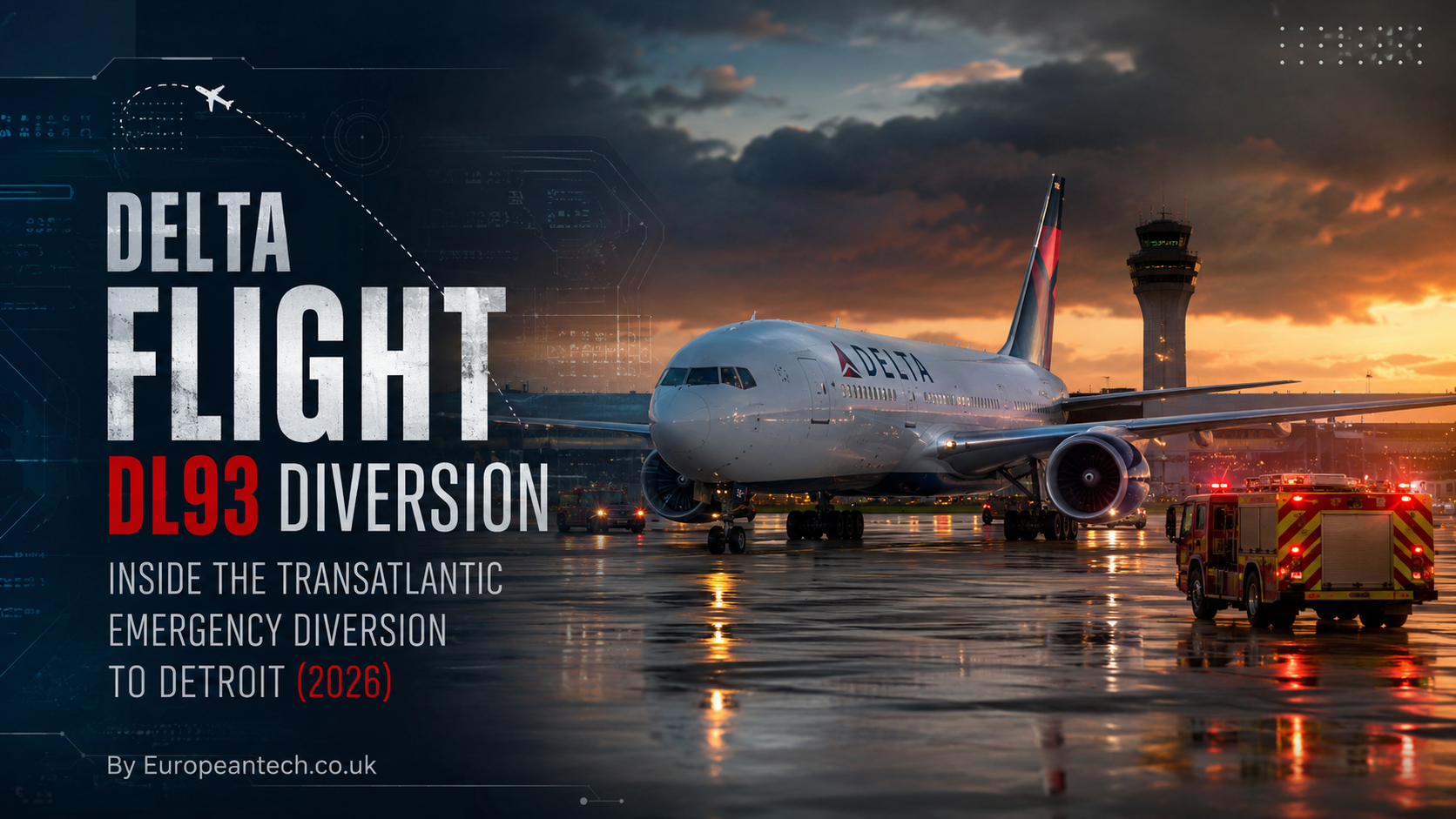
This was the reality for passengers aboard Delta Air Lines Flight DL93 on July 18, 2026.
The Delta Flight DL93 diversion was not just a minor inconvenience; it was a significant operational event involving a transatlantic crossing and an unscheduled landing in Detroit (DTW). While details of specific emergencies can be complex, this incident highlights the robust safety protocols airlines have in place to ensure passenger safety.
This article will explore what happened on Flight DL93, the reasons behind the diversion, and what it means for travelers. Let’s turn back the clock and analyze the event step-by-step.
Table of Contents
-
What Happened to Delta Flight DL93?
-
Why Did Flight DL93 Divert to Detroit (DTW)?
-
Timeline of Events: The Diversion
-
Understanding Transatlantic Diversions
-
The Aircraft: Boeing 767-300
-
Passenger Experience and Compensation
-
Comparison: DL93 vs. Other Diversions
-
Expert Analysis: What Makes a Diversion Necessary?
-
Frequently Asked Questions (FAQs)
-
Conclusion
What Happened to Delta Flight DL93?
On July 18, 2026, Delta Air Lines Flight DL93 was operating a scheduled service from Berlin Brandenburg Airport (BER) to New York John F. Kennedy International Airport (JFK) . This is a standard transatlantic route covering approximately 6,392 kilometers (3,970 miles) with an average flight time of about 8 hours and 41 minutes .
However, the flight never made it to New York.
Instead, the flight crew made the decision to divert the aircraft. According to flight tracking data, the plane was diverted and made a landing in Detroit, Michigan (DTW) .
The decision to land in Detroit took the aircraft significantly off its planned route, adding substantial time for the passengers already hours into their journey.
The Nature of the Emergency
While Delta Air Lines has not released the full specifics of the technical issue, historical data indicates that diversions of this nature on transatlantic routes are often precautionary measures. The Delta Flight DL93 diversion on July 18, 2026, was a safety-first decision, likely prompted by an issue that required the aircraft to land as soon as possible rather than continue over the ocean or proceed to the original destination in New York.
Why Did Flight DL93 Divert to Detroit (DTW)?
Transatlantic flights are governed by strict ETOPS (Extended-range Twin-engine Operational Performance Standards) regulations, which dictate how far twin-engine aircraft can fly from a suitable diversion airport. However, in the event of an emergency, a pilot is authorized to land at the nearest suitable airport.
Possible Reasons for the Diversion
While we await official confirmation from the FAA or Delta, transatlantic diversions are usually triggered by one of the following scenarios. Based on context and industry precedent (such as the incident with Flight DL43 in February 2025 where “smoke was detected in the galley” ), the most probable cause is a technical fault, often related to fumes or a mechanical issue.
-
Smoke in the Cabin or Galley: This is one of the most common reasons for emergency landings. In February 2025, a Delta flight (DL43) from LAX to Sydney returned to Los Angeles after smoke was detected in the galley . The pilots requested medical assistance for potential smoke inhalation, which is standard procedure in such situations .
-
Mechanical Failure: Mechanical faults can range from engine issues (single or dual, though dual-engine failure is extremely rare) to issues with electrical systems or hydraulics.
-
Medical Emergency: If a passenger has a life-threatening condition, pilots will often divert to the nearest airport to get them to a hospital quickly.
Given that the DL93 flight landed in Detroit on July 18, 2026, which is further west than the direct Berlin-to-New York route, it suggests the issue likely required a landing relatively soon after it was detected, possibly while crossing the North Atlantic .
A Look at Delta’s Diversion History
The DL93 incident is part of a broader pattern of Delta flights experiencing technical issues. In August 2025, Delta Flight 1893 safely landed at Austin-Bergstrom International Airport after a portion of the Boeing 737’s wing flap detached mid-flight . That incident involved a flap malfunction, which startled passengers on board .
Timeline of Events: The Diversion
Here is a concise timeline of what we know about the Delta Flight DL93 status:
-
Scheduled Departure (BER): 09:50 (Local Time) – July 18, 2026
-
Actual Departure (BER): 14:26 (Local Time) – July 18, 2026 (significant delay)
-
Diversion Decision: The flight was routed away from JFK during the cruise phase of the flight.
-
Landing (DTW): The aircraft touched down at Detroit Metropolitan Wayne County Airport.
-
Cancellation (JFK): The leg from Detroit to JFK was later canceled .
On July 19, 2026 (the following day), the flight status was recorded as “Cancelled” for the direct BER-JFK leg .
Understanding Transatlantic Diversions
When a flight diverts, pilots are trained to land at the “most suitable airport.” This takes into account several factors:
-
Location: What airports are within range based on the current fuel load and aircraft position?
-
Weather: Does the airport have acceptable weather conditions for landing?
-
Runway Length: Can the aircraft safely land and stop on the available runway?
-
Emergency Services: What level of fire and medical support is available on the ground?
Detroit is a major Delta hub, meaning that if the aircraft lands in Detroit, the airline has maintenance, crew, and logistical support readily available to handle repairs, rebook passengers, and get the plane back in service.
ETOPS Considerations
ETOPS rules are crucial for transatlantic flights. These regulations ensure that twin-engine aircraft like the Boeing 767-300 (used on the DL93 route) are always within a certain flight time (usually 60, 120, 180, or 240 minutes) of a viable diversion airport.
The Aircraft: Boeing 767-300
The aircraft operating Flight DL93 on July 18, 2026, was a Boeing 767-300 (winglets) Passenger .
-
Range: Approximately 5,200 – 6,400 nautical miles.
-
Capacity: Typically 200-240 passengers depending on configuration.
-
Role: Wide-body twin-engine jet used primarily for long-haul routes.
The B767 is a reliable aircraft type that has been flying since the 1980s. However, it’s older than newer models like the 787 Dreamliner or A350, and as with any machine, mechanical issues or technical faults can occasionally arise despite rigorous maintenance schedules.
Passenger Experience and Compensation
When a flight is diverted, passengers may be entitled to compensation depending on the reason for the diversion and the regulations governing the airline.
-
EU Regulation 261/2004: Since the flight departed from Berlin (an EU airport), this regulation applies. If the cause of the diversion was within the airline’s control (e.g., mechanical issues, crew scheduling), passengers are entitled to compensation (up to €600) plus duty of care (food, accommodation, communication).
-
Exclusions: If the diversion is caused by “extraordinary circumstances” (e.g., severe weather, air traffic control strikes, or security risks), compensation may not be payable.
Duty of Care
Even if compensation is not provided, Delta has a duty of care to its passengers. This includes:
-
Meals and Refreshments: Vouchers or supplies.
-
Accommodation: Hotel rooms if a new overnight stay is required.
-
Transportation: Transport to/from the airport/hotel.
-
Re-booking: Rebooking passengers on alternative flights to their final destination.
Given that the flight landed in Detroit and the onward leg to JFK was canceled , Delta likely provided accommodation in Detroit and rebooked passengers on the next available flights to New York.
Comparison: DL93 vs. Other Diversions
While the DL93 diversion was significant, it is not the only incident. Let’s look at a comparison table of recent Delta diversions to understand the scale and variety of issues:
| Flight Number | Date | Route | Incident Summary |
|---|---|---|---|
| DL93 | July 18, 2026 | Berlin (BER) -> JFK | Diverted to Detroit (DTW) due to an operational or technical issue. Onward leg canceled. |
| DL1893 | August 19, 2025 | Orlando -> Austin | Wing flap partially detached mid-flight; plane landed safely . |
| DL43 | February 22, 2025 | LAX -> Sydney | Smoke detected in the galley; returned to LAX . |
Note: There is a presentation online titled “Flight DL93: Pacifico Disaster” that describes a fictional catastrophic crash involving a diversion to the Pacific . This is a work of fiction or a simulation. The real DL93 operates between Berlin and New York (and sometimes LAX-Brisbane) and the 2026 event was a diversion, not a “disaster” as the fictional account suggests.
Expert Analysis: What Makes a Diversion Necessary?
In aviation, safety is the number one priority. When a pilot chooses to divert, they are following the “Better safe than sorry” philosophy.
-
Procedural Nature: Diversions are a normal part of aviation operations. They happen daily across the globe.
-
No Such Thing as “Minor” Issues on a Long-Haul: What might be a minor maintenance issue on the ground can become a serious threat at 35,000 feet.
-
Passenger Safety: The decision to divert is almost always driven by a perceived threat to safety. Even a smell of “smoke” (which often is an electrical fault or overheated component) is enough to trigger a landing.
Frequently Asked Questions (FAQs)
Q: What is Flight DL93?
Flight DL93 is a Delta Air Lines flight that usually operates between Berlin Brandenburg Airport (BER) in Germany and New York John F. Kennedy International Airport (JFK) in the USA . However, the flight number “DL93” has also been used for the Los Angeles (LAX) to Brisbane (BNE) route in the past .
Q: What happened to Delta Flight DL93 on July 18, 2026?
On this date, Delta Flight DL93 diverted to Detroit (DTW) while traveling from Berlin (BER) to New York (JFK). While Delta has not disclosed the specific cause, the diversion was likely due to a technical issue or safety precaution .
Q: Is the “Pacifico Disaster” story about Delta Flight DL93 real?
No. There is a fictional presentation circulating online about a “Flight DL93: Pacifico Disaster” which is an imaginative scenario describing a crash in the Pacific Ocean . This is not a real event. The real DL93 operates across the Atlantic and diverted to Detroit in 2026, not crashed.
Q: Was anyone hurt on Flight DL93 on July 18, 2026?
Based on available flight data and news reports, there are no reports of injuries associated with the DL93 diversion to Detroit on July 18, 2026 .
Q: How long is Flight DL93 from Berlin to New York?
The average flight time for Delta Flight DL93 from Berlin (BER) to New York (JFK) is approximately 8 hours and 41 minutes . The distance is about 6,392 kilometers.
Q: Why is Detroit a diversion airport for flights to New York?
Detroit is a major hub for Delta Air Lines. If an aircraft diverts there, the airline has access to a large maintenance facility, spare parts, and plenty of crew, making it easier to fix the aircraft and rebook passengers.
Q: What kind of plane is Flight DL93?
Delta Flight DL93 is typically operated by a Boeing 767-300 (with winglets) aircraft, which is a wide-body twin-engine jet used for long-haul international flights .
Q: What does “diverted” mean on a flight status?
A “diversion” means the flight has changed its destination while in the air. Instead of landing at the planned destination, the pilot has decided to land at a different airport, usually due to an emergency, weather, or other unforeseen circumstances.
Q: Why are smoke incidents so common on flights?
Smoke in a cabin or galley is often caused by an electrical fault, a malfunctioning air conditioning pack, or an overheated oven in the galley. These are taken very seriously because smoke can quickly turn into a fire.
Q: Are passengers compensated if a flight diverts to another city?
Passengers on flights departing from the EU (like Berlin) are protected by EU Regulation 261/2004. If the diversion is due to technical issues (within the airline’s control), you may be entitled to compensation of up to €600 plus meals, accommodation, and rebooking.
Conclusion
The Delta Flight DL93 diversion to Detroit on July 18, 2026, serves as a reminder of how seriously the aviation industry takes safety. While inconvenient and undoubtedly frustrating for the passengers onboard, the decision to land in Detroit rather than continue to New York was a textbook example of “better safe than sorry.”
The incident highlights the rigorous training pilots undergo to handle technical faults and the importance of ETOPS regulations that ensure aircraft always have a viable diversion option. Moreover, it demonstrates the robust support system in place at major airline hubs to handle emergencies swiftly.
About the Author