Google Gemini Intelligence + Android 17 (2026) – Complete Official Guide, Release Date, Features, AI Tools, Devices, Security, Android Auto & Full Ecosystem Breakdown
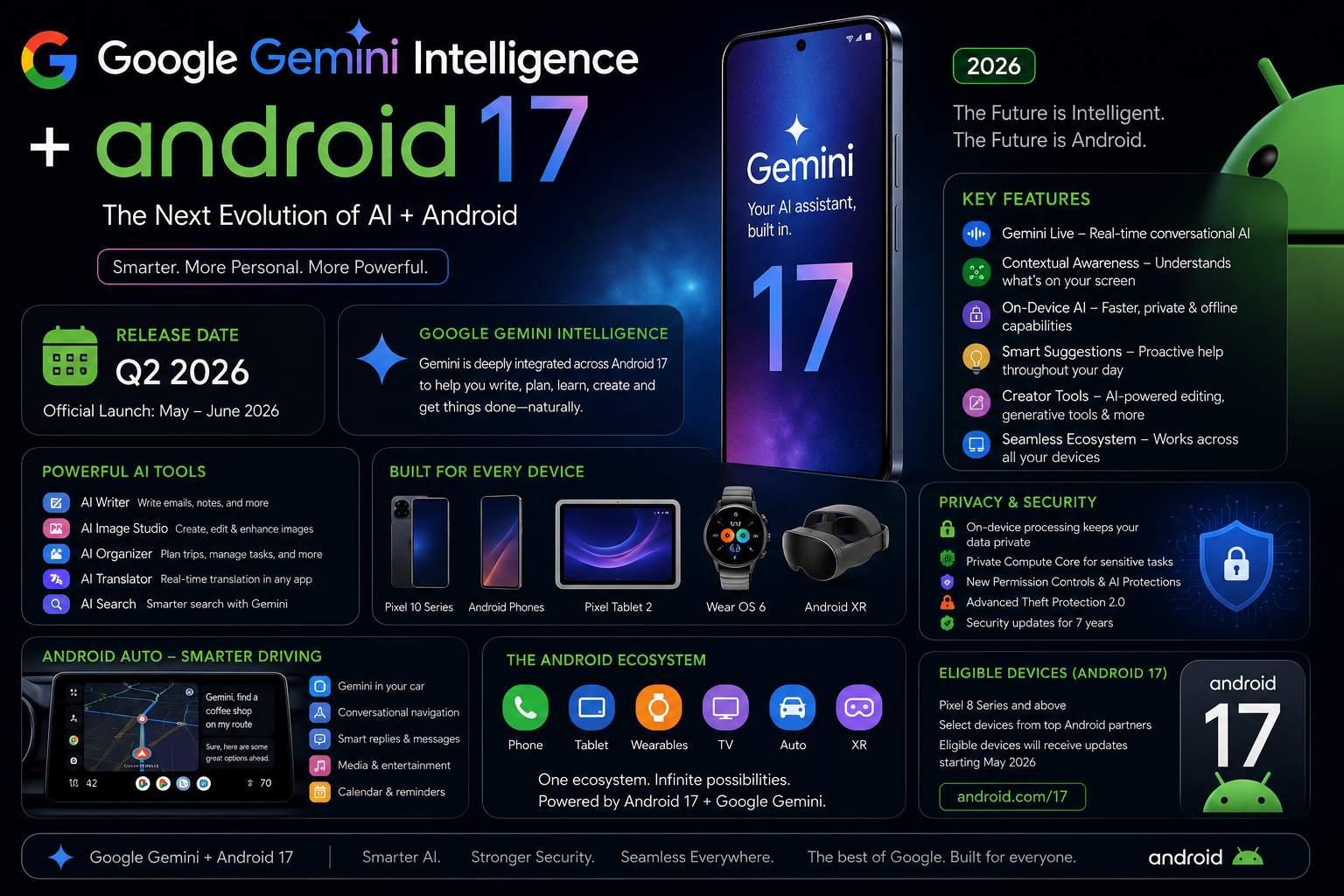
Table of Contents
ToggleIntroduction: Google’s Biggest Android Transformation Yet
In 2026, Google is not simply launching another Android update—it is reshaping Android into a full AI-powered operating ecosystem through Gemini Intelligence + Android 17.
This marks one of the most important software transitions in Android history, potentially comparable to:
- Android’s original launch
- Material Design
- Google Assistant
- Tensor AI chips
Android 17 is the platform, but Gemini Intelligence is the core product.
Together, they introduce:
- System-wide AI
- Agentic task execution
- AI-generated widgets
- Advanced voice intelligence
- Scam prevention
- Cross-device productivity
- Googlebook ecosystem
- Android Auto transformation
Basic Overview
| Category | Details |
|---|---|
| Full Name | Google Gemini Intelligence + Android 17 |
| Developer | |
| Parent Company | Alphabet |
| Launch Reveal | Android Show: I/O Edition (May 12, 2026) |
| Main Event Expansion | Google I/O 2026 (May 19–20) |
| Android Version | Android 17 |
| Internal Codename | Cinnamon Bun |
| Main Focus | AI-first mobile & ecosystem OS |
| Core Technology | Gemini AI |
| Stable Release | Expected June 2026 |
| Device Rollout | Mid to Late 2026 |
| Key Innovation | Task-based AI operating system |
What Is Gemini Intelligence?
Definition:
Gemini Intelligence is Google’s system-level AI layer built directly into Android 17.
Unlike earlier Gemini integrations that worked mostly as apps or assistants, Gemini Intelligence becomes part of:
- Home screen
- Widgets
- Notifications
- Settings
- Chrome
- Android Auto
- Productivity tools
- Security systems
Core Philosophy:
Previous Android:
Open apps → Complete tasks manually
Android 17:
Tell Gemini what you want → AI helps complete tasks
Example:
Instead of:
- Open weather
- Open calendar
- Open maps
- Open reminders
You can say:
“Plan my day, avoid rain, remind me of my meeting, and find the fastest route.”
Gemini Intelligence aims to manage this workflow automatically.
Android 17 Release Date & Rollout Timeline
Confirmed Development Timeline:
| Stage | Date |
|---|---|
| Developer Preview | January 2026 |
| Beta 1 | February 13, 2026 |
| Beta 2 | February 26, 2026 |
| Beta 3 (Platform Stability) | March 26, 2026 |
| Beta 4 | April 16, 2026 |
| Android Show Reveal | May 12, 2026 |
| Stable Public Launch | June 2026 (Expected) |
| OEM Rollout | Q3–Q4 2026 |
Major Android 17 Features
1. Gemini Intelligence (System-Wide AI)
This is Android 17’s headline innovation.
Key Functions:
Personal Task AI:
- Multi-step commands
- Smart reminders
- Cross-app planning
- AI scheduling
- Email summarization
- Form assistance
Productivity:
- Writing help
- Research support
- Smart recommendations
- Contextual app actions
2. Create My Widget (AI Widget Builder)
What It Is:
A natural-language widget generation tool.
User examples:
- “Make a cricket + prayer time widget”
- “Create a student dashboard”
- “Build a travel widget with maps and flights”
Benefits:
- No manual widget setup
- Personalized dashboard creation
- Better Android customization
3. Rambler Voice Engine
Google’s next-gen multilingual AI dictation system.
Improvements:
Better:
- Voice recognition
- Accent handling
- Urdu/Hindi code-switching
- Punctuation
- Real-time correction
- Command precision
Why It Matters:
Rambler may become essential for:
- Students
- Journalists
- Business users
- Accessibility
4. Android Auto 2026 Revolution
Android Auto receives one of its largest upgrades ever.
New Features:
Gemini Driver Assistant:
- Real-time route suggestions
- Message handling
- Voice commands
- Smart stops
- Calendar sync
New UI:
- 3D Maps
- Widgets
- Better screen adaptation
- Vehicle app integration
- Entertainment options
5. Security & Scam Defense
Android 17 heavily expands anti-fraud systems.
New Tools:
Scam Detection:
- Fraudulent call analysis
- Banking scam alerts
- Fake app warnings
- APK risk scanning
Theft Protection:
- Mark as Lost
- Remote biometric lock
- Identity verification
Why This Matters:
Google is treating Android security as a competitive advantage.
6. iPhone to Android Migration Upgrade
Google is aggressively targeting switchers.
Easier Transfer:
- Passwords
- Apps
- Home screen
- Messages
- eSIM
- Photos
Design & User Interface Changes
New UI Style:
Expected:
- Frosted-glass visuals
- Dynamic transparency
- New icon behavior
- Adaptive layouts
- Foldable optimization
- Tablet-first scaling
Gemini Across Google’s Ecosystem
Gemini Intelligence is expanding to:
Mobile:
- Pixel
- Samsung
- Xiaomi
- OPPO
- Honor
Other Devices:
- Tablets
- Foldables
- Android Auto
- Chrome
- Googlebook laptops
- Wearables (expected)
Googlebook: A New AI Laptop Push
Googlebook could become Google’s answer to AI-first computing.
Rumored Focus:
- ChromeOS + Android synergy
- Gemini-native workflow
- AI productivity suite
- Student + enterprise devices
Supported Devices (Expected)
Pixel:
- Pixel 6+
- Pixel Fold
- Pixel Tablet
Samsung:
- Galaxy S24+
- Galaxy Z Fold/Flip
- New flagship devices
Others:
- Xiaomi
- Honor
- OPPO
- OnePlus (likely)
Android 17 vs Android 16
| Feature | Android 16 | Android 17 |
|---|---|---|
| AI | Gemini app | Gemini Intelligence OS-wide |
| Widgets | Manual | AI-generated |
| Voice | Standard Assistant | Rambler AI |
| Security | Traditional | Scam + theft intelligence |
| Android Auto | Improved | Full AI redesign |
| Ecosystem | Device-centric | Cross-device AI |
Business Strategy: Why Google Is Doing This
Competitive Goals:
Against Apple:
- Broader AI ecosystem
- Easier switching
- More customization
Against Microsoft/OpenAI:
- Mobile-first AI
- Hardware integration
- Consumer reach
Against Samsung:
- Google retains Android leadership
Strengths
Biggest Wins:
Users:
- More personalization
- Better productivity
- Enhanced security
- Smarter devices
Google:
- Ecosystem lock-in
- More Gemini adoption
- Stronger AI monetization
Risks & Concerns
Potential Issues:
Privacy:
- More data dependency
- AI behavior concerns
Battery:
- AI workload impact
Fragmentation:
- OEM update delays
Feature Gating:
- Pixel-first exclusives
Who Should Upgrade?
Best For:
Power Users:
- Productivity
- AI workflows
- Android Auto users
Creators:
- Voice
- Widgets
- Automation
iPhone Switchers:
- Easier migration
Who May Wait?
Consider waiting if:
- Older hardware
- Privacy concerns
- Battery priority
- Minimal AI use
Community Reactions (Early)
Positive:
- “Most exciting Android update in years”
- “Gemini feels like real Android evolution”
Concerns:
- Too much AI
- Data/privacy
- Feature fragmentation
Final Verdict
Android 17 + Gemini Intelligence Is Not Just an OS Update
It is Google’s attempt to transform Android into:
“Your AI-powered personal operating system.”
About the Author




1 thought on “Google Gemini Intelligence + Android 17 (2026) – Complete Official Guide, Release Date, Features, AI Tools, Devices, Security, Android Auto & Full Ecosystem Breakdown”