Introduction
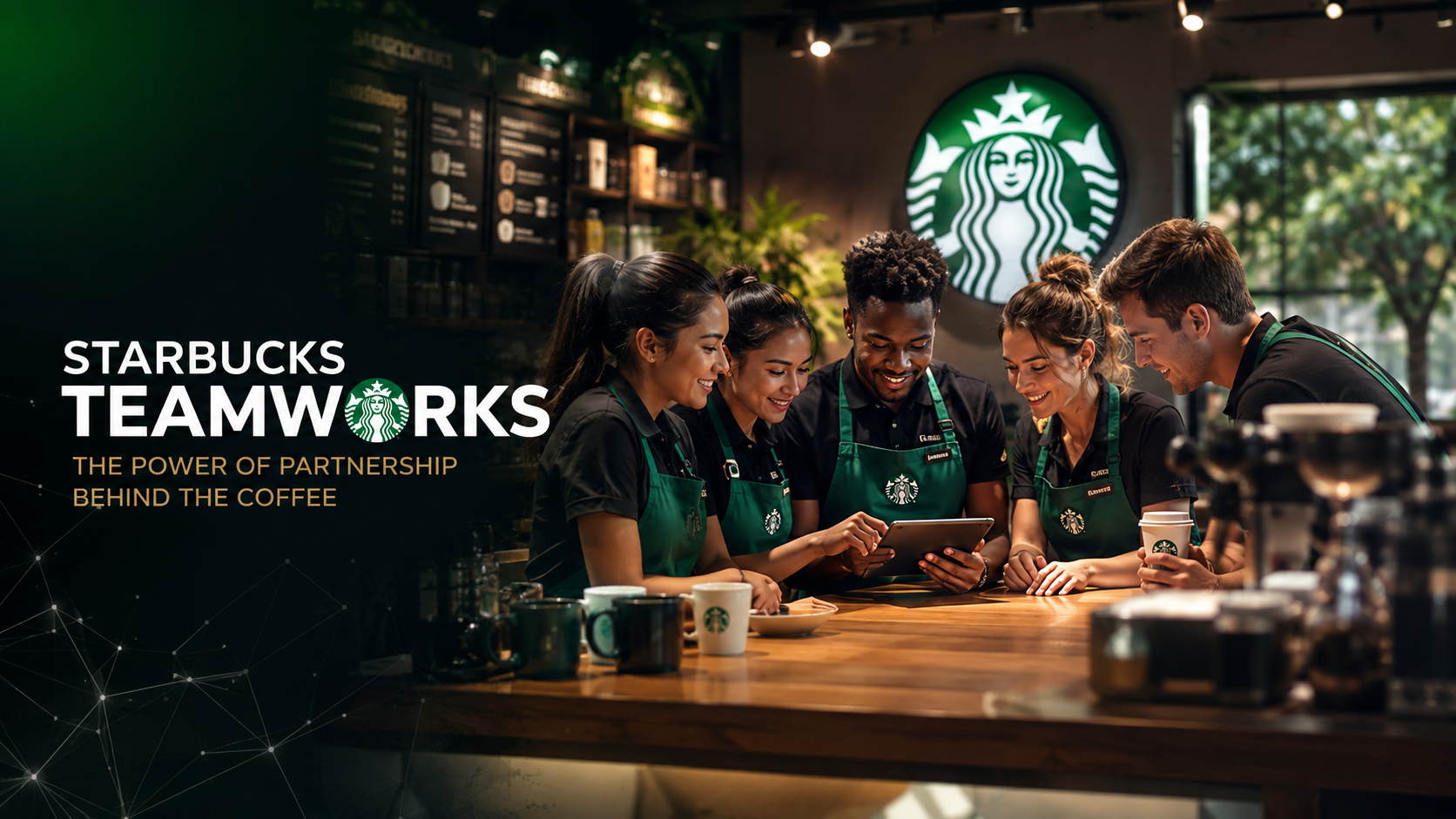
Walk into any Starbucks, and you will notice something beyond the aroma of freshly roasted coffee. The barista who remembers your name, the supervisor who handles a sudden rush with calm precision, and the store manager who ensures everything runs smoothly are not just employees. They are “partners.”
This single word reveals a fundamental truth about the company: Starbucks is built on teamwork. The company’s global success is not a product of its coffee alone but of a deeply ingrained culture of collaboration that extends from the espresso machine to the boardroom .
In 2025, this culture is being tested and reshaped as Starbucks implements significant operational changes. This article explores the evolution of Starbucks teamworks—what it means, how it is changing, and what it reveals about the future of work in the fast-paced retail world.
Table of Contents
-
What Is Starbucks Teamworks? Understanding the “Partner” Culture
-
The Evolution of Teamwork: The “Project Sailing” (Qihang) Initiative
-
Why Starbucks Is Changing Its Operations
-
Key Features of the New Multi-Store Community (MSC) Model
-
Benefits of the New Model: Efficiency and Opportunity
-
Drawbacks and Challenges: The Human Cost of Efficiency
-
Comparison with Competitors: How Starbucks Teamworks Stacks Up
-
Pros and Cons at a Glance
-
Frequently Asked Questions
-
Conclusion: The Future of Starbucks Teamworks
What Is Starbucks Teamworks? Understanding the “Partner” Culture
At its core, “Starbucks teamworks” refers to the company’s comprehensive philosophy of collaboration. It is not merely a buzzword but a foundational operational principle.
The “Partner” Ethos
Starbucks refers to all its employees as “partners.” This is more than a semantic choice. It reflects a commitment to shared success. The company invests in its workforce through health benefits, stock options (Bean Stock), and career development programs . The idea is simple: when partners feel valued and invested in, they are motivated to work together to create a welcoming environment for customers.
This internal teamwork is crucial. Baristas collaborate with supervisors, store managers support their teams, and regional leaders provide guidance. The goal is consistent quality service and the creation of a “third place”—a comfortable space between home and work.
Teamworks in Practice
The results of this culture are visible in every well-run store. Partners cover for each other during peak hours, share knowledge about new beverages, and collectively solve problems. Recent examples from Starbucks India highlight this spirit. The launch of “All Women Stores” demonstrates how teamwork can address social goals. These stores, run entirely by women partners, contribute proceeds to support girl education in rural communities .
Furthermore, the expansion of Starbucks globally is a testament to both internal collaboration and external partnerships. Licensing agreements with grocery stores and collaborations with organizations have extended the brand’s reach .
The Evolution of Teamwork: The “Project Sailing” (Qihang) Initiative
Starting in January 2025, Starbucks China introduced a major operational shift called “Project Sailing” (Qihang) . This initiative marks the most significant change to the Starbucks teamworks model in recent history.
From Single-Store to Multi-Store Communities
Historically, each Starbucks store operated as an independent unit managed by a single store manager. Project Sailing changes this by grouping certain stores into Multi-Store Communities (MSC) .
In this model, one Senior Store Manager (SM-2) is responsible for managing two stores simultaneously. The goal is to achieve a “1+1>2” effect by sharing resources, coordinating staff, and optimizing operations across locations .
This is not a universal mandate but a strategic choice. Starbucks selects stores for this model based on factors like proximity, complementary peak hours, and customer demographics. For instance, if two neighboring stores have different rush periods, a single manager can deploy staff between them to improve coverage and efficiency.
New Roles and Opportunities
Project Sailing introduces new career pathways:
-
Senior Store Manager (SM-2): A new promotion level between store manager and district manager. These leaders manage either a Multi-Store Community or a high-complexity single store .
-
Increased Shift Supervisor Roles: More supervisory positions are created to support the multi-store structure, offering more promotion opportunities for baristas .
Why Starbucks Is Changing Its Operations
The introduction of this new model is a response to pressing challenges in the China market—one of Starbucks’s most crucial regions.
Competitive Pressure
The Chinese coffee market has become fiercely competitive. Brands like Luckin Coffee and Cotti Coffee have introduced a price war, with beverages regularly priced at 9.9 yuan or 6.9 yuan, significantly undercutting Starbucks’s premium pricing . This has forced consumers to become more price-conscious.
Revenue and Traffic Challenges
Starbucks’s 2024 fiscal data reveals the urgency. In the fourth quarter, global comparable store sales declined by 7%, with China seeing a 14% decline in comparable store sales . The “affordable luxury” perception of Starbucks is eroding as coffee becomes a daily necessity rather than a treat.
Rising Operational Costs
Rent and labor costs have put pressure on profitability. The new multi-store model is an attempt to improve “people efficiency” . By enabling one manager to oversee two locations, the company can streamline management layers and potentially control costs. This is similar to strategies already adopted by Yum China, which has allowed store managers to oversee multiple locations .
Key Features of the New Multi-Store Community (MSC) Model
The shift to Multi-Store Communities is the centerpiece of the operational change. Here are its defining features:
-
Dual-Store Management: A single Senior Store Manager oversees two physical locations.
-
Dynamic Resource Allocation: Staff can be flexibly scheduled between the two stores based on demand.
-
New Senior Store Manager (SM-2) Role: This role comes with a new set of responsibilities and a modified compensation structure.
-
Enhanced Training Systems: To support the model, Starbucks is updating its training with programs like the “Star Project” for high-potential shift supervisors and a revamped “Excellent Leader” training system for managers .
-
Digital Enablement: Starbucks is leveraging technology to make the model work. AI insights, AI interviews, AI coaching, and automated ordering systems are being deployed to reduce the administrative burden on store leaders .
Benefits of the New Model: Efficiency and Opportunity
Proponents of the new Starbucks teamworks model point to several advantages.
Operational Efficiency
The primary benefit is improved efficiency. By having a single management point for two stores, the company can reduce duplication of managerial tasks. This is particularly useful in areas with lower traffic where a full-time manager for a single store might be underutilized.
Promotion Opportunities
Starbucks claims the model creates more than 1,000 additional promotion opportunities . In 2024 alone, nearly 6,400 partners were promoted. The new structure adds new leadership roles that ambitious partners can aspire to. Senior Store Managers are compensated with a higher salary, recognizing their increased responsibility .
Customer Experience Consistency
In theory, having a single manager oversee two nearby stores can create a more consistent customer experience across locations. The manager can ensure that standards are uniform and that best practices are shared.
Testing and Validation
Starbucks has stated that the model was piloted in selected stores for months before the official launch. The company reported that partners in the test stores showed improved morale and motivation . This suggests that, under the right conditions, the model can work.
Drawbacks and Challenges: The Human Cost of Efficiency
Despite the official optimism, the implementation of the multi-store model has raised significant concerns, particularly regarding its impact on employees—the very “partners” Starbucks claims to value.
The “One-Takes-Two” Dilemma
Industry insiders refer to this management model as “one takes two” (yī tuō èr) . While it sounds efficient, the reality for managers can be grueling. The compensation for managing two stores has been a major point of contention.
Reports indicate that the salary increase for taking on a second store ranges from just 500 yuan to 1,000 yuan per month . This seems disproportionate to the added workload.
Performance Penalties: The compensation structure is heavily tied to performance. A manager overseeing two stores must meet targets for both to receive bonuses. If one store underperforms, the manager may lose bonuses for both locations, even if the other store is performing well . This creates significant financial stress and disincentivizes participation.
The Erosion of “Partner” Culture
Critics argue that the new model represents a fundamental shift away from Starbucks’s core values. The company’s identity has been built on treating employees with dignity and respect. Founder Howard Schultz famously emphasized that Starbucks’ success was built on love, passion, and genuine human connection .
However, many current employees feel that the “one-takes-two” model prioritizes cost-cutting over well-being . The pressure to maximize efficiency is seen as clashing with the principle of creating a warm, inclusive culture. Some partners have even taken legal action, with labor arbitration cases emerging regarding the new management contracts .
Limited Advancement for Full-Time Staff
While Project Sailing is supposed to create more opportunities, some store staff report that the advancement pathway has narrowed. There are claims that companies prefer to promote student interns (who are cheaper to hire) to shift supervisor roles instead of full-time employees. This is perceived as a cost-saving measure that discourages full-time staff seeking career growth .
Comparison with Competitors: How Starbucks Teamworks Stacks Up
To understand the significance of Starbucks’s changes, it is helpful to compare its approach to team management with that of its main rivals.
| Feature | Starbucks (Post-Project Sailing) | Luckin Coffee | Manner Coffee |
|---|---|---|---|
| Primary Model | Multi-Store Community (1 Manager for 2 stores) | Multiple store management (attempted but reportedly retracted) | Multi-store management (1 Manager may oversee many stores) |
| Staff Culture | “Partner” culture (formalized) | Operational efficiency (employee-as-worker) | High-intensity (employee-as-worker) |
| Job Description | Broad (Management + Customer Service) | Narrow (Specific, often robotic) | Broad (Baristas do everything) |
| Key Differentiator | Culture & Brand (Third Place, Employee Benefits) | Price & Tech (Digital-first, low price) | Price & Quality (Low price, high volume) |
| Impact on Team | Maintained but strained (Focus on retention is challenged by new model) | Less emphasized (Focus is on order fulfillment) | Less emphasized (Focus is on high-speed output) |
Pros and Cons at a Glance
| Pros | Cons |
|---|---|
| Strategic Adaptation: Allows Starbucks to respond to intense price competition in China. | Compensation Imbalance: Pay increases for managers are often insufficient for the added responsibility, and performance metrics can be punitive . |
| Increased Promotion Opportunities: Creates new roles like Senior Store Manager and more shift supervisor positions . | Erosion of Culture: The model prioritizes efficiency and cost-cutting, potentially undermining the “partner” culture that was core to the brand’s identity . |
| Operational Efficiency: Optimizes labor, especially when store traffic is low, by allowing cross-store resource sharing . | Employee Burnout: The “one-takes-two” model increases stress and workload for managers and staff, with limited compensation for the “one-takes-two” effort . |
| Digital Empowerment: Integrates AI and digital tools to reduce administrative burdens on partners . | Full-Time Staff Discontent: Advancement for full-time partners is perceived to be blocked in favor of lower-cost student interns . |
| Consistency: A single manager can drive consistent quality across stores in the same community. | Loss of Focus: Managers may struggle to maintain the “third place” environment across two stores, leading to lower customer satisfaction. |
Frequently Asked Questions
1. What does “Teamworks” mean at Starbucks?
“Teamworks” refers to the collaborative culture Starbucks has cultivated, particularly through its “partner” philosophy. It means employees work together as owners, sharing in the company’s success and supporting each other.
2. What is Starbucks’s “Project Sailing” (Qihang)?
It is a major operational change launched in January 2025, primarily in China. It introduces “Multi-Store Communities” where one Senior Store Manager is responsible for two stores. It aims to improve efficiency and create more career opportunities .
3. What is the “one-takes-two” (一拖二) model?
It’s the industry term for the multi-store management approach where a single manager oversees two locations. This is the core of the new Starbucks model .
4. Is Starbucks replacing all store managers with the new model?
No. The multi-store model is not universal. It is applied to “suitable” stores based on factors like location and traffic. High-complexity single stores still have their own managers .
5. Why is Starbucks implementing these changes?
The primary drivers are intense price competition in China (from Luckin and Cotti), falling sales, and the need to control operational costs like rent and labor .
6. What is the new Senior Store Manager (SM-2) role?
It is a new management level above the store manager but below the district manager. SM-2s are responsible for managing either a Multi-Store Community or a high-complexity single store .
7. How are managers compensated for managing two stores?
They receive a base salary increase (ranging from 500 to 1,000 yuan per month depending on the region) plus bonuses. However, bonuses are structured so that they can lose all bonuses if either store misses its targets .
8. Is this model successful?
Officially, Starbucks says pilot tests showed improved partner morale. However, employee reports and labor disputes suggest that the model is causing significant stress and dissatisfaction among workers, indicating a challenging transition .
9. How does Starbucks’s approach differ from Luckin Coffee?
Luckin has attempted similar multi-store management but reportedly faced employee backlash. Starbucks is trying to implement the model more systematically while maintaining its “partner” culture, which is proving to be a difficult balance .
10. Will this model be used in the US or other markets?
Currently, the specific “Project Sailing” initiative is a China-focused strategy. However, operational adjustments to improve efficiency are a global priority for CEO Brian Niccol, suggesting similar ideas may be explored elsewhere .
Conclusion: The Future of Starbucks Teamworks
Starbucks is at a crossroads. The brand that once defined premium coffee culture is now adapting to a world where coffee is a commodity and efficiency is king.
The “Project Sailing” initiative represents a pragmatic response to market realities. It is a bold experiment in retail management that seeks to balance the need for cost control with the desire to provide career growth.
However, the execution has revealed a tension. The new model risks undermining the “partner” culture that has been Starbucks’s greatest strength. If partners feel undervalued and overworked, the quality of the customer experience—and the brand’s reputation—may suffer.
Ultimately, the success of the new Starbucks teamworks model will not be measured by spreadsheets alone. It will be determined by whether the company can foster genuine collaboration and trust among its partners. If it can demonstrate that this model benefits everyone—not just the balance sheet—it may find a sustainable path forward. If not, it risks losing the very human spirit that made it an icon.
About the Author