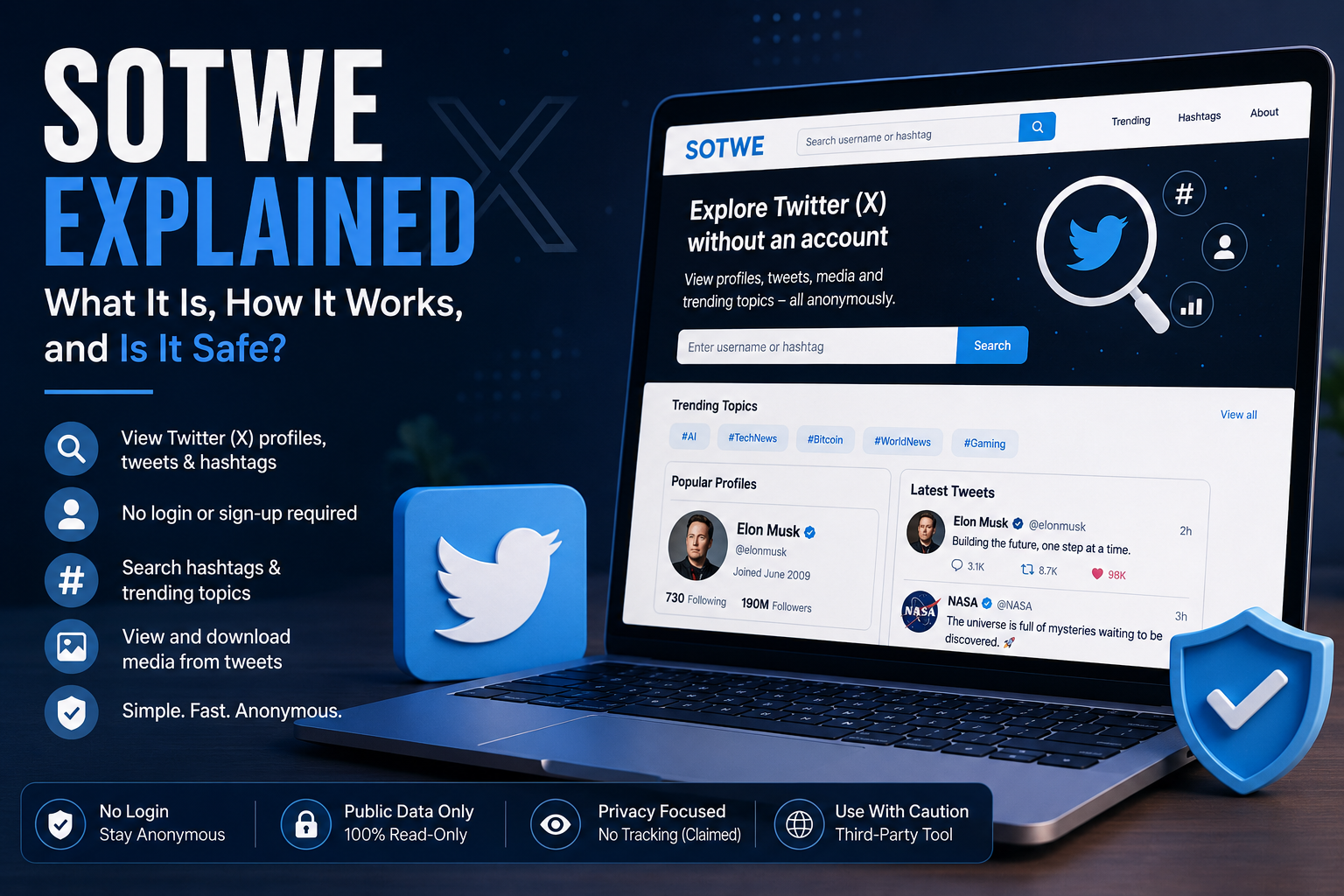
Sotwe Explained: What It Is, How It Works, and Is It Safe?
Introduction
Type “Sotwe” into Google and you’ll land in a strange corner of the internet: dozens of lookalike websites, each claiming to be the place to view Twitter (now X) content without logging in. Some look polished. Some look thrown together overnight. Almost none of them clearly say who runs them.
That’s confusing if you just want a quick answer: what is Sotwe, does it actually work, and can you trust it?
This guide walks through what Sotwe is supposed to do, how “no-login” Twitter viewers work in general, the real safety concerns worth knowing about, and what alternatives exist if you’d rather not take the risk. Where the facts are murky — and with Sotwe, several things genuinely are — that’s called out directly instead of guessed at.
What You’ll Learn
- What Sotwe is and how third-party Twitter/X viewers function
- Why there are so many different “Sotwe” websites
- Key features people associate with the tool
- Sotwe vs. alternatives like Nitter and other viewers
- Realistic safety and privacy considerations
- Pros and cons at a glance
- Answers to the most common Sotwe-related questions
What Is Sotwe?
Sotwe is the name attached to a category of third-party Twitter/X viewer websites. The pitch across nearly all of them is the same: search for a public username or hashtag, and the site pulls up that account’s public tweets, profile bio, and follower stats — without you needing to create a Twitter/X account or sign in.
Here’s the part worth being upfront about: “Sotwe” isn’t one single, verifiable company with a clear owner. Searching the name turns up multiple domains — including sotwe.com, sotwe.in, sotwe.cc, and sotwe.world — all describing themselves almost identically, and at least one source claims the “original” sotwe.com domain went dark after X tightened restrictions on third-party data access, only for similarly named sites to pop up afterward. Domain registration records for these sites are also typically private, so there’s no independently confirmable company name, headquarters, or founding date behind the brand. If you’ve seen conflicting claims about who runs Sotwe or when it launched, that’s not you missing something — the information genuinely isn’t public.
What can be said with confidence is the general category of tool this falls into: a lightweight, no-account front end that scrapes or mirrors publicly visible Twitter/X data.
How Does Sotwe Work?
Tools like Sotwe don’t connect to your personal X account, and they don’t ask for your password. Instead, they work by:
- Pulling public data — profile info, tweets, and media that are visible to anyone, logged in or not.
- Rendering it in a simplified interface — usually stripped of ads, algorithmic recommendations, and engagement features like liking or retweeting.
- Depending entirely on X’s public access rules — if X changes what data is visible without login, or blocks scraping traffic, these viewers stop working until (or unless) they adapt.
That last point matters a lot in practice. X has progressively restricted how much content is visible without logging in and has taken action against automated scraping over the past few years. That’s the core reason third-party viewers like Sotwe are inherently unstable — their functionality isn’t guaranteed by any official agreement, so outages, missing tweets, or sudden shutdowns are common across this whole category of tool, not just one site.
Why Are There So Many Sotwe Websites?
This is one of the more legitimate points of confusion, so it’s worth addressing directly.
Because “Sotwe” isn’t a registered brand with obvious trademark enforcement, multiple unrelated websites use the name. Some appear to be genuine attempts to rebuild the tool after an earlier domain went offline. Others look more like SEO clones — sites built purely to rank for the keyword “Sotwe,” often larded with ads, affiliate links, or unrelated product pushes (VPN and identity-protection tools showed up repeatedly in third-party safety checks of these domains).
Practical takeaway: there is no single “official” Sotwe website that can be confirmed as canonical. If you decide to use one, treat every domain claiming the name with equal caution rather than assuming any one of them is the “real” or safest version.
Key Features
Based on what these sites consistently advertise, a typical Sotwe-style viewer includes:
- Profile viewer – Look up a public username and see their bio, follower/following counts, and recent tweets.
- No login required – No account creation, no password, no linking to your real X profile.
- Hashtag and keyword search – Browse tweets tied to a specific hashtag or search term.
- Trending topics – A feed of what’s currently popular on the platform.
- Media viewing/downloading – Some versions claim you can view or save images, GIFs, and videos from public tweets (this feature is inconsistently available and, per some of the sites’ own FAQs, is disabled entirely on certain versions).
Benefits
- Useful for quickly checking a public account without the friction of signing up
- Ad-free or low-ad experience compared to browsing X directly, on some versions
- No personal engagement history is created (no likes, follows, or reading receipts tied to your identity)
Drawbacks
- Functionality can disappear overnight if X changes its access rules
- No customer support, terms of service transparency, or accountable company behind most versions
- Some independent reviews report intrusive ads, unexpected redirects, and occasional inappropriate content surfacing through ad networks
- Private accounts, DMs, and login-gated content are never accessible — this only ever works on public data
Is Sotwe Safe to Use?
This is the question most people actually want answered, and the honest response is: it depends heavily on which specific website you land on, and the safety signals are mixed.
What’s known:
- Independent site-safety checkers have given various “Sotwe” domains a wide range of trust scores — from scores in the 90s (low risk) to the 60s (flagged for “small risk” factors like potential phishing or spam patterns) depending on which specific domain and which checker you look at.
- Some domains reportedly use anti-bot and DDoS protection, which is a sign of basic operational security, though not a guarantee of trustworthiness overall.
- Several independent write-ups mention user complaints of pop-up ads, unexpected redirects, and — in a few cases — inappropriate content surfacing through third-party ad networks embedded on these sites.
- Because most of these viewers rely on scraping rather than an official X partnership, using them may run against X’s terms of service, even if what you personally see is limited to public data.
Practical safety guidance:
- Never enter your real X/Twitter login credentials into a third-party viewer — legitimate ones shouldn’t ask for them in the first place.
- Be skeptical of any pop-ups, “download required” prompts, or browser extension installs the site pushes on you.
- Use an ad blocker if you choose to use these tools, since ad-network-driven content is the most commonly cited risk.
- Treat every version of “Sotwe” as an unverified third-party tool, not an official X product, regardless of how polished the site looks.
Sotwe vs. Alternatives
Sotwe isn’t the only tool built for logged-out Twitter/X browsing. Here’s how it generally compares to other commonly mentioned options.
| Tool | Login Required? | Trend/Hashtag Browsing | Media Download | Official Company Behind It | Reliability |
|---|---|---|---|---|---|
| Sotwe (various domains) | No | Yes (claimed) | Inconsistent, varies by domain | Unclear/unverified | Low–moderate; frequent domain changes |
| Nitter (open-source instances) | No | Limited | No | Open-source community project | Historically unstable; individual instances often go down due to API limits |
| Official X app/website (logged out) | Partial — X limits what’s visible without an account | Yes | No | X Corp. (official) | High, but access is intentionally restricted for non-logged-in users |
| Social listening tools (e.g., Sprout Social, Keyhole) | Yes, via official API access | Yes, in-depth analytics | N/A | Verified companies with paid plans | High, but not free and not anonymous |
The realistic takeaway: there’s no free, anonymous, fully reliable way to browse Twitter/X at scale right now — every option trades off something, whether that’s reliability, official backing, cost, or anonymity.
Pros and Cons
| Pros | Cons |
|---|---|
| No account or sign-up needed | No verifiable owner or company behind most versions |
| Can view public profiles and tweets quickly | Frequent outages when X changes access rules |
| Doesn’t require sharing your real identity | Multiple lookalike domains make it hard to know which is “official” |
| Some versions are lightweight and ad-light | Other versions reportedly show intrusive ads or redirects |
| No engagement history tied to your account | Likely in a gray area regarding X’s terms of service |
How to Use a Twitter Viewer Responsibly
If you decide to try a Sotwe-style tool anyway, a few habits reduce your risk:
- Stick to viewing, not credentials. Never type your actual X username and password into any third-party viewer.
- Check the URL carefully. Since multiple domains use the name, watch for subtle misspellings or unfamiliar extensions.
- Keep a browser ad blocker and antivirus/anti-malware extension active.
- Avoid downloading anything the site prompts you to install — a legitimate viewer doesn’t need a browser extension or desktop app just to display public tweets.
- Remember it’s read-only. These tools generally can’t post, like, or follow — if a site asks you to log in to “unlock” more features, treat that as a red flag.
Conclusion
Sotwe sits in a genuinely murky part of the internet: useful in concept, inconsistent in execution, and impossible to pin down as one accountable product. If your goal is a quick, anonymous peek at a public tweet or profile, one of these viewers might get the job done — but go in knowing you’re relying on an unverified third-party site, not an official X tool, and that ads or downtime are part of the deal.
If reliability and safety matter more than anonymity, the official X site or app — even with its login prompts — remains the more dependable option. And if you’re doing anything resembling professional research or monitoring, a paid analytics tool with verified API access will save you the guesswork these free viewers come with.
Whatever you choose, don’t hand over your real credentials to any site claiming to be Sotwe, and treat every version of it as unverified until proven otherwise.
Frequently Asked Questions
1. Is Sotwe an official Twitter/X product? No. It’s an independent third-party tool, and there’s no confirmed connection between it and X Corp.
2. Do I need an account to use Sotwe? No — the entire point of these viewers is browsing public content without logging in or signing up.
3. Can Sotwe show me private Twitter/X accounts? No. It can only display content that’s already public. Private accounts and protected tweets stay hidden.
4. Why does Sotwe sometimes stop working? Because it depends on scraping publicly available data rather than an official partnership with X, it’s vulnerable to outages whenever X changes its access rules or blocks non-standard traffic.
5. Which Sotwe website is the real one? There isn’t a confirmed “official” domain. Several sites use the name, and none can be independently verified as the original or most trustworthy.
6. Is it legal to use a Twitter viewer like Sotwe? Viewing public information generally isn’t illegal, but scraping tools like this often conflict with a platform’s terms of service. That’s a contractual issue between the site and X, not necessarily a matter of criminal law, but it’s worth knowing this exists in a gray area.
7. Can Sotwe post tweets or interact with accounts on my behalf? No. These tools are read-only viewers; they can’t like, comment, follow, or post since they don’t have login access to any account.
8. Does Sotwe track or store my personal data? Multiple versions claim not to use cookies or track visitors, but since there’s no verified company behind most domains, that claim can’t be independently confirmed. Treat any such promise with caution.
9. What’s a safer alternative to Sotwe? Browsing X directly (even without logging in, where content is visible) is the most reliable official option. For research at scale, paid tools with verified API access, such as social listening platforms, are more dependable.
10. Why do some Sotwe-related sites show ads or redirects? Because many of these sites rely on ad networks for revenue rather than a subscription or business model, and there’s no consistent moderation standard across the different domains using the name.
Read Also: PS5 Controller Guide – Versions, Problems & Features
About the Author




1 thought on “Sotwe Explained: What It Is, How It Works, and Is It Safe?”