Introduction
In May 2026, SAP officially introduced one of the most ambitious AI enterprise platforms in the software industry:
SAP Autonomous Enterprise
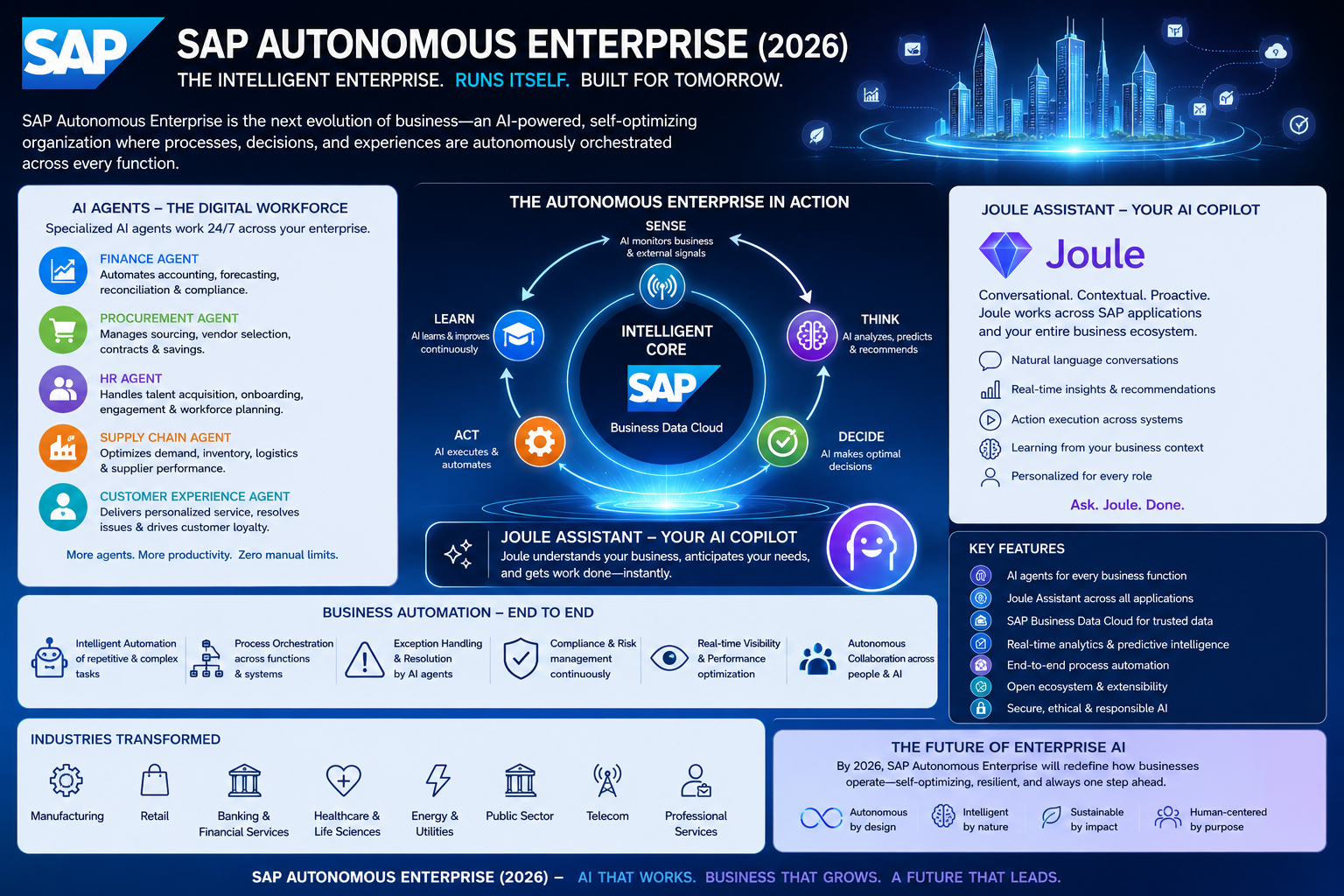
Announced during the global SAP Sapphire 2026 event, the platform represents SAP’s vision for the next generation of enterprise software—where AI agents, automation systems, and business intelligence tools work together to help companies operate more efficiently with less manual work.
Unlike normal AI chatbots or productivity assistants, SAP Autonomous Enterprise is designed specifically for:
- large corporations,
- enterprise workflows,
- finance operations,
- supply chain management,
- procurement,
- logistics,
- and human resources.
The platform combines:
- AI agents,
- enterprise data,
- automation,
- cloud infrastructure,
- and business analytics
into one integrated business ecosystem.
Basic Overview
| Category | Details |
|---|---|
| Full Name | SAP Autonomous Enterprise |
| Developer | SAP |
| Announcement Date | May 2026 |
| Event | SAP Sapphire 2026 |
| Main Technology | Enterprise AI + Automation |
| AI Assistant | Joule |
| Main Goal | Autonomous business workflows |
| Core Focus | Finance, HR, logistics, procurement |
| Platform Type | Enterprise AI operating ecosystem |
| Industry Target | Large enterprises & corporations |
| Main Competitors | Microsoft, Oracle, Salesforce, Google |
What Is SAP Autonomous Enterprise?
SAP Autonomous Enterprise is an AI-powered business platform designed to automate many of the tasks traditionally handled by employees and enterprise software teams.
In Simple Terms:
Instead of workers manually:
- creating reports,
- checking spreadsheets,
- moving data,
- approving workflows,
- or analyzing operations,
AI systems can increasingly:
- analyze information,
- make recommendations,
- automate actions,
- and complete business tasks automatically.
The Main Vision
SAP wants businesses to move from:
“software tools that humans operate”
to:
“AI-assisted operational systems.”
The idea is not to fully replace workers, but to allow AI systems to handle repetitive and data-heavy operations while humans supervise strategy and decision-making.
Why This Launch Is Important
This launch is considered one of the biggest AI shifts in enterprise software because SAP already powers critical systems for many of the world’s largest corporations.
Thousands of major companies use SAP for:
- finance,
- payroll,
- manufacturing,
- supply chains,
- procurement,
- and operations management.
Now SAP is integrating AI directly into those systems.
Main Components of SAP Autonomous Enterprise
1. SAP Business AI Platform
This is the foundation layer of the ecosystem.
Purpose:
To connect:
- enterprise data,
- cloud systems,
- AI models,
- workflows,
- and automation tools
into one unified environment.
Main Capabilities:
AI Workflow Management
Companies can automate:
- approvals,
- reporting,
- procurement,
- scheduling,
- and operational tasks.
Enterprise Data Integration
The platform connects multiple business systems and departments together.
AI Governance
SAP includes security and monitoring systems to help businesses manage enterprise AI safely.
2. Joule AI Assistant
Joule is SAP’s enterprise AI assistant.
Employees can ask Joule questions using natural language.
Example Commands:
- “Generate financial report”
- “Check inventory shortages”
- “Analyze supplier delays”
- “Show procurement status”
- “Create expense summary”
The AI can then:
- search enterprise systems,
- generate reports,
- automate workflows,
- and recommend actions.
3. AI Agents
One of the biggest features of SAP Autonomous Enterprise is its use of AI agents.
What Are AI Agents?
AI agents are specialized AI workers built for specific business tasks.
Instead of one general chatbot, SAP uses many focused AI systems.
Examples of AI Agents
Finance Agent
Can:
- reconcile accounts,
- analyze cash flow,
- detect anomalies,
- automate reporting.
HR Agent
Can:
- answer employee questions,
- assist onboarding,
- help recruitment teams,
- manage HR workflows.
Supply Chain Agent
Can:
- monitor inventory,
- predict shortages,
- optimize logistics,
- detect shipping delays.
Procurement Agent
Can:
- automate purchasing,
- compare suppliers,
- process approvals,
- manage orders.
4. SAP Knowledge Graph
The Knowledge Graph helps AI understand how enterprise systems connect together.
It organizes:
- business relationships,
- workflows,
- company structures,
- operational logic,
- and enterprise rules.
This is important because enterprise environments are extremely complex.
5. Joule Studio
Joule Studio allows businesses to create custom AI workflows.
Companies can:
- build AI automations,
- create specialized AI agents,
- connect external tools,
- customize workflows.
Both:
- no-code
and - professional development options
are supported.
Main Features of SAP Autonomous Enterprise
1. Workflow Automation
The platform automates repetitive business operations.
Examples:
- invoice processing,
- procurement approvals,
- employee onboarding,
- reporting workflows,
- compliance checks.
2. Predictive Analytics
AI analyzes business data to predict:
- shortages,
- operational risks,
- demand changes,
- supply disruptions,
- and financial trends.
3. Real-Time Decision Support
Managers receive:
- live insights,
- recommendations,
- and AI-generated operational guidance.
4. Enterprise Search & AI Assistance
Employees can search company information using conversational AI instead of manually navigating software systems.
5. Cross-System Integration
SAP Autonomous Enterprise integrates with:
- ERP systems,
- cloud infrastructure,
- procurement platforms,
- HR systems,
- analytics tools.
Industries Targeted
| Industry | Use Cases |
|---|---|
| Manufacturing | Supply chain optimization |
| Retail | Demand forecasting |
| Banking | Financial analysis |
| Logistics | Route & inventory management |
| Healthcare | Operational coordination |
| Energy | Equipment monitoring |
| Enterprise IT | Workflow automation |
Example Workflow Comparison
Traditional Enterprise Workflow
Employee:
- Opens ERP software
- Downloads spreadsheets
- Reviews inventory
- Sends approval emails
- Creates reports manually
SAP Autonomous Enterprise Workflow
AI:
- Detects issue automatically
- Analyzes operational impact
- Suggests solution
- Creates workflow
- Notifies management
- Executes approved tasks
Major Partnerships
SAP expanded AI partnerships with major technology companies.
Key Partners:
| Company | Role |
|---|---|
| Anthropic | AI model integration |
| Cloud & AI interoperability | |
| Microsoft | Enterprise integrations |
| Amazon Web Services | Cloud infrastructure |
| NVIDIA | AI hardware infrastructure |
| Palantir Technologies | Enterprise data systems |
Why Businesses Are Interested
Potential Benefits
Faster Operations
AI can react instantly to operational changes.
Reduced Manual Work
Employees spend less time on repetitive tasks.
Better Forecasting
Predictive analytics improve planning.
Improved Productivity
Teams focus more on strategy and decision-making.
Reduced Errors
Automation lowers repetitive human mistakes.
Risks & Challenges
1. AI Accuracy
Enterprise systems require extremely high reliability.
Even small AI mistakes can impact:
- finance,
- procurement,
- logistics,
- or compliance.
2. Data Quality
AI systems depend heavily on clean and organized business data.
3. Enterprise Complexity
Large corporations often use complicated legacy systems that are difficult to modernize.
4. Cost of Implementation
AI transformation can be expensive for enterprises.
5. Employee Concerns
Some workers worry automation may reduce certain administrative roles.
SAP vs Competitors
| Company | Enterprise AI Strategy |
|---|---|
| SAP | Autonomous Enterprise |
| Microsoft | Copilot Enterprise |
| Salesforce | Agentforce |
| Oracle | Oracle AI Cloud |
| Gemini Workspace AI |
Future Outlook
SAP plans to continue expanding:
- AI agents,
- automation tools,
- enterprise AI workflows,
- and industry-specific AI systems
throughout 2026 and beyond.
The company believes enterprise software is moving toward:
“AI-assisted autonomous operations.”
Final Verdict
SAP Autonomous Enterprise Could Become One of the Most Important Enterprise AI Platforms of the Decade
Instead of using AI only as a chatbot or assistant, SAP is embedding AI directly into:
- business workflows,
- finance systems,
- logistics,
- procurement,
- and enterprise operations.
This could fundamentally change how large corporations operate in the future.
About the Author




1 thought on “SAP Autonomous Enterprise (2026) – Complete Informational Guide, AI Agents, Joule Assistant, Business Automation, Features, Industries & Future of Enterprise AI”