Wispr Flow (2026) – Complete Professional Guide, Android Launch, AI Voice Typing, Features, Pricing, Growth, Competitors & Full Details
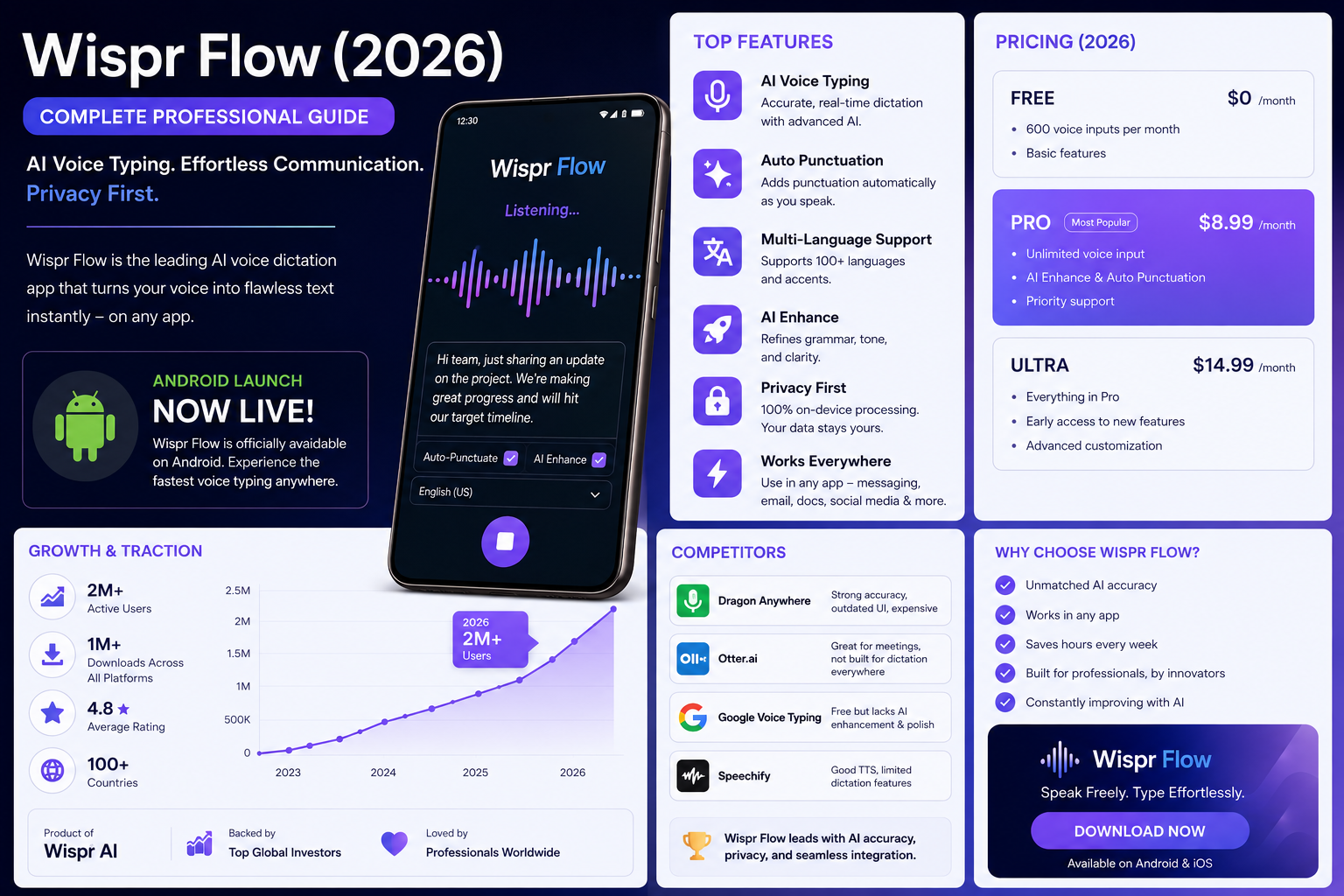
Table of Contents
ToggleIntroduction
In 2026, AI productivity software is rapidly evolving beyond simple chatbots and text generators. One of the fastest-growing tools in this space is Wispr Flow, an AI-powered voice-to-text platform designed to make dictation smarter, faster, and more natural.
Unlike traditional voice typing tools that only transcribe speech, Wispr Flow uses artificial intelligence to:
- understand context,
- improve sentence structure,
- remove filler words,
- add punctuation automatically,
- and generate cleaner written output.
The company officially expanded to Android in February 2026, helping Wispr Flow become one of the most discussed AI productivity apps of the year.
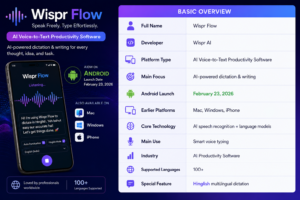
Basic Overview
| Category | Details |
|---|---|
| Full Name | Wispr Flow |
| Developer | Wispr AI |
| Platform Type | AI Voice-to-Text Productivity Software |
| Main Focus | AI-powered dictation & writing |
| Android Launch | February 23, 2026 |
| Earlier Platforms | Mac, Windows, iPhone |
| Core Technology | AI speech recognition + language models |
| Main Use | Smart voice typing |
| Industry | AI Productivity Software |
| Supported Languages | 100+ |
| Special Feature | Hinglish multilingual dictation |
What Is Wispr Flow?
Wispr Flow is an AI-enhanced dictation platform that converts spoken language into clean, properly formatted text.
Instead of simply transcribing speech word-for-word, the software intelligently improves the final writing output.
In Simple Terms
Traditional voice typing:
Converts speech directly into raw text.
Wispr Flow:
Uses AI to transform speech into polished writing.
Example
User Says:
“umm can you send the report tomorrow thanks”
Wispr Flow Outputs:
“Can you send the report tomorrow? Thanks.”
The AI automatically:
- removes filler words,
- adds punctuation,
- improves readability,
- and formats the sentence naturally.
Android Launch Details
Official Android Release
Wispr Flow officially launched its Android app on:
February 23, 2026
The Android launch significantly expanded the company’s user base because Android dominates global smartphone usage.
Before Android, the software was already available on:
- Mac
- Windows
- iPhone
The Android release helped Wispr Flow enter broader international markets, especially Asia and multilingual regions.
Why Wispr Flow Became Popular
The rise of:
- AI productivity,
- remote work,
- mobile content creation,
- and hands-free communication
created strong demand for smarter dictation software.
Wispr Flow positioned itself as:
“AI writing assistance through voice.”
Main Features
1. AI Voice Typing
The core feature allows users to speak naturally while AI converts speech into polished text.
Benefits:
- Faster writing
- Reduced typing effort
- Better productivity
- More natural communication
2. Automatic Punctuation
The AI automatically adds:
- commas,
- periods,
- question marks,
- paragraph spacing,
- and formatting.
This creates more readable output compared to standard voice typing systems.
3. Filler Word Removal
Wispr Flow removes unnecessary speech patterns such as:
- “um”
- “uh”
- “like”
- repeated pauses
This helps users produce cleaner professional writing.
4. Multilingual Support
The platform supports over 100 languages.
This is especially important for:
- global users,
- multilingual professionals,
- international teams,
- and mixed-language communication.
5. Hinglish & Mixed-Language AI
One of Wispr Flow’s standout features is its support for:
Hinglish (Hindi + English mixed speech)
Example:
“Kal meeting reschedule kar do”
The AI can understand mixed-language dictation more effectively than many traditional systems.
This feature helped the platform gain attention in South Asian markets.
6. Floating Bubble Interface (Android)
Instead of replacing the entire keyboard, the Android app uses a floating microphone bubble.
Benefits:
- Faster access
- Cross-app usage
- Minimal interruption
- Easier mobile workflow
Users can activate dictation from almost any text field.
Cross-App Compatibility
Wispr Flow works across many applications, including:
- Gmail
- Slack
- Notes apps
- Browsers
- Social media platforms
- AI chat tools
This broad compatibility is one of the reasons for its rapid growth.
AI Formatting & Writing Assistance
Wispr Flow can also help organize:
- lists,
- paragraphs,
- notes,
- messages,
- and structured writing.
This moves the platform closer to AI writing assistance rather than simple speech recognition.
Productivity Use Cases
Students
Can:
- dictate assignments,
- create notes,
- summarize lectures.
Professionals
Can:
- draft emails,
- create reports,
- respond faster,
- improve workflow efficiency.
Content Creators
Can:
- generate ideas quickly,
- script videos,
- create captions,
- produce long-form content.
Accessibility Users
Voice-based writing helps users who:
- struggle with typing,
- need hands-free input,
- or prefer speech communication.
Technology Behind Wispr Flow
Wispr Flow combines:
- AI speech recognition,
- natural language processing,
- contextual language modeling,
- and formatting intelligence.
The system attempts to understand:
- sentence structure,
- user intent,
- and conversational flow.
Wispr Flow vs Traditional Dictation
| Feature | Traditional Voice Typing | Wispr Flow |
|---|---|---|
| Raw Transcription | Yes | Yes |
| AI Cleanup | Limited | Advanced |
| Automatic Formatting | Basic | Strong |
| Filler Removal | Minimal | Intelligent |
| Multilingual Mixing | Weak | Improved |
| Writing Assistance | Limited | AI-assisted |
Privacy & Cloud Processing
Like many AI tools, Wispr Flow relies heavily on cloud processing.
This raises important discussions around:
- user privacy,
- voice data handling,
- cloud storage,
- and enterprise security.
The company states it focuses on secure processing and user privacy controls, but concerns remain common across the AI industry.
Funding & Business Growth
Wispr Flow has become one of the fastest-growing startups in AI productivity.
Reported Funding:
- Approximately $81 million raised
Estimated Valuation:
- Around $700 million
The company’s growth reflects increasing investor interest in:
- AI productivity,
- voice interfaces,
- and mobile AI tools.
Community Reactions
The AI and productivity communities generally reacted positively to Wispr Flow.
Common Praise:
- Excellent punctuation
- Natural formatting
- Fast speech recognition
- Strong multilingual support
- Better than standard dictation
Common Concerns:
- Privacy permissions
- Occasional recognition errors
- Cloud dependency
- Subscription pricing concerns
Competitors
| Product | Main Focus |
|---|---|
| Google Voice Typing | Basic Android dictation |
| Apple Dictation | iPhone voice typing |
| SuperWhisper | AI transcription |
| Google AI Edge Eloquent | Offline AI dictation |
| Wispr Flow | AI-enhanced writing dictation |
Why Wispr Flow Matters
Wispr Flow reflects a broader industry shift:
from typing-based computing
toward:
voice-first AI productivity.
The company is trying to position voice interaction as a primary method of digital communication and content creation.
Future Outlook
Industry analysts expect future Wispr Flow development to include:
- deeper AI writing assistance,
- enterprise productivity tools,
- offline AI processing,
- stronger personalization,
- and broader multilingual intelligence.
The Android expansion could significantly increase its global adoption.
Final Verdict
Wispr Flow Is More Than a Simple Voice Typing App
It combines:
- AI writing,
- speech recognition,
- formatting intelligence,
- and productivity automation
into a modern AI communication platform.
For users who rely heavily on:
- messaging,
- note-taking,
- content creation,
- or hands-free productivity,
Wispr Flow represents one of the most advanced AI dictation tools currently available.
About the Author




1 thought on “Wispr Flow (2026) – Complete Professional Guide, Android Launch, AI Voice Typing, Features, Pricing, Growth, Competitors & Full Details”