GPT-5.5, HP AI Tools & Wispr Flow Expansion (2026) – Complete Detailed Article on the New Era of AI Productivity
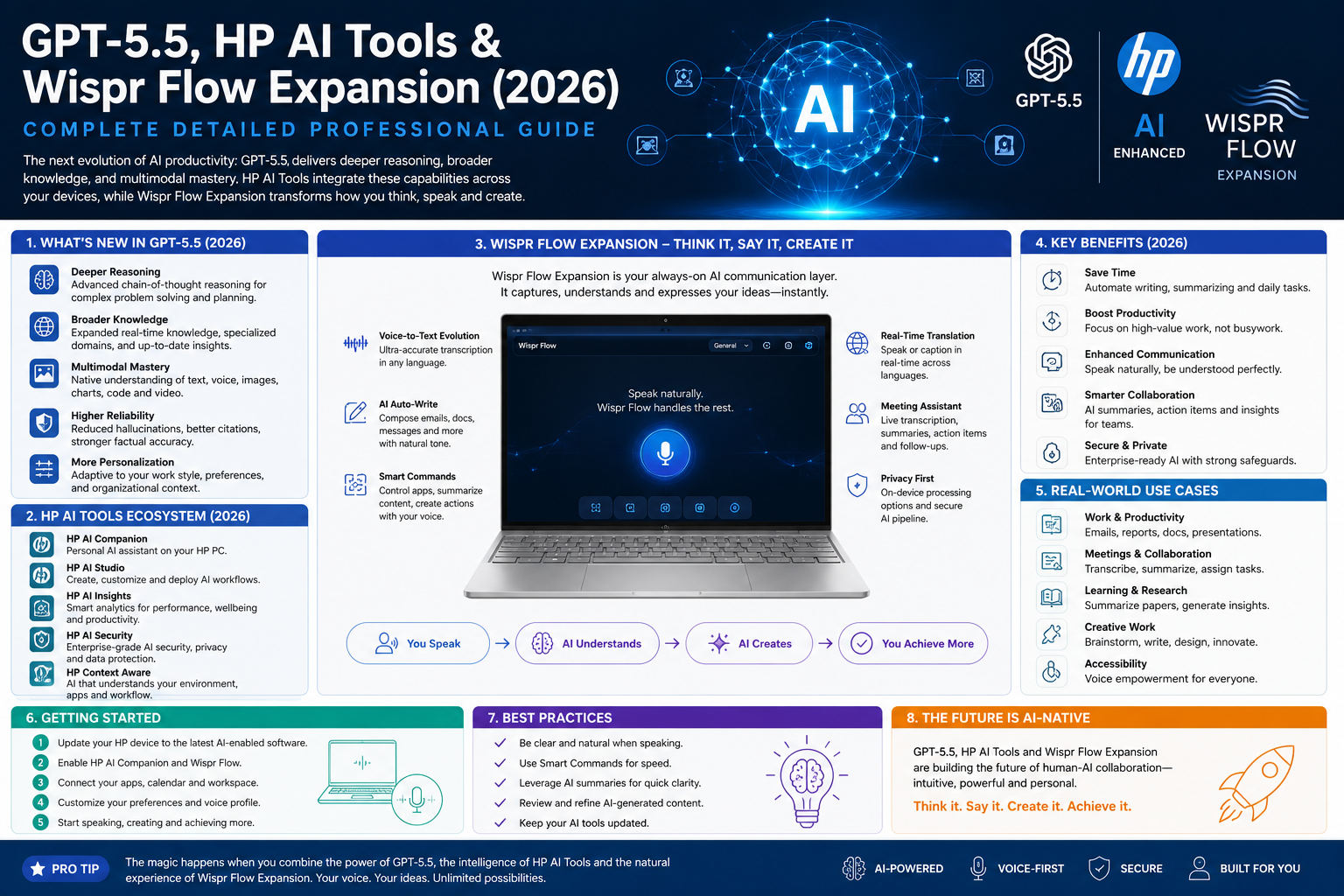
Table of Contents
ToggleIntroduction
The AI industry in 2026 is evolving far beyond traditional chatbots.
Major technology companies are now building complete AI productivity ecosystems designed to transform how people:
- work,
- communicate,
- create content,
- manage businesses,
- and interact with devices.
Three major developments leading this transition are:
- OpenAI GPT-5.5 & GPT-5.5 Instant
- HP AI Tools & HP IQ Ecosystem
- Wispr Flow Android Expansion
These platforms represent three different but connected directions in modern AI:
AI reasoning and autonomous workflows
AI-powered hardware ecosystems
Voice-first AI productivity
Together, they highlight how AI is shifting from:
“simple assistants”
toward:
“intelligent operating ecosystems.”
GPT-5.5 & GPT-5.5 Instant
Basic Overview
| Category | Details |
|---|---|
| Full Name | GPT-5.5 |
| Developer | OpenAI |
| Initial Launch | April 23, 2026 |
| GPT-5.5 Instant Rollout | May 2026 |
| Main Focus | AI reasoning & productivity |
| Core Technology | Large multimodal language model |
| Key Innovation | Agentic workflow intelligence |
| Main Users | Consumers, developers, enterprises |
What Is GPT-5.5?
GPT-5.5 is OpenAI’s next-generation AI model focused on:
- reasoning,
- workflow execution,
- coding,
- productivity,
- and personalized AI assistance.
Unlike earlier chatbot-focused AI systems, GPT-5.5 is designed to function more like:
“an intelligent digital work assistant.”
GPT-5.5 Instant
GPT-5.5 Instant became the default fast-response model for many ChatGPT users in May 2026.
The model focuses on:
- lower latency,
- faster responses,
- cleaner outputs,
- and better personalization.
Major Improvements in GPT-5.5
1. Better Reasoning
GPT-5.5 improves:
- logical analysis,
- coding workflows,
- multi-step planning,
- and technical understanding.
The model performs better on:
- math,
- science,
- programming,
- and structured problem solving.
2. Reduced Hallucinations
One of OpenAI’s major goals was improving factual reliability.
GPT-5.5 reportedly reduces hallucinated information significantly compared to previous fast models.
This is especially important for:
- finance,
- medical,
- legal,
- and research-related tasks.
3. Memory & Personalization
GPT-5.5 can better use:
- past chats,
- uploaded documents,
- connected services,
- and conversation context.
This allows more personalized and workflow-aware assistance.
4. Agentic Workflow Intelligence
GPT-5.5 is built for:
- long tasks,
- autonomous planning,
- research coordination,
- tool usage,
- and multi-step execution.
Instead of only answering prompts, the AI increasingly:
- organizes workflows,
- performs actions,
- and assists with real productivity tasks.
5. Coding & Development Upgrades
Developers benefit from:
- improved debugging,
- cleaner code generation,
- better documentation,
- and stronger programming logic.
GPT-5.5 is especially optimized for:
- software engineering,
- automation,
- scripting,
- and development assistance.
Why GPT-5.5 Matters
GPT-5.5 reflects a major AI industry transition:
from conversational AI
to:
productivity-focused AI systems.
The goal is no longer just:
“talking to AI”
but:
“working with AI.”
Community Reactions
Users and developers generally praised:
- improved answer quality,
- cleaner responses,
- stronger reasoning,
- and fewer hallucinations.
Some concerns included:
- privacy around personalization,
- growing AI dependency,
- and increasing automation.
HP AI Tools & HP IQ Ecosystem
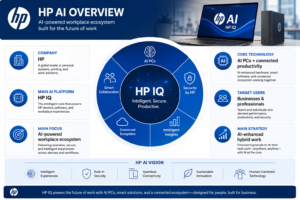
Basic Overview
| Category | Details |
|---|---|
| Company | HP |
| Main AI Platform | HP IQ |
| Main Focus | AI-powered workplace ecosystem |
| Core Technology | AI PCs + connected productivity |
| Target Users | Businesses & professionals |
| Main Strategy | AI-enhanced hybrid work |
What Is HP IQ?
HP IQ is HP’s new AI ecosystem designed to connect:
- AI PCs,
- smart workplace devices,
- hybrid work systems,
- and enterprise workflows.
Instead of isolated hardware products, HP wants devices to function as:
“connected AI productivity systems.”
HP’s Main Goal
HP believes computing is entering the:
“Agentic AI Era.”
This means devices increasingly:
- understand user workflows,
- assist productivity,
- automate repetitive tasks,
- and coordinate workplace systems.
Major HP AI Features
1. AI PCs
HP launched several AI-focused devices, including:
- EliteBook AI PCs,
- ProBook systems,
- EliteDesk workstations,
- and OmniPad AI devices.
These systems are optimized for:
- AI workloads,
- productivity tools,
- hybrid work,
- and intelligent computing.
2. Local AI Processing
One major focus is:
on-device AI.
Instead of sending everything to cloud servers, HP AI systems can process many AI tasks locally.
Benefits:
- better privacy,
- faster AI responses,
- lower latency,
- and reduced internet dependency.
3. HP Workforce Experience Platform
This enterprise platform helps companies:
- manage devices,
- monitor productivity,
- automate workflows,
- and support hybrid work environments.
4. HP OmniPad 12
One of HP’s notable launches is the:
HP OmniPad 12 AI device.
It combines:
- portability,
- AI productivity,
- keyboard support,
- and hybrid workflow features.
The product targets:
- students,
- remote workers,
- and business users.
Why HP AI Matters
HP is not trying to compete directly with AI model companies like OpenAI or Google.
Instead, HP wants to become:
“the hardware platform for AI productivity.”
This includes:
- AI laptops,
- AI workplace infrastructure,
- connected office systems,
- and intelligent workflow devices.
Enterprise Strategy
HP’s AI strategy focuses heavily on:
- enterprise customers,
- hybrid work,
- productivity,
- and device ecosystems.
The company believes future offices will rely heavily on:
- AI coordination,
- smart collaboration,
- and intelligent hardware systems.
Wispr Flow Expansion
Basic Overview
| Category | Details |
|---|---|
| Product | Wispr Flow |
| Developer | Wispr AI |
| Main Focus | AI voice typing |
| Android Launch | February 23, 2026 |
| Core Technology | AI dictation + formatting |
| Languages Supported | 100+ |
| Special Feature | Hinglish support |
What Is Wispr Flow?
Wispr Flow is an AI-powered dictation and writing platform.
Unlike traditional voice typing systems, it:
- improves grammar,
- adds punctuation,
- removes filler words,
- and formats speech into polished writing.
Example
User Says:
“umm can you send the report tomorrow”
Wispr Flow Outputs:
“Can you send the report tomorrow?”
The AI intelligently cleans and structures spoken language.
Android Expansion
Wispr Flow officially launched on Android in February 2026.
This expansion was important because Android dominates global smartphone markets.
The launch helped Wispr Flow rapidly grow in:
- Asia,
- multilingual regions,
- creator communities,
- and mobile productivity markets.
Major Features
1. AI Dictation
Speech becomes:
- clean,
- formatted,
- readable text.
2. Automatic Formatting
The AI automatically handles:
- punctuation,
- spacing,
- paragraph structure,
- and readability improvements.
3. Hinglish & Multilingual AI
One of Wispr Flow’s biggest strengths is:
mixed-language support.
Example:
“Kal meeting reschedule kar do”
The AI understands both:
- Hindi
- and English
within the same sentence.
This made the app especially popular in South Asian markets.
4. Floating Bubble Interface
Instead of replacing the entire keyboard, Wispr Flow uses a floating voice bubble on Android.
This allows easy dictation inside:
- WhatsApp,
- Gmail,
- Slack,
- browsers,
- and many other apps.
Funding & Growth
Wispr Flow has become one of the fastest-growing AI productivity startups.
Reportedly:
- raised around $81 million,
- with a valuation close to $700 million.
This reflects growing investor confidence in:
- voice-first AI,
- mobile productivity,
- and AI communication systems.
Why Wispr Flow Matters
Wispr Flow represents the growing movement toward:
“voice-first productivity computing.”
Instead of typing, users increasingly:
- speak naturally,
- and AI converts speech into polished writing.
Comparing GPT-5.5, HP AI & Wispr Flow
| Platform | Main Focus | Best For |
|---|---|---|
| GPT-5.5 | AI reasoning & workflows | Developers, businesses, productivity |
| HP IQ | AI hardware ecosystem | Enterprises & hybrid work |
| Wispr Flow | AI voice productivity | Mobile users & creators |
Biggest Industry Trend
All three platforms reveal the same major industry transformation:
AI is moving beyond chatbots.
The future is shifting toward:
- AI ecosystems,
- AI productivity tools,
- autonomous workflows,
- intelligent devices,
- and voice-first computing.
Future Outlook
GPT-5.5
Expected to expand:
- autonomous workflows,
- coding agents,
- productivity integration,
- and advanced reasoning.
HP AI Ecosystem
Likely to grow into:
- enterprise AI infrastructure,
- workplace orchestration,
- and AI-native computing systems.
Wispr Flow
Expected to expand:
- multilingual intelligence,
- offline AI dictation,
- enterprise productivity,
- and creator tools.
Final Verdict
2026 Is Becoming the Year of AI Productivity Ecosystems
The AI industry is no longer focused only on:
- chatbots,
- simple assistants,
- or isolated AI tools.
Instead, companies are building:
- intelligent operating ecosystems,
- AI-enhanced workflows,
- smart devices,
- and autonomous productivity platforms.
About the Author




1 thought on “GPT-5.5, HP AI Tools & Wispr Flow Expansion (2026) – Complete Detailed Article on the New Era of AI Productivity”