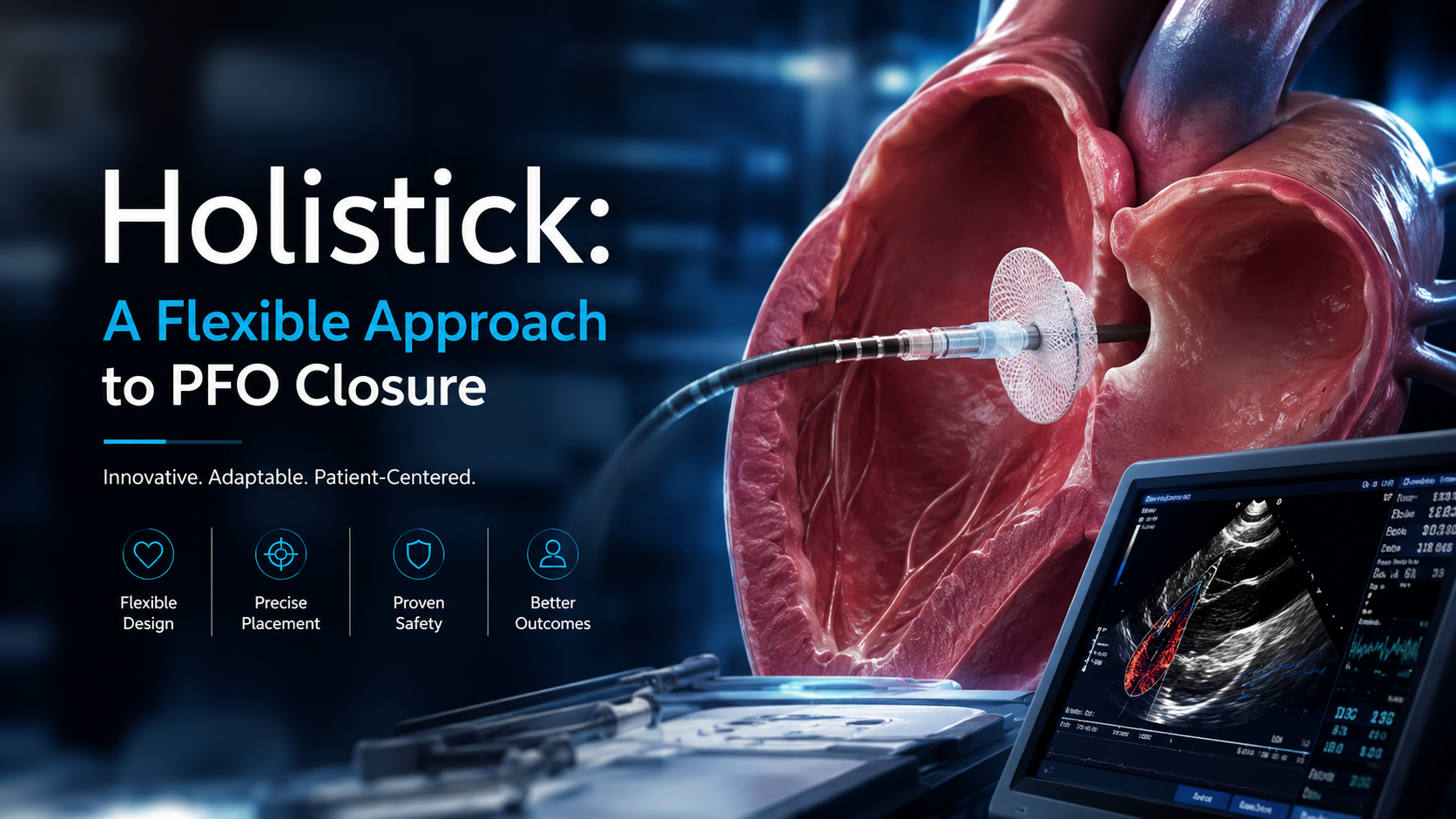
The world of medical device innovation is often characterized by rigid solutions applied to universal problems. But what if a softer, more adaptable approach could redefine how we treat common cardiac defects? Holistick Medical is a Paris-based company attempting to do just that, focusing on the closure of Patent Foramen Ovale (PFO), a condition affecting an estimated 25% of the population . This article provides a detailed examination of Holistick Medical, its technology, its potential impact on patient care, and its standing in the medtech landscape.
What is Holistick?
Holistick Medical is a manufacturer and developer of mini-invasive medical devices . Established in 2017, the company is currently a privately held, early-stage enterprise headquartered in Paris, France . Its primary focus is the development of an innovative catheter-based device to treat common cardiac defects, most notably Patent Foramen Ovale (PFO) . The company’s core innovation lies in utilizing flexible materials to offer an atraumatic closure of PFO that leaves the cardiac septum intact .
Holistick is positioned as a “small face care brand” on some consumer review sites, which appears to be a misclassification compared to its actual medtech profile . Its primary competitors are other medical device companies in the cardiovascular space, not skincare brands.
Key Features of the Holistick Device
-
Flexible Materials: The device is designed using flexible materials, a significant departure from traditional metallic implants .
-
Atraumatic Design: The flexible nature is intended to allow for a “small footprint PFO closure,” minimizing trauma to the heart tissue .
-
Septum Preservation: Unlike some current devices, the Holistick technology is engineered to leave the atrial septum intact after closure .
-
Catheter-Based Delivery: The device is deployed via a minimally invasive catheter procedure, targeting difficult-to-reach organs .
The Underlying Technology: Patent Foramen Ovale (PFO)
To understand Holistick’s value proposition, it’s essential to grasp the condition it aims to treat. A Patent Foramen Ovale (PFO) is a hole in the heart that didn’t close the way it should after birth. It’s a septal defect, a flap or opening between the left and right atria (the upper chambers) of the heart .
While a PFO is common—found in about 25% of the population—it often has no impact on an individual’s health and goes undetected . However, the condition has been linked to an increased risk of stroke, particularly in younger individuals. The concern is that blood clots can pass through the PFO from the right side of the heart to the left side, and then travel to the brain, causing a stroke. Several recent clinical studies have shown a significant reduction in recurring stroke after PFO closure . This evidence has driven the medical community to seek safer and more effective closure methods.
The Holistick Device and Procedure
Holistick’s device is a direct response to the need for improved PFO closure. The company’s technology focuses on the development of catheter devices that can repair holes in the heart using deployable soft structures . These mechanisms delicately close the hole without relying on rigid devices or sutures, which is a departure from traditional methods .
Use Cases:
The primary application is for patients who have suffered a stroke that is deemed to be cryptogenic (of unknown cause) and are found to have a PFO. The device offers a potentially less invasive and more tissue-preserving option for PFO closure. The company also suggests its technology could be adapted for repairing tissue defects in other organs, offering a non-invasive approach to tissue repair and better access to difficult-to-reach areas of the body .
Advantages:
-
Improved Long-Term Outcomes: The flexible, low-profile design is intended to improve long-term patient outcomes .
-
Future Therapies: By leaving the septum intact, the device theoretically preserves the option for future transseptal therapies, which are procedures that require access through the atrial septum .
-
Minimally Invasive: As a catheter-based procedure, it is less invasive than open-heart surgery, potentially leading to shorter recovery times and fewer complications.
Limitations:
-
Early-Stage Company: Holistick is an early-stage company with only 4 employees, which may limit its current production capacity and market reach .
-
Pending Clinical Data: While the technology is promising, the full scope of its clinical performance and long-term efficacy will need to be verified through more extensive studies and real-world use.
Holistick Medical Financial and Patent Profile
Holistick Medical has made significant strides in developing its intellectual property and securing funding.
Financials:
-
Founded: 2017 .
-
Funding Raised: $5.07 million .
-
Latest Deal Type: Accelerator/Inc (Incubator) .
-
Investors: Bpifrance, Harvard Innovation Launch Lab, Truffle Capital, and LabCentral .
Intellectual Property:
The company is actively building a robust patent portfolio. It currently holds 37 total patent documents and applications across 6 patent families . This includes 6 granted patents and 13 pending applications, with technology classified under CPC codes like A61B17/0057 related to surgical instruments for closing wounds or openings .
| Metric | Details |
|---|---|
| Total Patents | 37 Total Documents |
| Granted | 6 |
| Pending | 13 |
| Recent Filing | EP-4635424-A1 (Apr 2024) and WO-2025219094-A1 (Apr 2024) for a catheter device, suture, and method of suturing . |
Pros and Cons of Holistick
| Pros | Cons |
|---|---|
| Innovative Approach: Offers a flexible, atraumatic alternative to traditional metallic PFO closure devices . | Early-Stage Venture: As a small company with a nascent product, it faces significant market entry and scalability challenges . |
| Patient-Centric Design: Potentially leads to better long-term outcomes and preserves future treatment options . | Limited Public Data: Information on clinical trials and performance metrics is not yet widely available. |
| Strong IP Portfolio: 37 patents and applications indicate a serious commitment to protecting its technology . | Misclassification: The company is confused with a skincare brand on some platforms, which could create confusion in the market . |
Holistick FAQs
What is Holistick Medical?
Holistick Medical is a Paris-based medical device company founded in 2017 that is developing an innovative catheter device to close common cardiac defects like Patent Foramen Ovale (PFO) using flexible materials .
When was Holistick Medical founded?
Holistick Medical was founded in 2017 .
Where is Holistick Medical headquartered?
Holistick Medical is headquartered at 53 Rue De Turbigo, 75003 Paris, France .
What is PFO closure?
PFO closure is a procedure to close a small hole in the heart (Patent Foramen Ovale). This is often done to reduce the risk of stroke in patients who have had a stroke previously .
How does Holistick’s device differ from traditional PFO closure devices?
Unlike typical metallic devices, Holistick uses flexible materials to close the PFO, which leaves the septum intact and reduces trauma to the heart tissue .
Who has invested in Holistick Medical?
Holistick Medical’s investors include Bpifrance, Harvard Innovation Launch Lab, Truffle Capital, and LabCentral .
Is Holistick Medical a public or private company?
Holistick Medical is a private company .
How much funding has Holistick Medical raised?
Holistick Medical has raised a total of $5.07 million over four financing rounds .
How many employees does Holistick Medical have?
Holistick Medical has 4 employees .
What are the advantages of Holistick’s atraumatic PFO closure?
It aims to improve long-term patient outcomes and provides options for future therapies by avoiding damage to the septum .
Conclusion: A Holistic Approach to Heart Health?
Holistick Medical represents a promising shift in the approach to cardiac defect repair. By prioritizing flexible, atraumatic designs, the company is addressing the potential long-term consequences of more rigid, permanent implants. The term “holistic” in its name suggests a view of the patient beyond the immediate defect—a focus on the whole person and their future health, which is exactly what a successful medical device should do .
However, it is crucial to temper excitement with realism. As an early-stage company with a small team and limited funding, Holistick faces a lengthy and challenging path. The medical device industry is notoriously difficult to navigate, requiring rigorous clinical trials, regulatory approvals, and significant capital for commercialization.
The key for Holistick will be to prove its technology’s safety and efficacy in large-scale clinical trials and to successfully compete with established players in the medtech space. For now, Holistick’s flexible approach offers a hopeful glimpse into the future of cardiac care, one where the treatment is not just about fixing a hole, but about ensuring the patient’s long-term well-being and preserving options for the future.
About the Author