Porcelain Crucible Guide: Uses, Types & Care
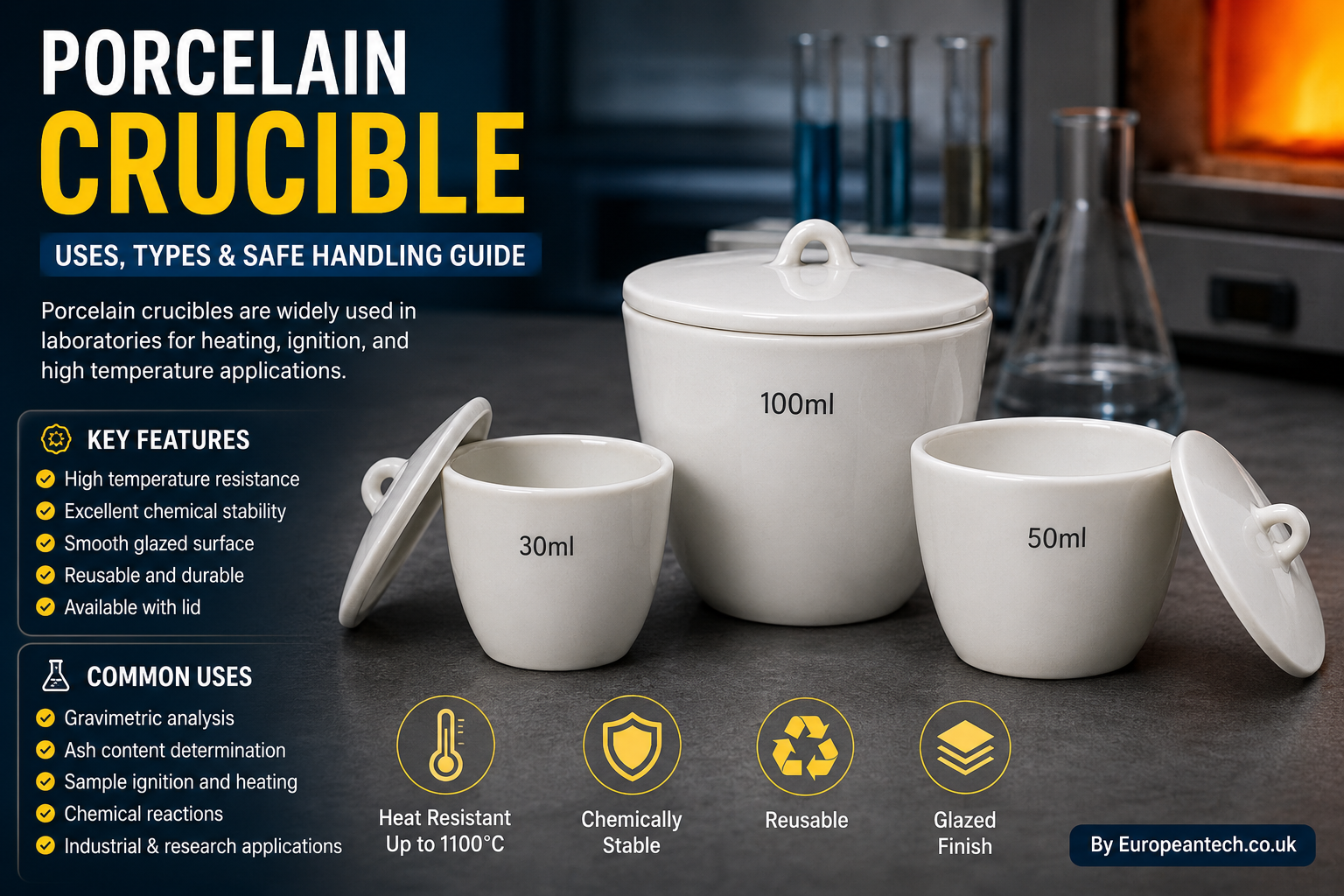
Table of Contents
TogglePorcelain Crucible: Complete Guide to Uses, Types, and Safe Handling
Porcelain crucibles are among the most commonly used laboratory containers for heating materials at high temperatures. Whether you’re conducting chemical analysis, performing gravimetric experiments, or preparing samples for furnace treatment, a porcelain crucible offers excellent heat resistance and chemical stability at an affordable cost.
Although they look simple, choosing the right crucible—and using it correctly—can significantly improve laboratory accuracy and safety.
In this guide, you’ll learn:
- What a porcelain crucible is
- How it works
- Common laboratory applications
- Advantages and disadvantages
- Temperature limits
- Comparison with other crucibles
- Best practices for cleaning and maintenance
- Frequently asked questions
Table of Contents
- What Is a Porcelain Crucible?
- Parts of a Porcelain Crucible
- How a Porcelain Crucible Works
- Common Uses of Porcelain Crucibles
- Types of Porcelain Crucibles
- Key Features
- Technical Specifications
- Temperature Resistance
- Advantages
- Limitations
- Porcelain Crucible vs Other Crucibles
- Safe Handling Guidelines
- Cleaning and Maintenance
- Common Mistakes to Avoid
- Buying Guide
- Pros and Cons
- Frequently Asked Questions
- Conclusion
What Is a Porcelain Crucible?
A porcelain crucible is a small ceramic container specifically designed for heating, melting, or igniting chemical substances at elevated temperatures.
It is manufactured from high-quality laboratory porcelain that has been fired at extremely high temperatures to produce:
- High mechanical strength
- Excellent thermal stability
- Good resistance to many chemicals
- Low porosity
- Smooth glazed exterior
Most porcelain crucibles include a matching porcelain lid that helps reduce contamination and minimizes sample loss during heating.
Parts of a Porcelain Crucible
A standard porcelain crucible consists of:
| Part | Purpose |
|---|---|
| Body | Holds the sample |
| Lid | Reduces contamination and splashing |
| Base | Provides stability during heating |
| Thick Rim | Makes handling easier with crucible tongs |
How a Porcelain Crucible Works
Porcelain crucibles withstand high temperatures while maintaining their structural integrity.
The basic process involves:
- Weighing the empty crucible.
- Adding the sample.
- Heating over a burner, hot plate, or muffle furnace.
- Cooling inside a desiccator.
- Reweighing to determine changes in mass.
This process is especially important in gravimetric analysis, where precise weight measurements determine the composition of a substance.
Common Uses of Porcelain Crucibles
Porcelain crucibles are widely used across chemistry laboratories, educational institutions, industrial testing facilities, and research laboratories.
1. Gravimetric Analysis
One of the most common applications.
Scientists heat samples until only stable residues remain, allowing accurate quantitative measurements.
2. Ash Content Determination
Food laboratories use porcelain crucibles to determine mineral (ash) content by burning away organic matter.
Common industries include:
- Food processing
- Agriculture
- Animal feed testing
3. Sample Ignition
Chemical residues often require ignition to:
- Remove moisture
- Burn volatile compounds
- Produce stable oxides
4. High-Temperature Chemical Reactions
Certain inorganic reactions require temperatures above several hundred degrees Celsius, making porcelain crucibles suitable reaction vessels.
5. Educational Laboratories
Schools and universities commonly use porcelain crucibles because they are:
- Affordable
- Durable
- Easy to clean
- Safe for repeated laboratory use
6. Metallurgical Testing
Small metal samples can be heated for:
- Oxidation studies
- Heat treatment
- Material characterization
Types of Porcelain Crucibles
Different designs are available depending on laboratory requirements.
Tall Form
- Greater capacity
- Reduces splashing
- Suitable for liquids
Low Form
- Wider opening
- Easier evaporation
- Faster heating
Glazed Crucibles
Advantages include:
- Easier cleaning
- Lower absorption
- Better chemical resistance
Unglazed Crucibles
Used where direct ceramic contact is acceptable and maximum thermal performance is desired.
Key Features
Modern porcelain crucibles provide numerous benefits:
- High-temperature resistance
- Excellent thermal stability
- Good chemical resistance
- Smooth glazed finish
- Reusable construction
- Available with fitted lids
- Cost-effective
- Lightweight
- Suitable for laboratory furnaces
- Long service life with proper care
Technical Specifications
| Specification | Typical Value |
|---|---|
| Material | Laboratory porcelain |
| Color | White |
| Surface | Glazed exterior |
| Shape | Cylindrical |
| Lid | Usually included |
| Capacity | Approximately 5–250 mL (varies by model) |
| Reusable | Yes |
Temperature Resistance
Porcelain crucibles are designed for high-temperature laboratory work.
Typical operating conditions include:
| Property | Typical Range |
|---|---|
| Continuous Use | Up to approximately 1,000–1,100°C |
| Maximum Short Exposure | Up to approximately 1,150–1,200°C (depends on manufacturer) |
Actual temperature ratings vary by manufacturer and porcelain formulation. Always follow the specifications supplied with the crucible to avoid thermal damage.
Advantages of Porcelain Crucibles
Excellent Heat Resistance
Suitable for numerous laboratory heating applications.
Affordable
Less expensive than platinum, quartz, or many specialty ceramic crucibles.
Chemically Stable
Resists many laboratory chemicals under normal operating conditions.
Reusable
Can last for years when properly maintained.
Easy to Clean
Glazed surfaces reduce residue buildup.
Widely Available
Commonly stocked by scientific equipment suppliers worldwide.
Limitations
Despite their versatility, porcelain crucibles are not ideal for every application.
Brittle Material
Dropping one often results in cracking or complete breakage.
Thermal Shock
Rapid heating or cooling may cause fractures.
Chemical Restrictions
Some strong alkalis, hydrofluoric acid, and certain molten salts can attack porcelain. Always confirm chemical compatibility before use.
Temperature Ceiling
Applications requiring substantially higher temperatures may require alumina, zirconia, graphite, platinum, or other specialized crucible materials.
Porcelain Crucible vs Other Crucibles
| Feature | Porcelain | Quartz | Alumina | Platinum |
|---|---|---|---|---|
| Cost | Low | Medium | Medium-High | Very High |
| Heat Resistance | High | High | Very High | Very High |
| Chemical Resistance | Good | Excellent (many acids) | Excellent | Excellent |
| Durability | Good | Moderate | Excellent | Excellent |
| Best For | General laboratory work | High-purity applications | Extreme temperatures | Precision analytical chemistry |
Real-World Applications
Porcelain crucibles are commonly found in:
- University chemistry laboratories
- Pharmaceutical quality control laboratories
- Environmental testing laboratories
- Geological analysis
- Food safety laboratories
- Cement manufacturing
- Ceramic industries
- Research institutions
- Metallurgical laboratories
- Industrial quality assurance
Safe Handling Guidelines
Always prioritize laboratory safety.
Before Heating
- Inspect for cracks.
- Ensure the crucible is clean and dry.
- Use compatible laboratory equipment.
During Heating
- Increase temperature gradually.
- Avoid direct mechanical impact.
- Keep the lid slightly offset if gases must escape.
After Heating
- Handle only with crucible tongs.
- Allow gradual cooling when possible.
- Cool in a desiccator before weighing if accurate mass measurements are required.
Cleaning and Maintenance
Proper maintenance extends the life of porcelain crucibles.
Basic Cleaning
- Remove loose residue.
- Wash with warm water and suitable laboratory detergent.
- Rinse thoroughly.
- Dry completely before reuse.
Stubborn Deposits
If compatible with the residue and manufacturer recommendations:
- Soak using an appropriate cleaning solution.
- Avoid abrasive tools that can damage the glazed surface.
Never use damaged crucibles for analytical work where precision is required.
Common Mistakes to Avoid
Many crucibles fail because of improper handling.
Avoid:
- Heating wet crucibles rapidly
- Placing hot crucibles on cold surfaces
- Using damaged crucibles
- Exceeding the recommended temperature rating
- Using incompatible chemicals
- Touching hot crucibles without proper tongs
Buying Guide
When purchasing a porcelain crucible, consider:
Capacity
Select a size appropriate for your sample volume.
Temperature Rating
Verify the manufacturer’s maximum operating temperature.
Lid Quality
A properly fitting lid improves heating efficiency and minimizes contamination.
Glazed Finish
High-quality glazing simplifies cleaning and reduces absorption.
Manufacturer Reputation
Choose laboratory-grade products from reputable scientific equipment suppliers that provide clear specifications and quality standards.
Pros and Cons
| Pros | Cons |
|---|---|
| Affordable | Brittle |
| Reusable | Can crack from thermal shock |
| High heat resistance | Limited compatibility with some chemicals |
| Easy to clean | Lower maximum temperature than some advanced ceramics |
| Excellent for laboratory work | Not suitable for every high-temperature application |
Frequently Asked Questions
1. What is a porcelain crucible used for?
It is primarily used for heating, igniting, drying, and ashing samples during laboratory experiments, particularly in analytical chemistry.
2. What temperature can a porcelain crucible withstand?
Many laboratory porcelain crucibles are intended for continuous use up to about 1,000–1,100°C, with some models tolerating short exposures approaching 1,150–1,200°C. Always consult the manufacturer’s specifications.
3. Can porcelain crucibles be reused?
Yes. When cleaned properly and free from cracks or chips, they can be reused many times.
4. Why does a porcelain crucible have a lid?
The lid helps reduce contamination, minimizes sample loss, and limits splashing while still allowing controlled gas release if positioned slightly ajar.
5. Can porcelain crucibles be heated directly over a flame?
Many are suitable for direct heating, but gradual temperature increases are recommended to reduce the risk of thermal shock. Follow the manufacturer’s guidance for your specific crucible.
6. Are porcelain crucibles resistant to acids?
They resist many chemicals but are not universally resistant. Certain substances—such as hydrofluoric acid and some strongly alkaline melts—can damage porcelain.
7. How should a hot porcelain crucible be handled?
Always use appropriate crucible tongs and heat-resistant personal protective equipment. Allow the crucible to cool gradually.
8. Why is a desiccator used after heating?
A desiccator prevents the cooled crucible from absorbing moisture from the air before accurate weighing.
9. How do you know when a crucible should be replaced?
Replace it if it develops cracks, chips, glazing damage, or deformation that could affect safety or analytical accuracy.
10. Is porcelain better than quartz?
It depends on the application. Porcelain is generally more economical for routine laboratory work, while quartz may be preferred for certain high-purity or chemically demanding applications.
Conclusion
A porcelain crucible remains one of the most practical and widely used pieces of laboratory equipment for high-temperature experiments. Its combination of affordability, durability, chemical resistance, and ease of use makes it suitable for educational, research, industrial, and quality-control laboratories.
While porcelain crucibles perform well in many heating applications, they are not universal solutions. Understanding their temperature limits, chemical compatibility, and proper handling techniques helps ensure accurate experimental results and extends their service life.
When selecting a porcelain crucible, focus on laboratory-grade quality, verify the manufacturer’s temperature rating, and match the crucible to your specific application. Proper care and careful handling will allow it to serve reliably through many heating cycles.
Read Also: Pixwox: Complete Guide to the Instagram Viewer (2026)
About the Author




1 thought on “Porcelain Crucible Guide: Uses, Types & Care”