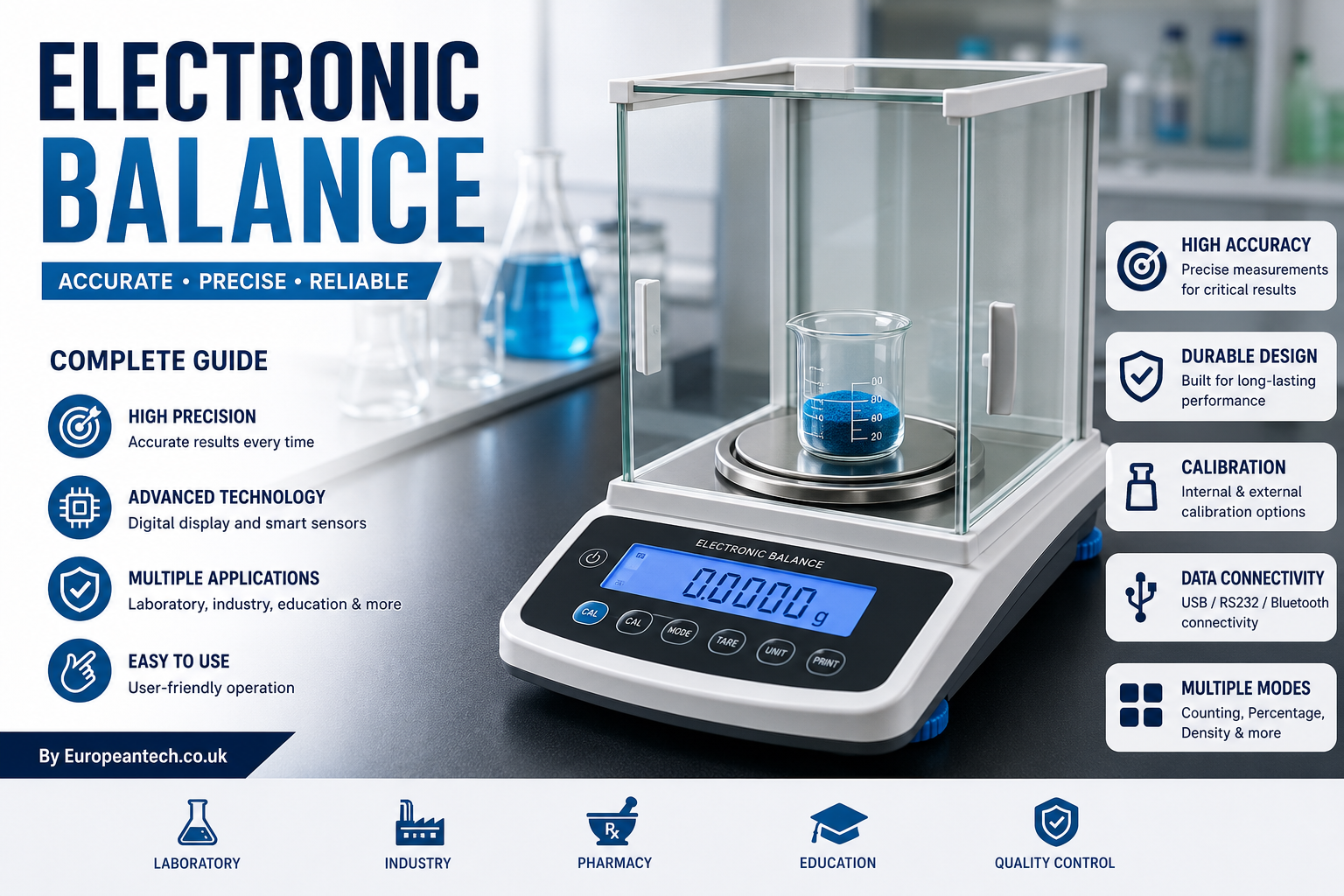
Electronic Balance: Complete Guide to Features, Uses, and Benefits
An electronic balance is one of the most important measuring instruments used in laboratories, research facilities, pharmacies, educational institutions, and manufacturing industries. It provides fast, highly accurate, and repeatable mass measurements, making it indispensable wherever precision matters.
Unlike traditional mechanical balances, electronic balances use electronic sensors and digital displays to deliver precise readings with minimal effort. Many modern models also include automatic calibration, data connectivity, counting functions, and statistical analysis.
This guide explains everything you need to know about electronic balances—from their working principle and types to calibration, maintenance, buying considerations, and frequently asked questions.
Table of Contents
- What Is an Electronic Balance?
- How an Electronic Balance Works
- Main Components
- Types of Electronic Balances
- Key Features
- Common Applications
- Advantages
- Limitations
- Electronic Balance vs Analytical Balance
- Specifications to Consider
- How to Use an Electronic Balance
- Calibration
- Maintenance Tips
- Buying Guide
- Pros and Cons
- FAQs
- Conclusion
What Is an Electronic Balance?
An electronic balance is a digital weighing instrument designed to determine the mass of objects with high precision.
Instead of relying on springs or mechanical levers, electronic balances measure the force generated by an object using electronic sensors and convert it into a digital reading.
Modern laboratory balances are available in various precision levels, from routine top-loading balances to highly sensitive analytical and microbalances.
How an Electronic Balance Works
Electronic balances operate using an electromagnetic force restoration system or a similar electronic sensing mechanism.
Basic Working Process
- Place the sample on the weighing pan.
- The load applies force to the sensor.
- Electronics measure the force.
- A processor converts the signal into mass.
- The result appears on the digital display.
Many balances also compensate for environmental factors such as vibration and temperature changes to improve measurement stability.
Main Components of an Electronic Balance
| Component | Purpose |
|---|---|
| Weighing Pan | Holds the sample |
| Load Cell/Sensor | Detects weight |
| Digital Display | Shows measurement |
| Processor | Calculates mass |
| Level Indicator | Ensures correct positioning |
| Calibration System | Maintains accuracy |
| Power Supply | Operates the instrument |
Types of Electronic Balances
1. Precision Balance
Suitable for:
- Schools
- General laboratories
- Industrial weighing
- Routine quality control
Typical readability ranges from 0.001 g to 0.1 g depending on the model.
2. Analytical Balance
Analytical balances provide much finer resolution, commonly 0.1 mg (0.0001 g), and are typically enclosed in a draft shield to minimize the effects of air currents. They are used for pharmaceutical, chemical, and research applications.
3. Microbalance
Designed for extremely small samples.
Applications include:
- Nanotechnology
- Scientific research
- Advanced laboratories
4. Top-Loading Balance
Top-loading balances are ideal for routine weighing where ultra-high precision is unnecessary.
Key Features of an Electronic Balance
Modern electronic balances often include:
- High precision measurements
- Fast response time
- Digital LCD display
- Automatic calibration (on some models)
- External calibration support
- Tare function
- Unit conversion
- Counting mode
- Density measurement
- Percentage weighing
- USB, RS-232, or Ethernet connectivity
- Data logging
- Overload protection
- Auto shut-off
Feature availability varies by manufacturer and model.
Applications of Electronic Balances
Electronic balances are used across many industries.
Laboratory Research
Researchers depend on accurate measurements for:
- Chemical preparation
- Solution formulation
- Scientific experiments
Pharmaceutical Industry
Used for:
- Drug formulation
- Quality testing
- Ingredient weighing
Food Industry
Applications include:
- Recipe formulation
- Quality assurance
- Ingredient measurement
Educational Institutions
Schools and universities use electronic balances during laboratory experiments.
Manufacturing
Manufacturers use them for:
- Material measurement
- Batch preparation
- Product quality control
Advantages of Electronic Balances
Major benefits include:
- Excellent accuracy
- Fast measurements
- Easy operation
- Digital readouts reduce reading errors
- Multiple weighing modes
- High repeatability
- Supports data recording
- Improved productivity
- Reduced human error
- Long operational life with proper maintenance
Limitations
Despite their benefits, electronic balances have some limitations.
- Sensitive to vibration
- Air currents can affect readings
- Temperature changes influence performance
- Require periodic calibration
- Generally cost more than mechanical balances
- Need stable electrical power or batteries
Electronic Balance vs Analytical Balance
| Feature | Electronic Balance | Analytical Balance |
|---|---|---|
| Purpose | General weighing | High-precision laboratory work |
| Readability | Lower to moderate precision | Very high precision (commonly 0.1 mg) |
| Draft Shield | Usually absent | Usually included |
| Applications | Routine weighing | Pharmaceutical, research, analytical chemistry |
| Cost | Lower | Higher |
Specifications to Consider Before Buying
When selecting an electronic balance, consider:
Maximum Capacity
Choose a balance that comfortably accommodates your heaviest routine sample.
Readability
Smaller readability values provide finer measurement resolution.
Accuracy and Repeatability
Look for specifications appropriate to your application, especially for regulated laboratory work.
Calibration
Choose between:
- Internal calibration
- External calibration
Connectivity
Many modern balances include:
- USB
- Ethernet
- RS-232
- Wireless connectivity
Compliance
Some laboratory environments require features supporting GLP, GMP, or ISO documentation.
How to Use an Electronic Balance
For accurate measurements:
- Place the balance on a stable surface.
- Ensure it is level.
- Allow warm-up if recommended by the manufacturer.
- Calibrate the balance if needed.
- Clean the weighing pan.
- Press the tare button if using a container.
- Place the sample gently.
- Wait for the reading to stabilize.
- Record the result.
- Remove the sample carefully.
Calibration
Calibration ensures that measurements remain accurate over time.
Calibration may be:
- Internal (built-in weights)
- External (certified calibration weights)
Regular calibration is recommended, particularly after moving the balance or when environmental conditions change. Frequency depends on laboratory procedures, manufacturer guidance, and regulatory requirements.
Maintenance Tips
To maximize accuracy:
- Keep the balance clean.
- Avoid overloading.
- Protect from vibration.
- Minimize drafts.
- Maintain stable room temperature.
- Perform routine calibration.
- Store in a clean, dry environment.
- Service periodically according to the manufacturer’s recommendations.
Buying Guide
Before purchasing, ask yourself:
- What maximum weight will I measure?
- What level of precision is required?
- Will the balance be used daily?
- Is internal calibration necessary?
- Do I need computer connectivity?
- Does my work require regulatory compliance?
- What is my available budget?
Pros and Cons
| Pros | Cons |
|---|---|
| High accuracy | Higher purchase cost |
| Digital display | Sensitive to environmental conditions |
| Fast measurements | Requires calibration |
| Easy to operate | Needs stable placement |
| Multiple weighing modes | Can require regular maintenance |
| Excellent repeatability | Power dependent |
Frequently Asked Questions
1. What is an electronic balance?
An electronic balance is a digital instrument that measures the mass of an object using electronic sensing technology.
2. How accurate is an electronic balance?
Accuracy depends on the model. General-purpose balances may read to 0.01 g or 0.001 g, while analytical balances commonly provide 0.1 mg readability.
3. What is the difference between an electronic balance and a digital weighing scale?
Electronic laboratory balances are designed for precision and scientific applications, while many digital weighing scales are intended for general commercial or household use.
4. Why is calibration important?
Calibration helps ensure measurements remain accurate and traceable over time.
5. What industries use electronic balances?
They are widely used in laboratories, pharmaceuticals, food processing, manufacturing, education, healthcare, and research.
6. Can an electronic balance measure liquids?
It measures the mass of liquids when they are placed in a suitable container, which is typically tared before weighing.
7. How often should an electronic balance be calibrated?
The appropriate interval depends on usage, environmental conditions, quality requirements, and manufacturer recommendations.
8. What affects measurement accuracy?
Factors include vibration, air movement, temperature fluctuations, static electricity, improper leveling, and poor calibration.
9. How long does an electronic balance last?
With proper maintenance and calibration, a quality electronic balance can provide reliable service for many years.
10. Can electronic balances connect to computers?
Many modern laboratory balances support data transfer through interfaces such as USB, RS-232, Ethernet, or other connectivity options, depending on the model.
Conclusion
An electronic balance is a fundamental instrument for accurate mass measurement in scientific, educational, industrial, and quality-control environments. Its digital operation, precision, and advanced features make it more efficient than traditional mechanical balances for many applications.
When choosing an electronic balance, focus on your required capacity, readability, calibration method, and environmental conditions rather than price alone. Proper installation, regular calibration, and routine maintenance will help ensure consistent, reliable measurements throughout the instrument’s service life.
About the Author




1 thought on “Electronic Balance: Complete Guide to Features & Uses”