Introduction
If you’re a parent, student, or staff member connected to the Wake County Public School System (WCPSS) in North Carolina, you’ve probably run into the term Wake ID — usually right when you’re trying to check grades, open an assignment in Canvas, or help your child log into a school Chromebook.
It’s one of those systems that’s simple once you understand it, but confusing the first time you’re staring at a login screen with no idea what username to type. That confusion is exactly why this guide exists.
Here’s what you’ll learn:
- What Wake ID actually is and who uses it
- How the login process works for students, staff, and parents
- What to do when you can’t remember your username or password
- Common problems and how to fix them
- How Wake ID compares to other school login systems
- Answers to the questions people search for most
Let’s get into it.
Table of Contents
- What Is Wake ID?
- Who Uses Wake ID?
- Key Features of the Wake ID Portal
- How to Log In to Wake ID
- First-Time Setup and Claiming Your Account
- Wake ID vs. Other School Login Systems
- Pros and Cons of Wake ID
- Troubleshooting Common Wake ID Problems
- Keeping Your Wake ID Account Secure
- Frequently Asked Questions
- Final Thoughts
What Is Wake ID?
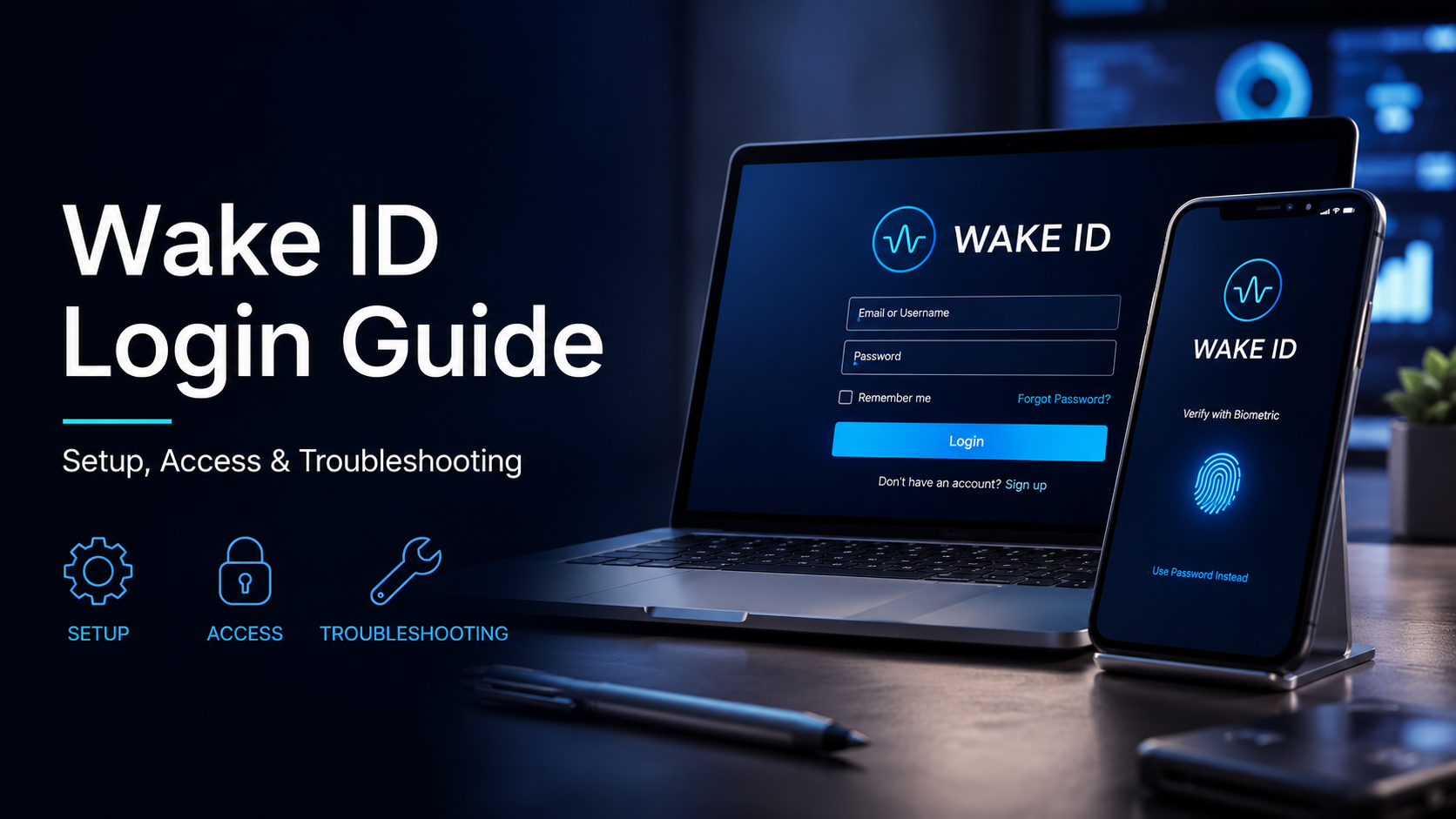
Wake ID is the single sign-on username and identity system used by the Wake County Public School System, the largest public school district in North Carolina. Instead of juggling separate logins for every app your child’s school uses, Wake ID gives students and staff one set of credentials that unlocks the WakeID Portal, a dashboard that connects to tools like Google Workspace, Canvas, PowerSchool, and other district applications.
Think of it the way you’d think of a single office badge that opens every door in a building, instead of a separate key for each room. That’s the practical idea behind Wake ID.
The portal is officially reached at wakeid.wcpss.net, and staff members typically authenticate through a related identity portal before their first login. According to WCPSS’s own guidance, a Wake ID is the username that WCPSS employees and students use to access applications and electronic resources through the WakeID Portal, and it is separate from any network login a person may also have.
It’s worth being precise here: Wake ID is not a stand-alone app you download. It’s an identity and access-management layer sitting in front of the apps WCPSS already uses. Nothing about it is proprietary software you’d compare to, say, a commercial SaaS product — it’s district infrastructure built to reduce password fatigue for a school system with well over 150,000 students.
Who Uses Wake ID?
Three groups interact with Wake ID, though not in exactly the same way:
- Students (grades K–13, including pre-K programs) use Wake ID to log into Chromebooks, Canvas, Google apps, and other classroom tools.
- WCPSS staff — teachers, administrators, and support employees — use Wake ID for email, gradebooks, and internal systems, and according to the district must claim their WakeID account before their very first login, unlike students.
- Parents and guardians don’t use Wake ID directly in most cases. Instead, they typically access student information — grades, attendance, meal accounts — through the PowerSchool Parent Portal, a related but separate system with its own username and password.
That last point trips a lot of families up, so it’s worth repeating: Wake ID is primarily a student and staff login, not a parent login. If you’re a parent looking for report cards or attendance records, you generally want the PowerSchool Parent Portal, not Wake ID itself.
Key Features of the Wake ID Portal
Single Sign-On Access
Once logged in, users see a dashboard of application icons rather than needing to remember a dozen separate URLs and passwords. Signing in once grants access to the approved apps tied to that account.
Multi-Factor Authentication
The district has been rolling out multi-factor authentication (MFA) using Duo for added account security, which matters for staff accounts in particular since they often carry access to sensitive student data.
QR Code Login for Young Students
For younger children who can’t reliably type a username and password, teachers can print a QR code that the student scans on a school device to log in — a practical workaround for K–2 classrooms where typing accuracy is still developing.
Password Self-Service
Users who forget their password can generally reset it themselves through the portal’s recovery flow rather than waiting on IT support for every request, which reduces help-desk load during the first weeks of a school year when logins are freshest in everyone’s minds.
Integration With Classroom Tools
Wake ID is designed to work alongside tools like Canvas (the learning management system), Google Workspace for Education, and Microsoft 365, so a single login can carry a student from email to assignments to shared documents without re-authenticating each time.
Benefits:
- Fewer passwords to remember and reset
- Centralized account management for IT staff
- Faster login for young students via QR codes
- Improved account security through MFA
Drawbacks:
- Can be confusing for new families who expect a parent-facing dashboard
- First-time login and password reset steps differ by grade level, which adds a learning curve
- Account lockouts can briefly interrupt classroom instruction if a student forgets credentials
How to Log In to Wake ID
The exact steps depend on whether you’re a student or staff member, but the overall flow is similar across user types.
Student Login
- Open a browser (Chrome or Firefox are recommended) on a school-issued or personal device.
- Go to the WakeID Portal.
- Select Student as the user type.
- Enter your WakeID username — this is typically your student ID number or a short version of your name.
- Enter your password. For a first-time login, the default password is often the student’s ID number.
- Students in grades 3 and up are generally required to create a new password after that first login; younger students may complete login without this step.
Staff Login
Staff accounts work a little differently because they carry access to more sensitive systems. WCPSS staff are expected to claim their Wake ID before logging in for the first time, a process that confirms identity through security questions before granting access. After claiming an account, staff log in the same way students do — username and password through the portal — often with MFA prompts added on top.
Parent Access
As mentioned above, parents typically won’t use the Wake ID Portal directly. Instead:
- Grades, attendance, and enrollment details are usually accessed through PowerSchool’s Parent Portal, which has its own separate account creation process.
- Meal balances, bus routes, and similar logistics may live in other district-linked tools.
If a parent ever is asked for Wake ID credentials specifically, it’s worth double-checking with the school — that’s the exception, not the rule.
First-Time Setup and Claiming Your Account
Getting a Wake ID account ready for first use generally involves:
- Locating your username. Students are usually given this by their school or teacher; staff are notified by their supervisor or the district’s technology services team.
- Logging in with a default password, which for new students is commonly their student ID number.
- Answering security questions or verifying identity, particularly for staff accounts, before the account is considered “claimed.”
- Setting a new, personal password that meets the district’s complexity requirements.
- Bookmarking the portal URL so returning to it later doesn’t mean digging through old emails or handouts.
If any step fails — for example, the default password doesn’t work — the next move is contacting the school’s front office or the district’s technology help desk rather than guessing repeatedly, since repeated failed attempts can temporarily lock an account.
Wake ID vs. Other School Login Systems
Families sometimes assume Wake ID is unique to WCPSS, but the underlying idea — a single sign-on portal in front of classroom apps — is common across large school districts. Here’s how it stacks up conceptually against similar systems used elsewhere.
| Feature | Wake ID (WCPSS) | ClassLink (used by many other districts) | Direct App Logins (no SSO) |
|---|---|---|---|
| Single login for multiple apps | Yes | Yes | No |
| QR code login for young students | Yes | Varies by district setup | No |
| Multi-factor authentication | Yes (Duo, in rollout) | Varies by district | Depends per app |
| Parent-facing dashboard | No (uses PowerSchool separately) | Sometimes, depending on configuration | N/A |
| District-specific | Yes, WCPSS only | Used by many districts nationwide | N/A |
The takeaway: Wake ID isn’t a competing product you’d “choose” over something else — it’s the specific implementation WCPSS uses, built on the same general single sign-on principle that districts everywhere rely on to cut down password chaos.
Pros and Cons of Wake ID
| Pros | Cons |
|---|---|
| One login for most classroom tools | Not the login parents usually need |
| QR code option removes typing barriers for young kids | First-time setup steps vary by grade, which can confuse new families |
| MFA adds a real security layer for staff | Account lockouts can pause access mid-class |
| Self-service password reset saves time | Requires an active internet connection and supported browser |
| Centralized for district IT to manage | Limited documentation aimed specifically at parents |
Troubleshooting Common Wake ID Problems
“I don’t know my username.” Students can usually get this from a teacher or the front office; staff can check with their supervisor or the technology department, since usernames are typically issued rather than self-created.
“My password isn’t working.” Double-check Caps Lock and browser autofill errors first. If the default password (often a student ID number) no longer applies because it’s already been changed, use the portal’s password recovery option.
“The QR code won’t scan.” This applies mainly to K–2 students. Make sure the printed code isn’t damaged or glared-over, and that the device’s camera has permission to scan in the browser.
“I’m locked out after too many attempts.” Most systems like this impose a temporary lockout after repeated failed logins as a security measure. Waiting a short period or contacting IT support is usually the fastest fix — repeatedly retrying the same wrong password tends to extend the lockout, not shorten it.
“I can see the portal but not the app I need.” Access to specific apps inside the portal is usually tied to grade level, course enrollment, or job role. If something’s missing that should be there, that’s a question for the school’s front office or IT support rather than something fixable from the student’s end.
Keeping Your Wake ID Account Secure
A few habits go a long way for any school-issued account:
- Never share your password, even with classmates who “just need to check one thing.”
- Log out on shared devices, especially school computers used by multiple students throughout the day.
- Use MFA where it’s offered, since a second verification step blocks most account-takeover attempts even if a password leaks.
- Report suspicious activity — like classes or documents that weren’t there before — to a teacher or IT support right away.
These aren’t Wake ID-specific tips so much as good practice for any shared or school-managed account, but they matter more in an education setting where one account can touch a lot of connected services at once.
Frequently Asked Questions
Is Wake ID the same as the PowerSchool Parent Portal? No. Wake ID is mainly a student and staff login for classroom tools. Parents generally use the separate PowerSchool Parent Portal to view grades and attendance.
What is my child’s WakeID username? It’s typically issued by the school and is often based on the student’s ID number or name. Teachers or the school office can confirm it if it’s been misplaced.
What is the default password for a new student account? For many new student accounts, the initial password is the student’s ID number, though students in higher grades are usually required to change it after the first login.
Do all students need to claim their Wake ID account? No. According to WCPSS, students generally do not need to go through an account-claiming process the way staff do — students can typically log in directly with their issued credentials.
Why does my staff account require extra security questions? Staff accounts require account claiming and often multi-factor authentication because they can access more sensitive systems and student data than a typical student account.
Can I access Wake ID from a personal phone or tablet? Yes, the portal is generally accessible from most modern browsers on phones, tablets, and computers, though some school-only apps may work best on district-managed devices.
What should I do if the Wake ID portal won’t load at all? Try a different supported browser, clear the cache, or check whether the issue is a wider outage rather than an individual account problem — the school’s IT help line can confirm this quickly.
Is Wake ID only for Wake County Public Schools? Yes. Wake ID is specific to the Wake County Public School System in North Carolina and isn’t used by other districts, even though many districts run similar single sign-on systems under different names.
How many failed login attempts trigger a lockout? This isn’t something publicly documented in detail, and the exact threshold can change for security reasons — if you’re locked out, the school’s IT support is the right place to confirm timing and next steps rather than guessing.
Can younger students log in without typing a password? Yes, for K–2 students specifically, a QR code scan option exists as an alternative to typing a full username and password.
Final Thoughts
Wake ID isn’t complicated once you know what it’s actually for: one login, issued by the school, that opens the classroom tools a student or staff member uses every day. The confusion almost always comes from expecting it to be something it’s not — usually a parent dashboard, which lives elsewhere in PowerSchool instead.
If you’re setting this up for the first time, the fastest path is simple: get the correct username from the school, use the default password only once, and change it immediately afterward. And if anything breaks along the way, the front office or district IT support will solve it far faster than trial and error will.
About the Author