Introduction
If you’ve searched for “Enerstor,” you’ve probably run into a wall of vague, interchangeable blog posts that describe it as a mysterious “smart energy company” without naming a founder, a headquarters, or a single verifiable product. That’s because most of that content isn’t describing a real company — it’s SEO filler built around a name nobody has fully defined.
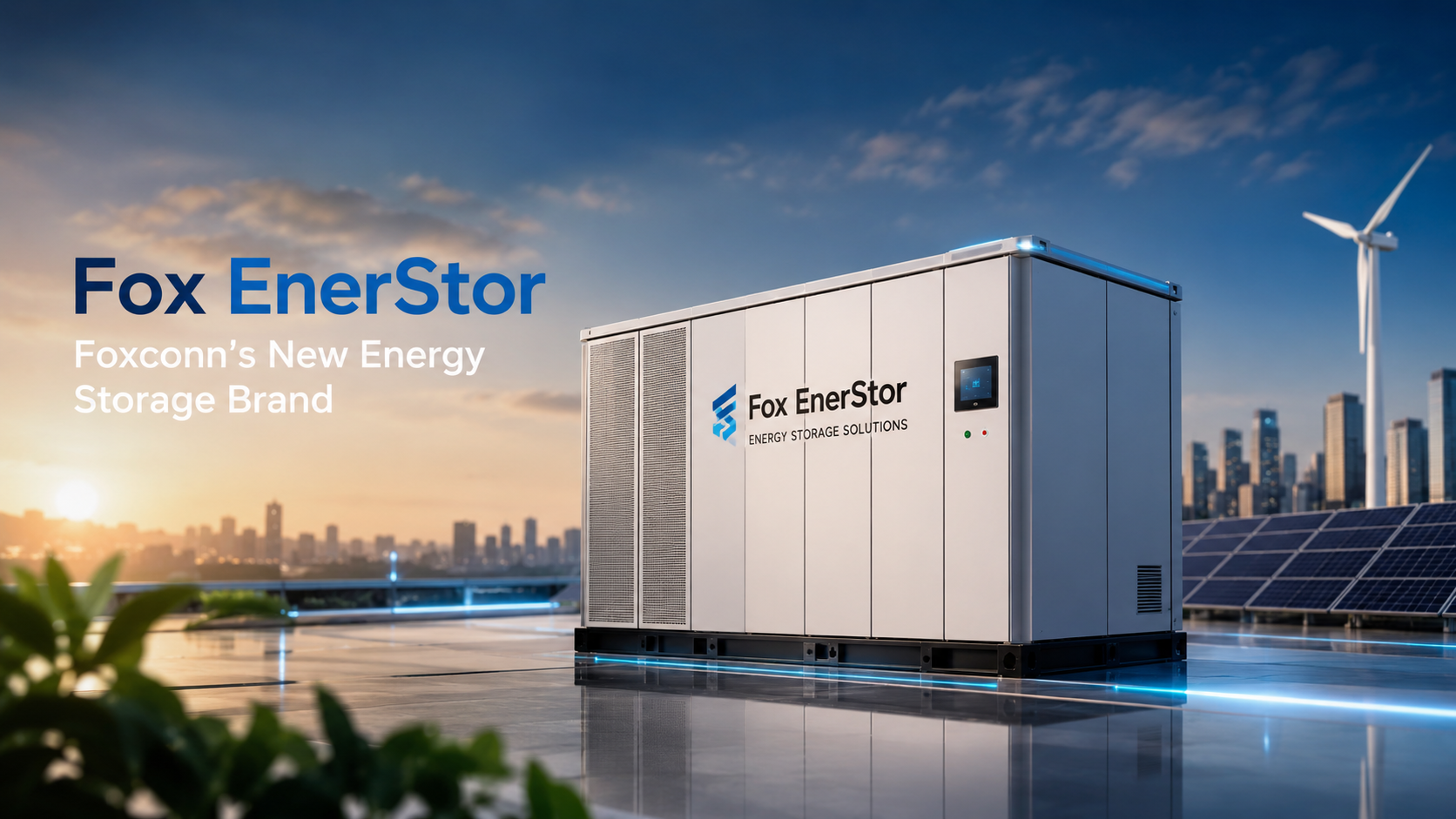
There is, however, a real, well-documented brand behind the name: Fox EnerStor, the energy storage division Foxconn launched in October 2025. Foxconn — the Taiwanese manufacturing giant best known for building electronics for companies like Apple — is using Fox EnerStor to enter the battery energy storage market and compete directly with established players like Tesla, CATL, and BYD.
This guide sticks to what’s actually been confirmed by Foxconn and covered by established energy-industry publications. You’ll learn what Fox EnerStor is, what products it has announced, how its technology compares to competitors, and what its entry into the market could mean for homeowners, businesses, and utilities. Where information hasn’t been made public yet, this article says so directly instead of guessing.
Table of Contents
- What Is Fox EnerStor?
- How Fox EnerStor Fits Into Foxconn’s Strategy
- Key Features of Fox EnerStor
- Fox EnerStor Product Lineup
- Fox EnerStor vs. FoxESS: Avoiding the Confusion
- How Fox EnerStor Compares to Tesla, CATL, and BYD
- Benefits and Drawbacks
- Who Fox EnerStor Is For
- Frequently Asked Questions
- Final Thoughts
What Is Fox EnerStor?
Fox EnerStor is the battery energy storage system (BESS) brand that Foxconn unveiled at an event in Zhengzhou, China, on October 21, 2025. It marks Foxconn’s formal entry into the global energy storage business, an industry it had previously touched only indirectly through its electronics manufacturing work.
The launch was framed as a milestone in what Foxconn calls its “3+3+3” strategic roadmap — the company’s broader plan to diversify beyond consumer electronics into new industries, including electric vehicles and energy. With Fox EnerStor, Foxconn is applying its background in precision manufacturing and large-scale supply chain management to a new product category: batteries that store electricity for later use.
In plain terms, a battery energy storage system does what a rechargeable power bank does for your phone, but at a much bigger scale. It captures electricity — often from solar panels, wind turbines, or the grid during low-demand hours — and releases it later when it’s needed, whether that’s during a blackout, a peak-demand evening, or a moment when electricity prices spike.
How Fox EnerStor Fits Into Foxconn’s Strategy
Foxconn’s move into energy storage isn’t happening in isolation. The company has been investing heavily in energy and EV-adjacent infrastructure in multiple regions, including a reported investment of more than $10 billion in India as of late 2024, with plans that include a dedicated BESS facility. Combined with the Fox EnerStor launch, this points to a company trying to build a genuinely global storage manufacturing footprint rather than a single flagship product.
That matters for buyers and integrators because BESS is a market where scale and supply chain reliability heavily influence who wins large contracts. A manufacturer with Foxconn’s existing production infrastructure has a different starting position than a newer battery-only startup, even if the brand itself is new.
Why Foxconn Is Betting on Storage
Three industry trends explain the timing:
- Renewable intermittency. Solar and wind only generate power when conditions allow, so storage is what makes that power usable around the clock.
- Grid strain. As more solar and wind capacity comes online, grids need faster, more flexible ways to balance supply and demand.
- Commercial and industrial demand. Businesses increasingly want backup power and the ability to shift energy use to cheaper times of day, which requires on-site storage.
Key Features of Fox EnerStor
Based on the official October 2025 launch, Fox EnerStor’s initial lineup and stated priorities include:
- Multi-segment coverage. Products aimed at residential, commercial and industrial (C&I), and utility-scale customers, rather than a single niche.
- In-house software stack. Foxconn has developed its own battery management system (BMS) and energy management system (EMS) rather than relying on third-party software, which it says gives it tighter control over safety and performance.
- High round-trip efficiency. The flagship C&I system is reported to deliver 91% round-trip efficiency, meaning very little energy is lost between storing and releasing power.
- Compact, low center-of-gravity design. The C&I unit uses an optimized thermal architecture intended to improve safety and stability.
- Emphasis on longevity and safety. Foxconn has publicly positioned long service life, reliability, and safety as the brand’s core differentiators, rather than competing purely on price.
Specifications (What’s Been Confirmed So Far)
| Attribute | Detail |
|---|---|
| Brand launch | October 21, 2025, Zhengzhou, China |
| Parent company | Foxconn |
| Flagship C&I system | 261 kW / 522 kWh all-in-one unit |
| Round-trip efficiency (C&I unit) | 91% (reported) |
| Planned additions (2026) | 488 kWh all-in-one unit; 6.25 MWh container unit |
| Market segments | Residential, commercial & industrial, utility-scale |
| Software | Proprietary BMS and EMS |
It’s worth being upfront here: pricing, warranty terms, and full technical datasheets for most Fox EnerStor products have not been widely published yet. Anyone comparing quotes should request current specification sheets directly from a certified installer or Foxconn’s own channels rather than relying on projected figures from the launch event.
Fox EnerStor Product Lineup
At launch, Foxconn’s stated roadmap for Fox EnerStor included:
- A 261 kW / 522 kWh all-in-one commercial and industrial system — the first product shown publicly, built around a low center-of-gravity chassis and optimized thermal management.
- A 488 kWh all-in-one unit — announced as a planned addition for 2026, aimed at expanding flexibility for smaller-footprint C&I deployments.
- A 6.25 MWh containerized system — also slated for 2026, intended for utility-scale projects that need much larger capacity in a single deployable unit.
This roadmap suggests Foxconn is building out its lineup from the middle (C&I) outward, toward both smaller and much larger capacity tiers, rather than launching a full residential-to-utility catalog all at once.
Fox EnerStor vs. FoxESS: Avoiding the Confusion
One thing that trips people up: FoxESS is a separate, already-established residential solar inverter and battery brand connected to the same corporate family, known for consumer-facing products sold through installers worldwide. Fox EnerStor, launched in late 2025, is the newer brand focused specifically on commercial, industrial, and utility-scale storage.
If you’re a homeowner shopping for a solar battery today, the product you’re most likely to encounter is a FoxESS system, not Fox EnerStor. If you’re evaluating storage for a business, industrial site, or utility project, Fox EnerStor is the more directly relevant brand. Because both names are similar and both trace back to the same manufacturing group, it’s easy to see how online content — including a lot of the vague “Enerstor” articles circulating — ends up blending the two together.
How Fox EnerStor Compares to Tesla, CATL, and BYD
Fox EnerStor enters a market with several entrenched, high-volume competitors. Here’s a general comparison based on publicly available positioning — treat the Fox EnerStor column as early-stage, since its full track record is still being established.
| Factor | Fox EnerStor | Tesla (Megapack/Powerwall) | CATL | BYD |
|---|---|---|---|---|
| Market entry | Late 2025 | Established since 2015 (Powerwall) | Established, world’s largest battery maker | Established, major EV and BESS supplier |
| Primary focus | C&I and utility-scale (residential via FoxESS) | Residential, C&I, and utility-scale | Cell manufacturing, utility-scale, OEM supply | EV batteries, utility-scale, residential |
| Manufacturing scale | Backed by Foxconn’s global electronics supply chain | Dedicated Gigafactories | Largest battery cell producer globally | Vertically integrated battery-to-vehicle production |
| Track record | Very limited (brand new) | Extensive, multi-year deployment history | Extensive, industry-leading capacity | Extensive, especially in EV and grid storage |
| Software/EMS | Proprietary, newly developed | Mature, proprietary | Cell-focused; software often via partners | Proprietary, mature |
The honest takeaway: Fox EnerStor’s manufacturing pedigree and initial specs are competitive on paper, but it doesn’t yet have the years of field deployment data that Tesla, CATL, and BYD have built up. That’s not a criticism — it’s simply the reality of a brand that’s a few months old versus companies that have shipped storage systems for close to a decade or more.
Benefits and Drawbacks
| Pros | Cons |
|---|---|
| Backed by Foxconn’s large-scale manufacturing and supply chain experience | Very new brand with no long-term field performance data yet |
| Covers residential (via FoxESS), C&I, and utility-scale segments | Full pricing and warranty details aren’t widely published |
| Reported 91% round-trip efficiency on its flagship C&I unit | Competing against entrenched players with years of deployment history |
| Proprietary BMS/EMS software for tighter safety control | Limited third-party independent reviews so far |
| Clear 2026 product roadmap already announced | Availability may be limited to certain regions initially |
Who Fox EnerStor Is For
- Commercial and industrial operators looking for backup power or ways to shift energy use to cheaper time-of-day rates may be the first to see Fox EnerStor systems available, since the C&I unit was the flagship launch product.
- Utility-scale developers planning projects for 2026 and beyond may want to track the announced 6.25 MWh container unit as it becomes available.
- Homeowners interested in solar-plus-storage should look into FoxESS rather than Fox EnerStor for now, since residential-specific Fox EnerStor products haven’t been detailed the same way the C&I unit has.
- Buyers who prioritize proven track records over newer entrants may want to wait for independent, real-world performance data before committing to a first-generation Fox EnerStor deployment.
Frequently Asked Questions
Is Fox EnerStor the same company as Foxconn? No — Fox EnerStor is a brand owned and operated by Foxconn, not a separate independent company. Foxconn created it specifically to house its energy storage products.
When did Fox EnerStor launch? Foxconn unveiled Fox EnerStor at an event in Zhengzhou, China, on October 21, 2025.
What’s the difference between Fox EnerStor and FoxESS? FoxESS is an established residential solar inverter and battery brand. Fox EnerStor is the newer brand focused on commercial, industrial, and utility-scale storage. They’re related through the same corporate family but target different customers.
Does Fox EnerStor make residential home batteries? Fox EnerStor’s confirmed launch products are aimed at commercial, industrial, and utility-scale use. Homeowners looking for a residential battery today would more likely encounter a FoxESS product.
How does Fox EnerStor compare to Tesla Powerwall or Megapack? Fox EnerStor is much newer and doesn’t yet have Tesla’s years of field deployment data, but its flagship C&I unit reports competitive efficiency (91% round-trip) and is backed by Foxconn’s large manufacturing base.
What is round-trip efficiency, and why does 91% matter? Round-trip efficiency measures how much of the energy you put into a battery you actually get back out. A 91% figure means only about 9% is lost as heat or other inefficiencies during charging and discharging — a competitive number for commercial-scale systems.
Is Fox EnerStor available to buy right now? The flagship C&I unit was unveiled in October 2025, with additional products (a 488 kWh unit and a 6.25 MWh container) planned for 2026. Availability likely varies by region, so check with a certified installer or Foxconn directly for current status in your area.
Who are Fox EnerStor’s main competitors? CATL, BYD, and Tesla are the most frequently cited competitors, given their scale and established presence in the battery energy storage market.
Is Fox EnerStor safe? Foxconn has emphasized safety as a core design priority, citing its proprietary battery and energy management software and thermal architecture. As with any storage system, safety in practice depends on proper installation and maintenance by certified professionals.
Why do so many articles about “Enerstor” seem vague or contradictory? A number of low-quality websites have published near-identical, unsourced posts using the word “Enerstor” without connecting it clearly to Foxconn’s Fox EnerStor brand or citing verifiable facts. When researching this topic, it’s worth checking whether a source names a real parent company, date, and specification — Foxconn’s Fox EnerStor is the entity with that kind of verifiable backing.
Final Thoughts
Fox EnerStor is a legitimate, newly launched energy storage brand from one of the world’s largest electronics manufacturers — not the vaguely defined “smart energy company” that a lot of low-effort articles describe. It has a confirmed launch date, a named flagship product with real specifications, and a stated roadmap for 2026.
What it doesn’t have yet is a long track record. If you’re evaluating it for a commercial or utility project, treat the specs as a starting point for due diligence, not a final answer — ask for current datasheets, confirmed regional availability, and warranty terms directly from Foxconn or an authorized dealer before making a decision. And if you’re a homeowner who landed here looking for a residential battery, look into FoxESS instead, since that’s the brand actually serving that market today.
About the Author




2 thoughts on “Fox EnerStor: Foxconn’s New Energy Storage Brand”